

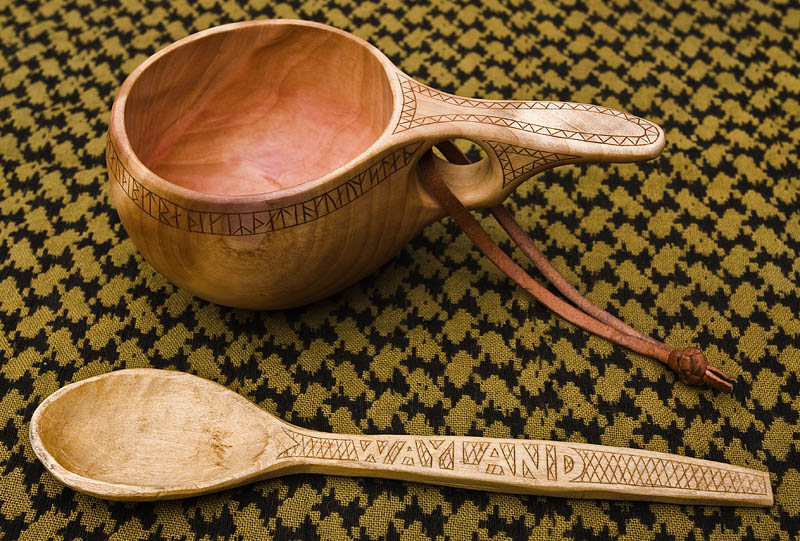
I can turn my hand to a few different crafts but woodwork is not one of my strong ones. I can get leather and metal to do just about anything I want, but I learnt very quickly that you can't force wood to do anything that doesn't suit it.
I can carve a little, this old spoon is about the limit of my skills in this department, but a good friend once showed me a great little technique for decorating wood, called kolrosing, that even I can manage.
Unlike carving, this does not remove any material from the object being decorated. What you do is make a shallow cut in the surface of the wood with the tip of a sharp knife and then rub powdered wood or bark into the cut, much like scrimshaw work.
Traditionally the powered bark was something like the inner bark of birch or alder which was darker than the wood and would show up well. Many people now use coffee powder as a convenient replacement but I prefer to use cinnamon powder which is just powdered bark after all. I decorated the kuksa above that Debs bought me for Yule and the spoon in just this way.
I start by marking out my design with a soft pencil which helps to avoid mistakes then follow the pencil lines with the tip of a sharp knife. Some people use special knives for the purpose but a craft knife works quite well enough. When the cuts have been made, rub the cinnamon or whatever else you are using into the cuts with the tip of your finger.
Now for the clever bit. Rub the surface over with a drop of oil. You could use any wood working oil but because I am often using the items for food preparation or eating with I usually use olive oil. The oil should make the design stand out a little darker but it also sets the powder into the cuts in a very permanent manner, like a wooden tattoo. Short of sanding or carving right down to the bottom of the cut, nothing will shift it.
As a useful side effect, the oil will also remove any lingering traces of the pencil lines.
All that remains to be done now is sand the item down a little to remove any raised edges around the cuts, give a final polish with oil and you have finished.
It's a great technique for decoration but also for simply labelling your equipment in places where it might be mixed up with others. Have fun.
Last edited:


 I really love the design around the rim of that kuksa.


 )and will have a go at decorating it shortly after I sober up!
 . Those short lines must be really tricky yet you have them nailed.


