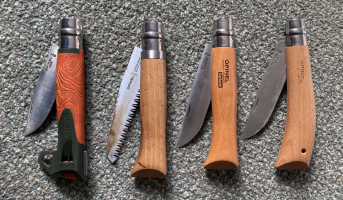
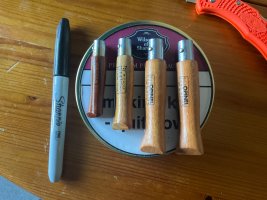
I use my big Opinels regularly and got to thinking about some of the reviews I’ve read and seen.
I am a big Opinel fan. I enjoy the simplicity and effectiveness of this traditional rustic range of tools.
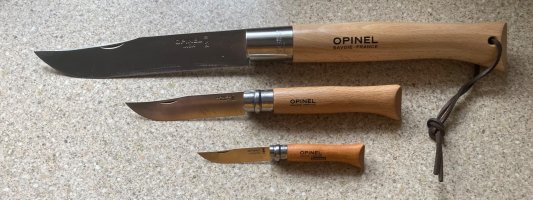
They can be taken to their five basic parts in seconds (after the first time.)
They can be chucked into the washing up after food prep.
They can do everything that I ask of a knife. Why would I look for anything else?
But the Opinel#13 Géant is a bit different!
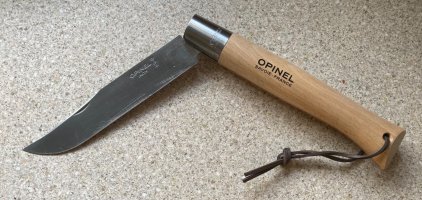
I own a #13 and from time to time I read all sorts of rubbish written about it. This post is based on my experience over more than 10 years of ownership. I’m guessing that much of the nonsense has been written by people who have never owned or used one. YouTube demonstrations mostly seem dramatised or aggressive, neither of which is appropriate in my view. Comparisons with fixed blades are ridiculous.
Just as with any tool, I had to learn to use my Géant appropriately.
Because it is proportioned much the same as all of the traditional knife range, it can be difficult to judge, from illustrations, just how big the #13 really is.
If you take the cardboard centre of a paper towel roll and place it over the handle of an ordinary carving knife you will get some idea of the Géant!
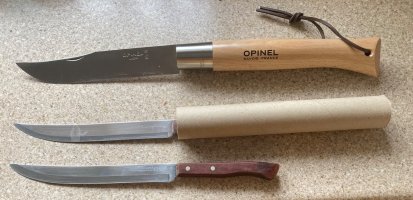
The detractors launch all sorts of criticisms about its dimensions and function most of which are totally irrelevant. The keenies hail it as some sort of folding machete or axe substitute. Both views are nonsense.
A very common claim made by its detractors is that it was created as a window dressing model. There is an element of truth in this:
In my childhood there did exist such a shop window model. This long predates the stainless steel knives like the 13 Géant which weren’t introduced until the year 2000.
I remember, as a child, gazing through a shop window at a huge knife. It had the tan varnished handle still seen on the carbon steel Opinels today. I seem to remember that the blade was etched with advertising and I’ve been told that it did not have an edge. However this knife was not proportioned like the pocket knives. It was much more elegant, the handle narrower for its length. They weren’t for sale. I remember that it looked like our bread knife at home and (at the age of about 8) I wanted one. No chance!
The #13 Géant is indeed used today as window dressing by a few tool shops and why not - it attracts attention. It is however a fully functional knife within its designated application.
Opinel have recently mounted the wooden #13 knife handle vertically on a base and furnished it with a dozen or so pegs on which they display their smaller knives, key rings and children’s knives. This may have added to the “window dressing” criticism.
The knife has been variously praised and criticised as some sort of folding machete. Videos of it being used to hack its way through lumber and branches and even splitting logs, abound.
When this inevitably damages both handle and blade the critics jeer.
Who on Earth ever batons any folding knife? It can easily shock the pivot with over 50KG.
In the case of the Opinel, doing so not only risks damage to the pivot but causes the Viroblock lock to cut flakes from the wooden handle impairing the locking mechanism.
The blade is 220mm long (as are those other knives in my kitchen). However it is also 3.6mm thick, 36mm wide and like all the traditional Opinels, it is ground flat. This gives the blade a highly acute angled cross section to which a minimal second beveled edge is applied. This acute angle means that there is very little metal behind the edge. It is totally inappropriate for any form of wood chopping.
This is something that I did not realise in the early days of ownership. I am as guilty of abusing mine as many others are theirs - but I learned.
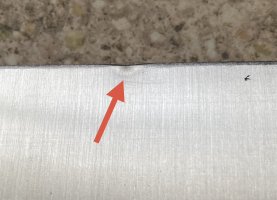
For several reasons, I do not consider my #13 to be an outdoor tool.
The first thing that strikes you as you pick up the newly arrived box is weight: 417gms (unboxed).
Fortunately it doesn’t take long to realise that the knife is perfectly balanced despite the weight of its massive blade.
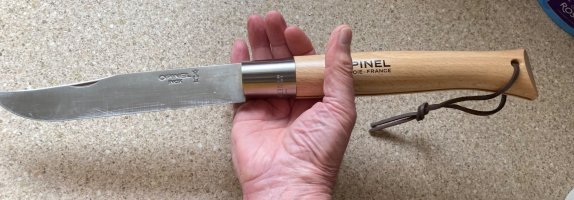
Unsurprisingly I hold it in the middle of its open length where it balances very comfortably.
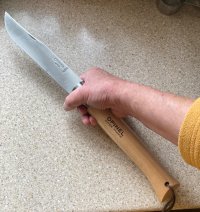
There is a second reason that I don’t take it out of my house. Outdoors and when camping, if I use a knife at all, then it will be one of my several Opinel#12s.
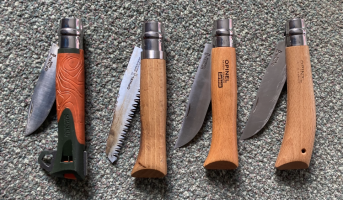
These I transport between home and camp locked in my fire drum and surrounded by camping kit. I have no qualms about being challenged for transporting an Opinel #12 despite it being a locking knife with a 120mm blade. The circumstances make it totally justifiable. Perhaps if I had a deer carcass or hog roast equipment in the back of my car I could argue for the 220mm blade of the #13. It would make a spectacular and effective contribution to a carcass roast.
Of course, like the vast majority of us, I have never been challenged.
“So what is it for?”
The question is asked and wrongly answered over and over again in discussion and video.
Back in my days in management development we had an acronym: RTFM!
READ THE FLIPPIN’ MANUAL!
The Opinel#13 function is clearly written in their publicity and on the box. It has precisely the same function as the other 220mm bladed knives owned by the most of us in the UK, (not just in Bushcraft.)
As is clearly stated on the box, it is for slicing meat, bread and cheese etc. (The vision of a lump of cheese requiring a 220mm blade is the stuff of my dreams). I also use it for slicing vegetables such as a cabbage or a swede.
I appreciate that it takes an Opinel enthusiast to use such a carving knife when so many others are available. Each design has its own adherents; we each have our preferences and foibles: this is one of mine. I love using it.
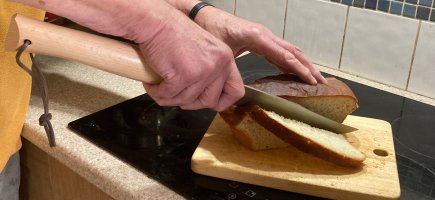
Form Follows Function.
So:
Am I pleased with my Opinel #13 Géant?
Definitely. It’s fun to own and fun to use. A drawer queen it isn’t.
Is it a necessity?
No of course not.
Would I recommend it to others?
That depends upon their intended use. I’d be reluctant to recommend the tool just for it to end up in a drawer but I suppose that collectors are collectors.
I’m more likely to point a practical enquirer to an elegant newcomer on the scene - the Opinel 12B .
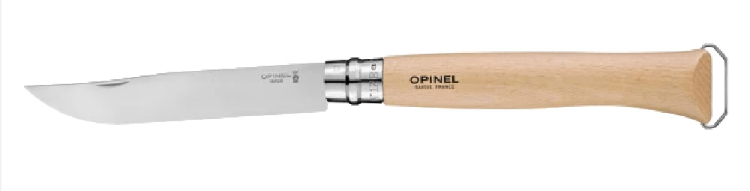
Set into a conventional #12 bolster, this knife has a 160mm blade and could perform much the same function as the #13 at a fraction of the weight. It is much more like the knife that I drooled over as an 8 year old. At the moment it can only be bought as part of the barbecue set @ €100. I am sure that there is a clammour for the knife on its own. I shall be patient and before long I shall own the knife that pressed my nose against a shop window seventy odd years ago.
Even then I shall continue enjoy my Géant.
Bon appetite.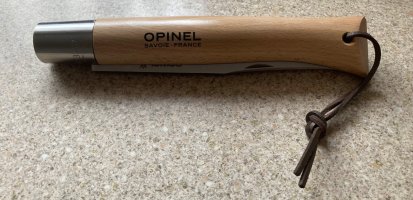
I am a big Opinel fan. I enjoy the simplicity and effectiveness of this traditional rustic range of tools.
They can be taken to their five basic parts in seconds (after the first time.)
They can be chucked into the washing up after food prep.
They can do everything that I ask of a knife. Why would I look for anything else?
But the Opinel#13 Géant is a bit different!
I own a #13 and from time to time I read all sorts of rubbish written about it. This post is based on my experience over more than 10 years of ownership. I’m guessing that much of the nonsense has been written by people who have never owned or used one. YouTube demonstrations mostly seem dramatised or aggressive, neither of which is appropriate in my view. Comparisons with fixed blades are ridiculous.
Just as with any tool, I had to learn to use my Géant appropriately.
Because it is proportioned much the same as all of the traditional knife range, it can be difficult to judge, from illustrations, just how big the #13 really is.
If you take the cardboard centre of a paper towel roll and place it over the handle of an ordinary carving knife you will get some idea of the Géant!
The detractors launch all sorts of criticisms about its dimensions and function most of which are totally irrelevant. The keenies hail it as some sort of folding machete or axe substitute. Both views are nonsense.
A very common claim made by its detractors is that it was created as a window dressing model. There is an element of truth in this:
In my childhood there did exist such a shop window model. This long predates the stainless steel knives like the 13 Géant which weren’t introduced until the year 2000.
I remember, as a child, gazing through a shop window at a huge knife. It had the tan varnished handle still seen on the carbon steel Opinels today. I seem to remember that the blade was etched with advertising and I’ve been told that it did not have an edge. However this knife was not proportioned like the pocket knives. It was much more elegant, the handle narrower for its length. They weren’t for sale. I remember that it looked like our bread knife at home and (at the age of about 8) I wanted one. No chance!
The #13 Géant is indeed used today as window dressing by a few tool shops and why not - it attracts attention. It is however a fully functional knife within its designated application.
Opinel have recently mounted the wooden #13 knife handle vertically on a base and furnished it with a dozen or so pegs on which they display their smaller knives, key rings and children’s knives. This may have added to the “window dressing” criticism.
The knife has been variously praised and criticised as some sort of folding machete. Videos of it being used to hack its way through lumber and branches and even splitting logs, abound.
When this inevitably damages both handle and blade the critics jeer.
Who on Earth ever batons any folding knife? It can easily shock the pivot with over 50KG.
In the case of the Opinel, doing so not only risks damage to the pivot but causes the Viroblock lock to cut flakes from the wooden handle impairing the locking mechanism.
The blade is 220mm long (as are those other knives in my kitchen). However it is also 3.6mm thick, 36mm wide and like all the traditional Opinels, it is ground flat. This gives the blade a highly acute angled cross section to which a minimal second beveled edge is applied. This acute angle means that there is very little metal behind the edge. It is totally inappropriate for any form of wood chopping.
This is something that I did not realise in the early days of ownership. I am as guilty of abusing mine as many others are theirs - but I learned.
For several reasons, I do not consider my #13 to be an outdoor tool.
The first thing that strikes you as you pick up the newly arrived box is weight: 417gms (unboxed).
Fortunately it doesn’t take long to realise that the knife is perfectly balanced despite the weight of its massive blade.
Unsurprisingly I hold it in the middle of its open length where it balances very comfortably.
There is a second reason that I don’t take it out of my house. Outdoors and when camping, if I use a knife at all, then it will be one of my several Opinel#12s.
These I transport between home and camp locked in my fire drum and surrounded by camping kit. I have no qualms about being challenged for transporting an Opinel #12 despite it being a locking knife with a 120mm blade. The circumstances make it totally justifiable. Perhaps if I had a deer carcass or hog roast equipment in the back of my car I could argue for the 220mm blade of the #13. It would make a spectacular and effective contribution to a carcass roast.
Of course, like the vast majority of us, I have never been challenged.
“So what is it for?”
The question is asked and wrongly answered over and over again in discussion and video.
Back in my days in management development we had an acronym: RTFM!
READ THE FLIPPIN’ MANUAL!
The Opinel#13 function is clearly written in their publicity and on the box. It has precisely the same function as the other 220mm bladed knives owned by the most of us in the UK, (not just in Bushcraft.)
As is clearly stated on the box, it is for slicing meat, bread and cheese etc. (The vision of a lump of cheese requiring a 220mm blade is the stuff of my dreams). I also use it for slicing vegetables such as a cabbage or a swede.
I appreciate that it takes an Opinel enthusiast to use such a carving knife when so many others are available. Each design has its own adherents; we each have our preferences and foibles: this is one of mine. I love using it.
Form Follows Function.
So:
Am I pleased with my Opinel #13 Géant?
Definitely. It’s fun to own and fun to use. A drawer queen it isn’t.
Is it a necessity?
No of course not.
Would I recommend it to others?
That depends upon their intended use. I’d be reluctant to recommend the tool just for it to end up in a drawer but I suppose that collectors are collectors.
I’m more likely to point a practical enquirer to an elegant newcomer on the scene - the Opinel 12B .
Set into a conventional #12 bolster, this knife has a 160mm blade and could perform much the same function as the #13 at a fraction of the weight. It is much more like the knife that I drooled over as an 8 year old. At the moment it can only be bought as part of the barbecue set @ €100. I am sure that there is a clammour for the knife on its own. I shall be patient and before long I shall own the knife that pressed my nose against a shop window seventy odd years ago.
Even then I shall continue enjoy my Géant.
Bon appetite.
Last edited: