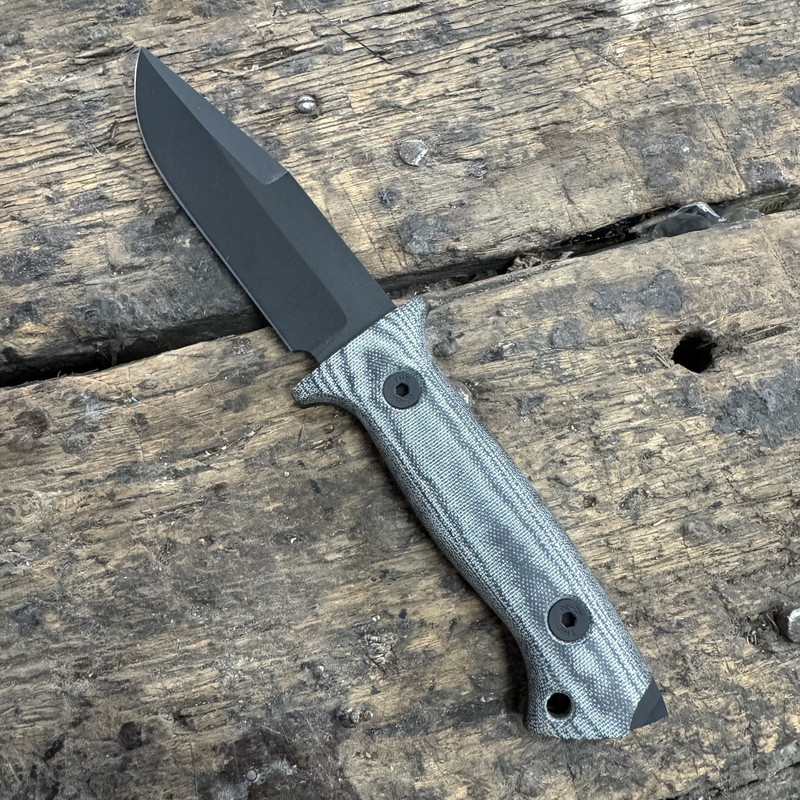
My On The Bench Today Thread

  • BushMoot: Come along to the amazing Summer Moot 31st July - 5th August (extended Moot : 27th July - 8th August), a festival of bushcrafting and camping in a beautiful woodland PLEASE CLICK HERE for more information.
Love that Orange P90. A great design
Thank you, I am very happy with it.

It was designed jointly with various deer stalkers that I work with/for, directly targeted at their market.

The P (Portland) name I am even happier with, once developed one of these professional stalkers, and I were on WhatsApp one evening attempting to name the three sizes of knives, 90, 120 and 150mm cutting edges, and all the same old same old was bandied around, Roe, Fallow and Red, Latin versions of etc, etc. The problem is that they have all been used time and time again; there is nothing new, nothing fresh.

Then we got to talking about my parents and the knives they made, and almost at the identical time we both messaged Portland.

Years ago, along with my parents, we made a range of working knives, honest, no frills working knives designed for outdoors folk. We called them the Portland Series, named after Portland Works, the historic works where they were made and where I am still based. I stopped making that range of knives some years ago.

These new ones were fitting the same bill though, and so P90, P120 and P150 were born. Following on from that came the Ultralite versions. More designs will be added to the new Portland Series as and when too.

This is the P90 and P120 side by side.
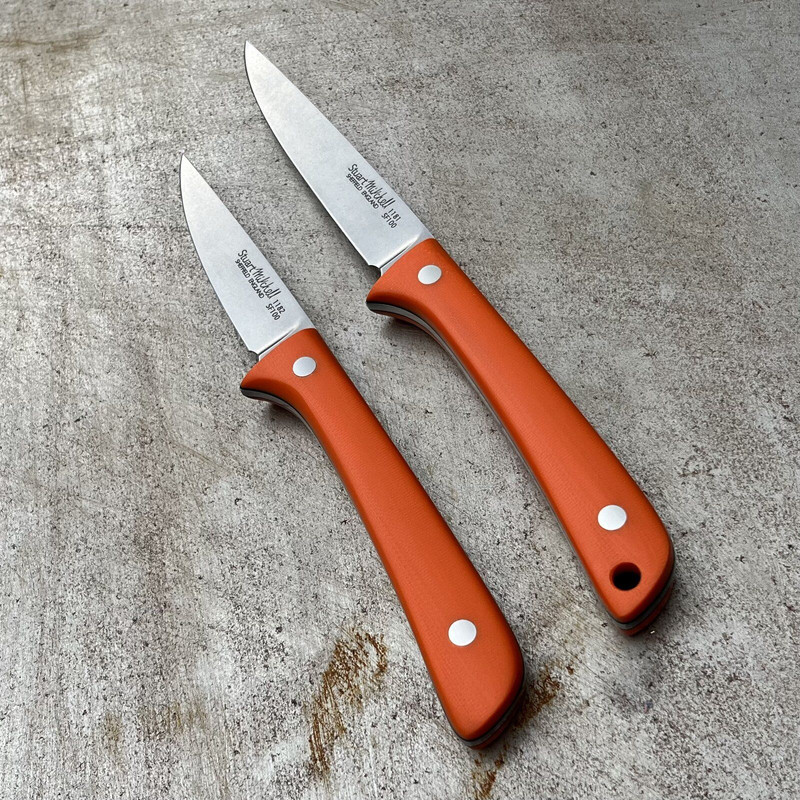
 
Thank you, I am very happy with it.

It was designed jointly with various deer stalkers that I work with/for, directly targeted at their market.

The P (Portland) name I am even happier with, once developed one of these professional stalkers, and I were on WhatsApp one evening attempting to name the three sizes of knives, 90, 120 and 150mm cutting edges, and all the same old same old was bandied around, Roe, Fallow and Red, Latin versions of etc, etc. The problem is that they have all been used time and time again; there is nothing new, nothing fresh.

Then we got to talking about my parents and the knives they made, and almost at the identical time we both messaged Portland.

Years ago, along with my parents, we made a range of working knives, honest, no frills working knives designed for outdoors folk. We called them the Portland Series, named after Portland Works, the historic works where they were made and where I am still based. I stopped making that range of knives some years ago.

These new ones were fitting the same bill though, and so P90, P120 and P150 were born. Following on from that came the Ultralite versions. More designs will be added to the new Portland Series as and when too.

This is the P90 and P120 side by side.

Really like them both but would probably stick with the 90. I like the "no lanyard hole" of the 90 too. How thick are they?
 
Really like them both but would probably stick with the 90. I like the "no lanyard hole" of the 90 too. How thick are they?
There was a time when I wouldn't dream of making a knife without a lanyard hole; fitting them was just a matter of course. Now, the vast majority of my work doesn't get one; they seem to be very out of fashion.

3mm stock SF100 steel, again, the vast majority of my work these days is 3mm stock and SF100.

For me, SF100, is the best all-around, real-world, knife steel around today. That is a big statement, isn't it?
 
There was a time when I wouldn't dream of making a knife without a lanyard hole; fitting them was just a matter of course. Now, the vast majority of my work doesn't get one; they seem to be very out of fashion.

3mm stock SF100 steel, again, the vast majority of my work these days is 3mm stock and SF100.

For me, SF100, is the best all-around, real-world, knife steel around today. That is a big statement, isn't it?


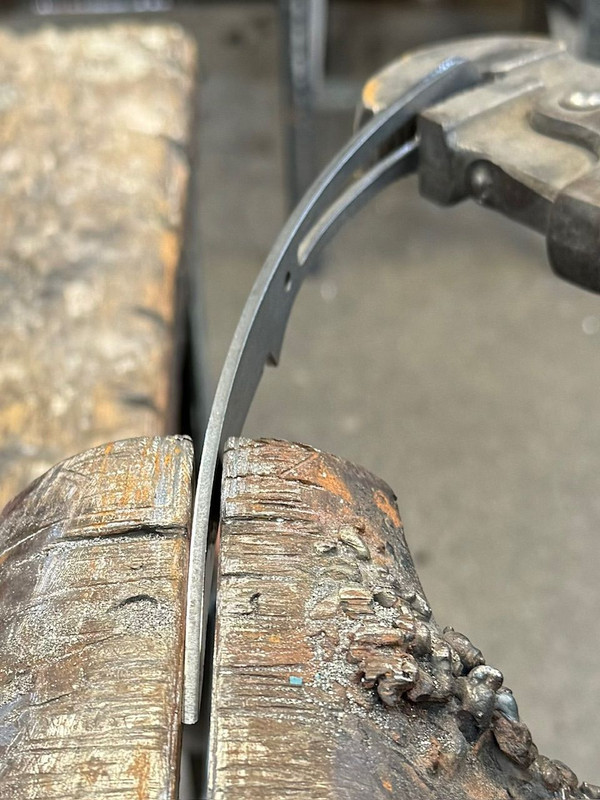
For instance.

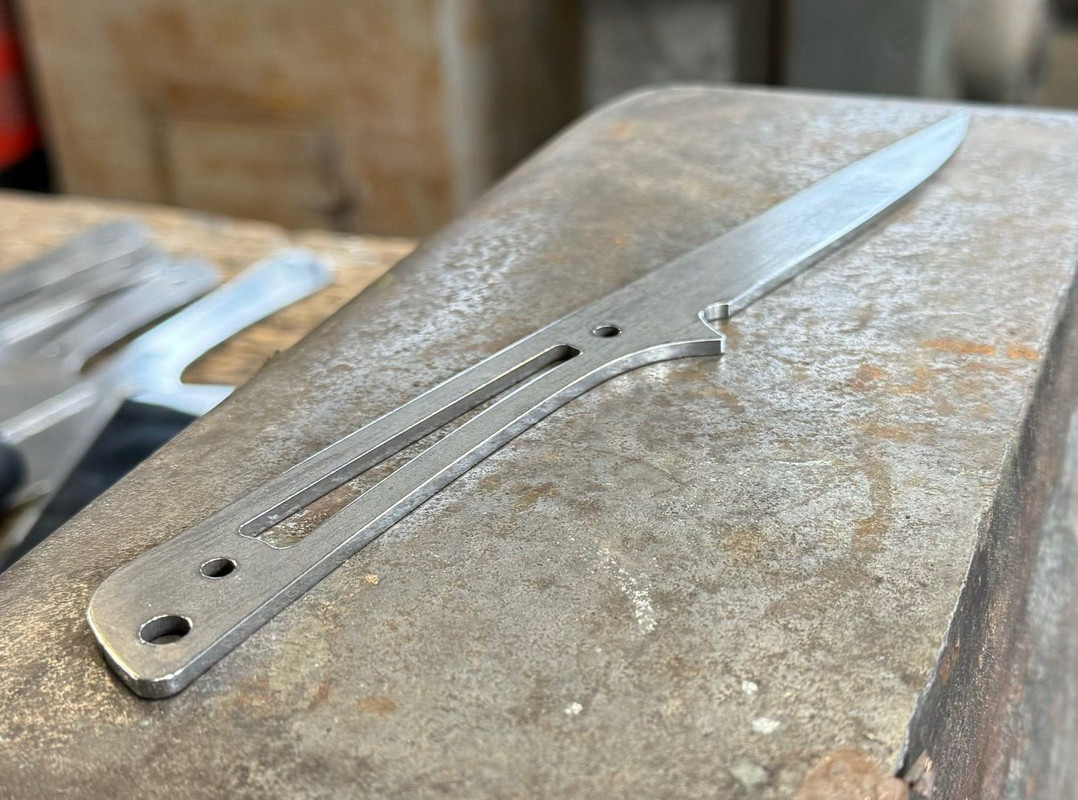
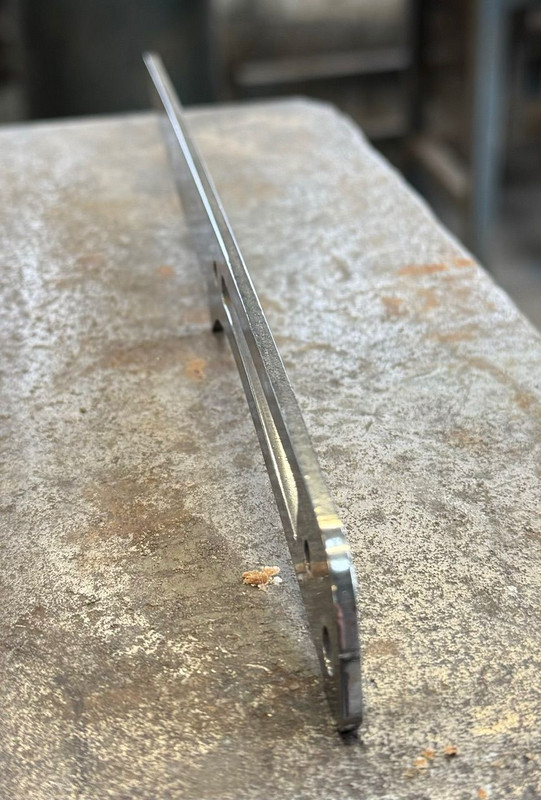
This is a laser cut, 3mm thick, SF100, P120 blank heat-treated to around 60/62 Rockwell hardness, with some 24" Stillsons on it.

Returns to perfectly flat.


That first picture made me wince! The recovery to perfectly flat was very impressive. Does SF100 hold a good edge?
I just copied this from my website.

I often refer to it as a real-world steel; steel properties, corrosion resistance, edge retention, and re-sharpening are always a trade-off. The harder it is, the longer it might keep its edge, but that is generally because it is more resistant to wear, which in turn makes it harder to sharpen without specialist gear. Carbon and chromium content have a knock-on to stain resistance, also again to edge retention though

For me, SF100 is the perfect middle ground, sitting smack bang in the middle of all those compromises, it takes a superb edge, it is resistant to corrosion, it holds that edge extremely well, and is not the end of the world when the time comes around to re-sharpen it, hence for me, real-world steel.
 
I just copied this from my website.

I often refer to it as a real-world steel; steel properties, corrosion resistance, edge retention, and re-sharpening are always a trade-off. The harder it is, the longer it might keep its edge, but that is generally because it is more resistant to wear, which in turn makes it harder to sharpen without specialist gear. Carbon and chromium content have a knock-on to stain resistance, also again to edge retention though

For me, SF100 is the perfect middle ground, sitting smack bang in the middle of all those compromises, it takes a superb edge, it is resistant to corrosion, it holds that edge extremely well, and is not the end of the world when the time comes around to re-sharpen it, hence for me, real-world steel.

Exactly why my design is made using SF100. :beerchug:
 
  • Like
Reactions: HillBill
There was a time when I wouldn't dream of making a knife without a lanyard hole; fitting them was just a matter of course. Now, the vast majority of my work doesn't get one; they seem to be very out of fashion.

3mm stock SF100 steel, again, the vast majority of my work these days is 3mm stock and SF100.

For me, SF100, is the best all-around, real-world, knife steel around today. That is a big statement, isn't it?
Its not a steel i'm familiar with. I've never made a knife from it or heat treated it. I did have 5 blanks sent to me to be ground relatively recently, which were already laser cut and heat treated. They all came warped, 5 less so than the other 5. (which i refused to grind as they had like a 2mm apex)

I prefer RWL for what you like SF100 for. Only because i am very familiar with it, and trust it.
 
  • Like
Reactions: FerlasDave
Its not a steel i'm familiar with. I've never made a knife from it or heat treated it. I did have 5 blanks sent to me to be ground relatively recently, which were already laser cut and heat treated. They all came warped, 5 less so than the other 5. (which i refused to grind as they had like a 2mm apex)

I prefer RWL for what you like SF100 for. Only because i am very familiar with it, and trust it.
Those blanks would have straightened, assuming the HT was properly done.

RWL is a good steel; I used it extensively before 2013, that being when I struck my SF100 deal. :)
 
  • Like
Reactions: HillBill
That bend is impressive! I'm increasingly a fan of thinner blades. I use a semi flexible Victorinox boning knife that's crazy thin compared to most knives but, being thin & full flat, cuts like a demon (easy to sharpen too)
Yes, me too.

I recall a time when all the hunters and outdoor knives we made were 5mm; I wouldn't dream of using that now. I only use 5mm for one of my knife models these days; all the rest are 3mm.

The kitchen/cooking knives I make are mostly 2mm.
 
  • Like
Reactions: HillBill
Yeah they were mine. Done by Barmond steels.
Ah, OK, I know where they will have been done then.

Smithing is a bit of a dark art, and ideally, you would need a carbide-tipped hammer, but I am guessing you don't have one of those?

Your warped blade will have a concave side and a convex side, if that makes sense, the inside and outside of a curve?

You'd think that to straighten it, you take it to your anvil and work on the outside curve/convex side, hammering that flat. Don't do that.

Just the opposite is the case; you work on the inside curve/concave side, in effect, you are attempting to relieve tension in that face, allowing it to give, almost allowing it to stretch as it were and return to straight.

With regards to the hammer, I have seen it done using the ball of a ball pein, so maybe start there?

Does that make sense?
 

BCUK Shop

We have a a number of knives, T-Shirts and other items for sale.

SHOP HERE