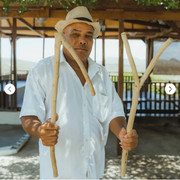
Curaçao (South Caribbean)

  • BushMoot: Come along to the amazing Summer Moot 31st July - 5th August (extended Moot : 27th July - 8th August), a festival of bushcrafting and camping in a beautiful woodland PLEASE CLICK HERE for more information.

Galemys

Settler
Dec 13, 2004
767
136
55
Zaandam, the Netherlands
I had a 2 week holiday on the South Caribbean island of Curaçao (my fathers birthplace), and in this thread I will try to post some stuff on plants and animals there that might be of interest to a bushcrafter. Most of the information in this thread will be applicable to Aruba and Bonaire as well.

Curaçao lies some 50 miles off the coast of Venezuela and is part of the ABC islands, Aruba, Bonaire & Curaçao. The temperature is mostly between 27-30 °C with a near constant Northeast trade wind, and the climate is quite dry which is reflected in the scrubby/thorny/spiky flora.

The only indigenous land mammals are bats (8 species), a vesper mouse, a rabbit and an endemic subspecies of white-tailed deer, probably introduced in pre-Colombian times by the indians that lived here. Nowadays there are also rats, mice, cats, dogs and goats to be found in the wild. There are some other invertebrate animals that can best be avoided: Scolopendra-centipedes (up to 30 cm!) with a poisonous bite, and these two scorpions:
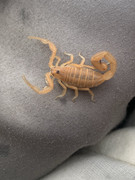
Centruroides testaceus (a stowaway in our beach bag!)
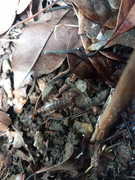

Didymocentrus hasethi

Both have a poisonous sting, but it should be comparable to a beesting (I have been told).
There are no tarantula on Curaçao.

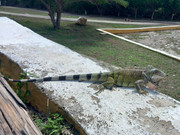
There is an indigenous (harmless) snake, an also harmless blindsnake, and some lizard species on the island of which the iguana is the biggest. The last one is still on the menu in some restaurants (tastes exactly like chicken) but is less eaten than in the past when it was a common food item. In the early eighties you could still see young children selling these alive after catching them with a catapult.
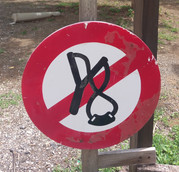
Despite this sign at the Christoffel mountain national park, I think most of todays kids on Curaçao have never seen a catapult...

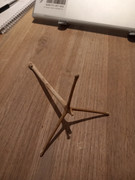
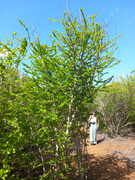
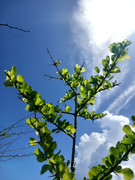
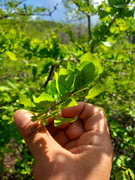
One of the thorny plants that has a remarkable use is Randia aculeata, or by its native (Papiamento) name palu di lele. 'Palu' means wood and 'lele' means to stir. It blooms with small white flowers.

Here is the bush, from its main stem side stems appear in 2's or 3's at an acute angle, and in an equidistant way:

And here is the implement that is made from it:
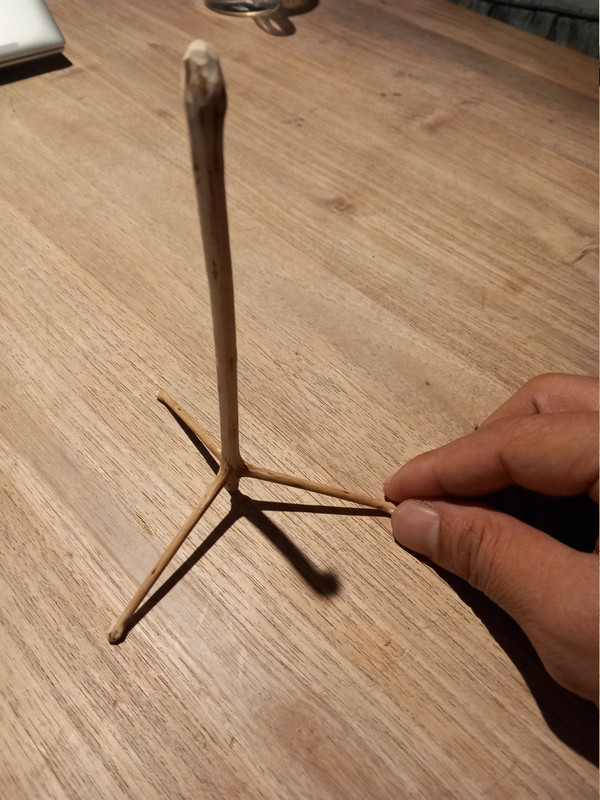

In the old days the palu di lele could be found in every Curaçao kitchen to be used as a whisk for milk, cream or eggs.

That is it for now, more to follow soon!

Cheers,

Tom
 
Interesting :) it is really, to hear of some place totally unfamiliar to most of us.

Never thought about eating lizard and wondering what it tasted like, and the wee whisk is a good idea :)
So very glad we don't have stinging scorpions or the like here though.
 
Part 2

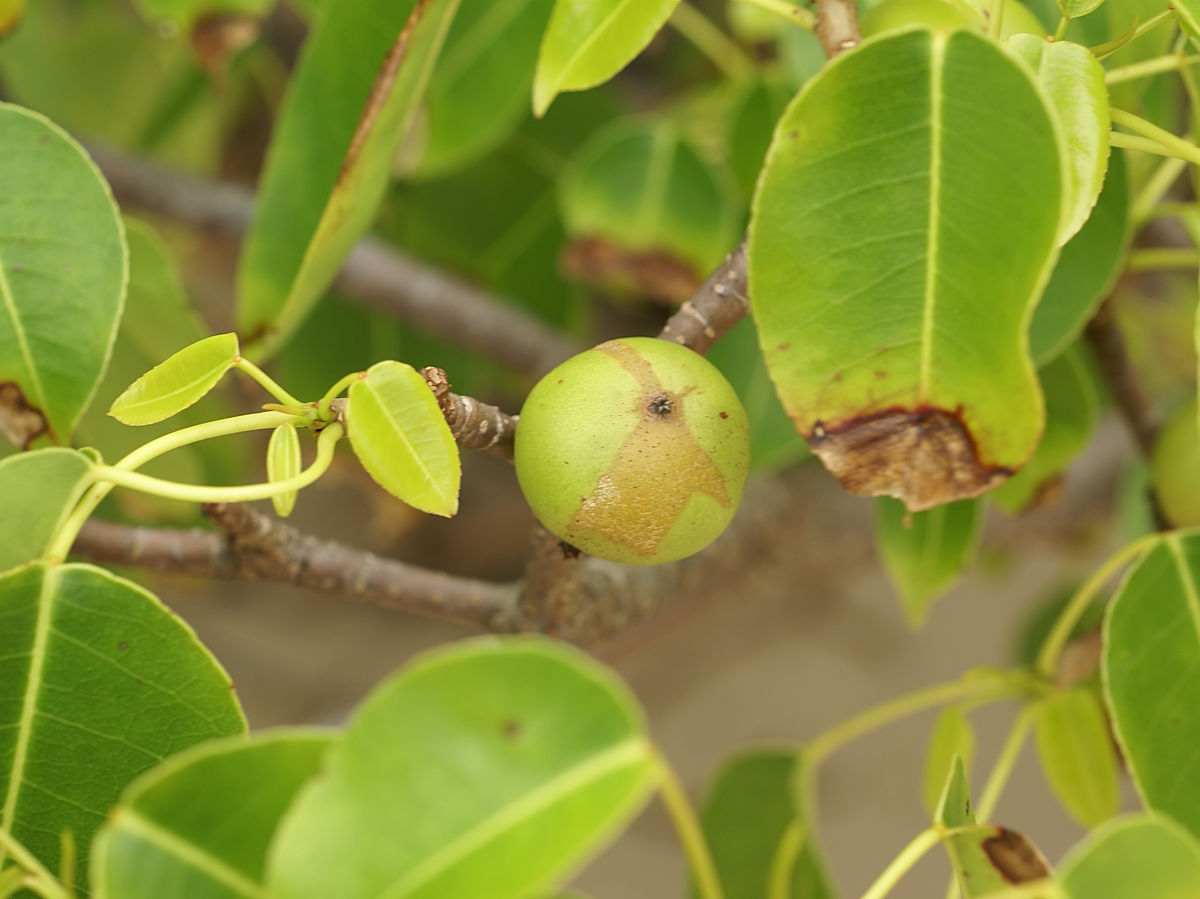
Things to avoid 1, the manchineel tree/ manzaliña

Quite common at beaches. The tree grows quite high, has grey bark and sports little apple-like fruits that have fooled people into eating them, but these fruits are seriously poisonous. Sap of the tree can cause blisters and even leaning against the stem or standing beneath the canopy in the rain is not recommended.

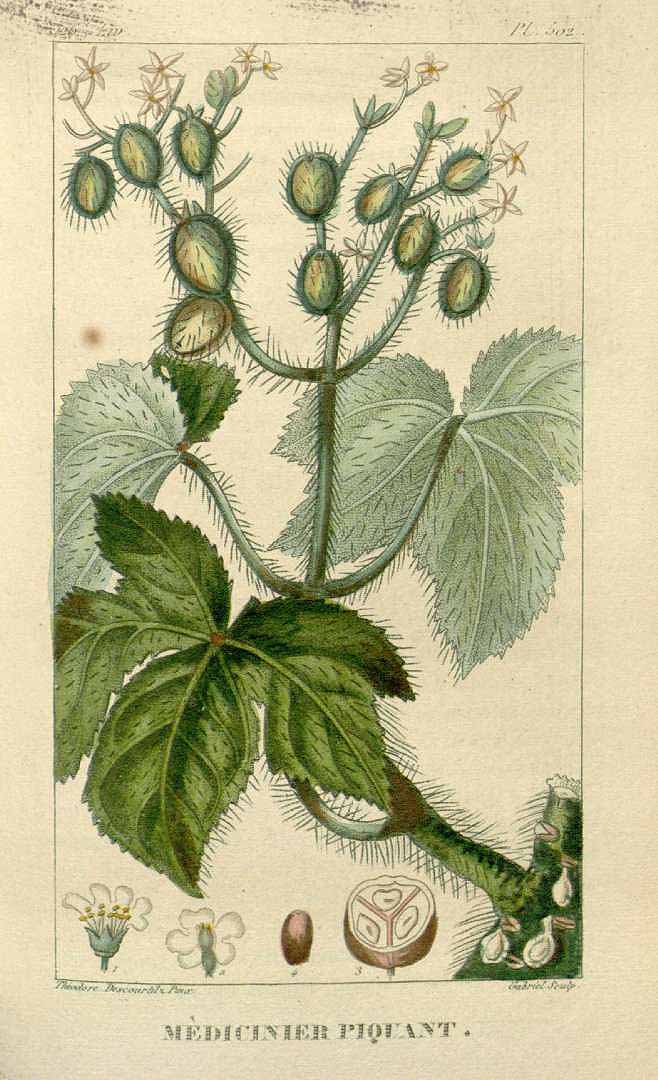
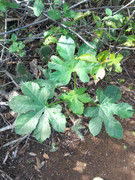
Things to avoid 2, the bringamosa ('fighting young lady') plant:


This is a bush that can grow up to more than 1.5 meters. It blossoms whith little white flowers. Like nettle it has stinging hairs all over, that can cause a burning/itching sensation.

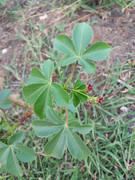
Help against the bringamosa's burning stings usually grows nearby: the flaira:


This bush superficially resembles the bringamosa but it has no stinging hairs. Other differences are its glossy leaves and small dark red flowers. The juice of the crushed leaves brings relief.

Things to avoid 3, big mangrove crabs... (Cardisoma guanhumi)


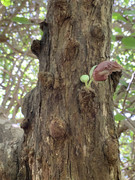
One very useful tree, the calabash.

It flowers almost directly from the stem:

The fruits can grow up to the size of a small melon, and all kinds of containers were made of these, from shot glasses to bowls. The pulp inside was used to make coughing syrup and a kind of shampoo.

More to follow, cheers,

Tom
 
Oh, thats interesting; I am reminded of Lafcadio Hearnes account of Martinique.

Are the local fruit heavenly as he described his?
 
calabash trees are common around my present location (costa rican caribbean coast), too -- the indigenous people used them quite extensively in the past but i didn't know about the shampoo and coughing syrup: do you have by chance and infos on how to make them?!
and there's even a nearby place named after the manchineel ("manzanillo", from "manzanillo de muerte", literally "little death apple")
 
@Tengu, everything tastes better on Curaçao ;)

@forrestdweller, I will try to find out more. For now, most of the information I have found talks about calabash shampoo as an anti-lice treatment for dogs!

Some wildlife:
A (very distant) picture of the 'bina' (Odocoileus virginianus curassavicus), the Curaçao subspecies of the white-tailed deer, it is smaller than its mainland cousins, and has surprisingly large ears.


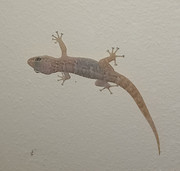
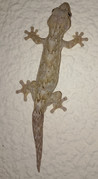
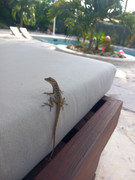
Gecko variety
The different species are best distinguished by the form of their toes (round, round with visible nails, pointy or sort of heartshaped). They are collectively known as 'pega-pega' (pega = to stick).

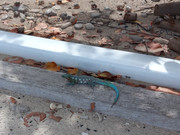
Yellow-headed gecko, Zwavelkop (= 'Sulphurhead'), Gonatodes antillensis. This is a male, the females are more cryptically coloured. It is small, has pointy toes and is mostly found on the ground and not particularly associated with human settlements.


Dutch leaf-toed gecko, Phyllodactylus martini, another small species, with heart-shaped toes, can be found in both human dwellings and in the bush.


Turnip-tailed gecko, with rounded toes. If its tail is lost it regrows a thicker turnip-styled one. Mostly found round houses.


The tropical house gecko (Hemidactylus mabouia) is a recent arrival from Africa/the Middle East, it has round toes with visible nails and calls audibly (the indigenous species are silent as far as I know). Found mostly in or around houses.


Other reptiles
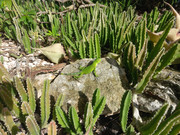
The well known iguana (Iguana iguana, 'yuana'), it swims quite good and if threatened will readily dive into water.


Young ones are bright green:


Striped anole, Anolis lineatus ('kako'), a tree-dwelling species with a colourful expendable dewlap which it shows during territorial disputes.


The most encountered lizard is the Curaçao whiptail, Cnemidophorus murinus ('bloblo' for the blue-speckled males, 'lagadishi' for the brown females/juveniles)


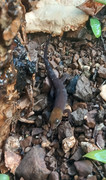
White-nosed blind snake, Liotyphlops albirostris ('bichi di dos kabes' = 'two-headed worm'). A blindsnake that lives between leaf litter and under stones and is rarely seen. Here is a link to one I found on a previous visit to the island:

The other reptiles are a small striped skink with a striking red tail (Gymnophtalmus lineatus, rarely seen), the Curaçao island snake (Erythrolamprus triscalis. https://observation.org/species/901368/) and several species of sea turtle.

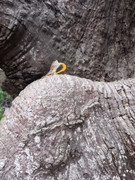
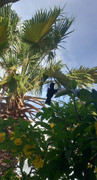
Hummingbirds are amazing...There are two species on Curaçao; the ruby-topaz (https://en.wikipedia.org/wiki/Ruby-topaz_hummingbird) and the blue-tailed emerald (https://en.wikipedia.org/wiki/Blue-tailed_emerald). Here is a poor picture of the last one, they are much too fast for my photographic skills:


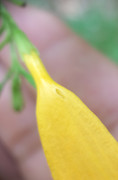
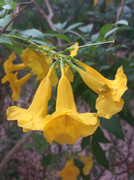
The yellow-flowered bush (I think it is called yellow trumpetbush, Tecoma stans) it was visiting several times a day contained a few hundred flowers, and the little bird had pierced each single flower at the base to create a shortcut for feeding...amazing!


Cheers,

Tom
 
Last edited:
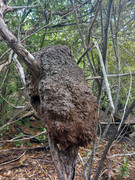
A termite nest. The brown-throated parakeet ('Prikichi', Aratinga pertinax, each of the ABC-islands has its own subspecies)
uses these nest to make their own: they hack out a space in the brittle blob and the termites close off the walls of the bird's nest hole (the nest hole entrance is on the left in this picture). Smouldering pieces of the termites nest are used to deter mosquitoes.


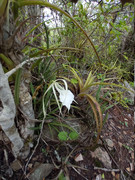
The beauty of the lady of the night orchid, Brassavola nodosa ('orkidia blanku')


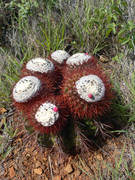
Turks' head cactus (Melocactus macracanthus, 'milon di seru', 'mountain melon', the white fibers on the top were used with flint and steel in the old days.


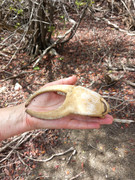
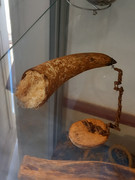
Strike-a-light in the Savonet landhouse museum, the cow's horn contains the cactus fibers, and presumably also flint and steel. I have tried the fibers but could not get them to light so I assume they were first charred before use.


There are three species of columnar cactus on Curaçao of which there are two that can be encountered anywhere. All have edible fruits that are very important food for lizards, birds and bats in dry periods. The two species of fruit-eating bats (Glossophaga longirostris & Leptonycteris curasoae) are also the main pollinators of these cacti.

The 'kadushi' (Cereus repandus, https://en.wikipedia.org/wiki/Cereus_repandus) is the most treelike, with a single stem splitting into multiple branches that can reach up to 10 metres. Its interior flesh is pounded to be turned in to a slimy green soup, 'sopa di kadushi'. Kadushi fruits are thornless.

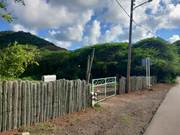
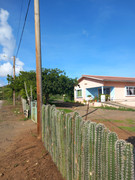
The 'datu' (https://en.wikipedia.org/wiki/Stenocereus_griseus) is the other ubiquitous columnar cactus. One very peculiar use of the datu is to make fences; 'trankera di datu'/'tranké 'i datu'. A shallow trench is dug and filled with cut off pieces of the datu, all the same length. The pieces are held upright and together with woven iron wire (in the old days with wooden sticks or rope) and will readily take root. Use of the tranké 'i datu was dwindling in the past decades but there seems to be a small revival now, I saw freshly made fences on at least two locations.


How to handle such spiky columns?
You use the 'chi ku cha' off course! The 'chi' is a forked branch that is pushed against the cactus, the 'cha' a hooked one that is pulled. Together you can handle a piece of datu easily, and if you have placed them well with two hands you can even hold both chi & cha together in one hand to clamp and handle a piece of cactus and use the other hand for other purposes (picture is not mine but from a facebook page)


Cheers,

Tom
 

BCUK Shop

We have a a number of knives, T-Shirts and other items for sale.

SHOP HERE