Sharpening

  • BushMoot: Come along to the amazing Summer Moot 31st July - 5th August (extended Moot : 27th July - 8th August), a festival of bushcrafting and camping in a beautiful woodland PLEASE CLICK HERE for more information.

Pattree

Full Member
Jul 19, 2023
4,197
2,930
78
UK
For someone who probably uses a knife less than anyone else on the Forum I’m spending a lot of time here in Edge Tools :lmao:

On the other hand I have some experience in (literally) every day Industrial sharpening in the field:
Axe, cross cut saw, circular saw, chain saw, sickle, scythe and a range of knives, chisels and gouges. These skills I learned several decades ago. They are all done “freehand”.

On the other-other hand, I have no experience of modern sharpening techniques and systems. I was introduced to sharpening compounds by Matt at the makers moot just last year!

Would there be any interest in sharing experience and techniques for sharpening various edges?

Would it be here or on a forum of its own? Guess that depends on the degree of interest.

What do you think?


Edited to add for clarity:
Shaping, sharpening, honing and whetting!
 
I for one would be interested.
Couldn’t add much to the conversation given a lack of skill.
One thing that always gets me is the pressure required when using a stone. Push hard, hardly push?
 
Push hard, hardly push?
You’ll need the hive mind for that one.

I sharpen my knives in mid air.

I use a diamond block for chisels and lathe gauges. I keep looking at the working face and judging how much I’m taking off and where. I sort of adjust the pressure to that.
I find that if I push hard it’s difficult to keep the angle of attack uniform.
 
  • Like
Reactions: GreyCat
Yeah, keeping the angle seems to be a muscle memory thing that maybe just comes after long practice?
Hence the attraction of the various systems, of which I have two more or less the same type and which do give good results. Not for smaller blades though, which is annoying.
The stones (diamond, carbide, stone, etc) have a strange attraction that lures you in, they’re obviously really easy to use aren’t they. ;-)
 
  • Haha
Reactions: Pattree
I love Terry Pratchett descriptions of sharpening death's scythe ... he ends with flowing silk over the edge and then the first beams of morning light playing across the edge. As for me my dad taught me at young years old and im 58 , i hold the angle without noticing. Just did an aldi axe this week. It was a 45' edge , more akin to a hammer than an axe, im doing feather stick now.
Stropping is a key element .
 
  • Like
Reactions: GreyCat and Pattree
Yeah, a blue glow around the edge of the scythe as DEATH strops it on the wind and it cuts the molecules into ions.

If you are working regularly with a tool you get to know the best angle without thinking, in my experience. If your pay is related to output you learn even quicker. However it’s hard to teach that way.
Also
A polished 90 degree edge can slice through a fox pelt. I use the spine of a chefs knife as a pelt scraper and “sharpen“ the spine as I do the cutting edge. I can trim the pelt using the spine.

The Norwegians taught us to field sharpen our chain saws by leaning them at the right correct angle against a log and filing flat. A very simple and very effective lesson.
 
When I teach sharpening, I generally describe the amount of pressure needed as putting a sandwich together. If you are making a crisp sandwich, then it's probably a bit too hard.

Apart from being difficult to control the angle, it's easy to ruin a stone/the blade, accidents happen and you lose feedback as to what you are doing ;-) That's pretty much across the board with different sharpening media but especially so with soft waterstones (gouging happens) and new diamond stones (diamond particles come out of the base, lodge in the blade and then plough the diamonds out in it's path!)
 
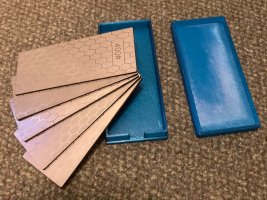
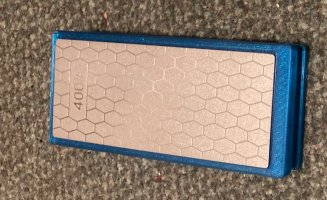
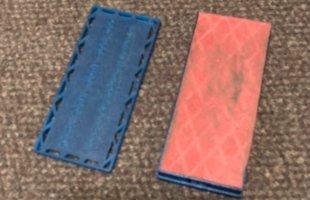
This is very timely @Dave Budd , thank you. Last year I was given a set of diamond sheets of various grades. I’ve only used two but I will bear your advice in mind with the unused sheets when I eventually use them.

My son printed a wonderful box for them. It has two lids. The top lid closes the box but has a recess and end stop for a single sheet so it’s like a conventional stone.
The other lid is on the bottom and covers a strop.

IMG_9184.jpeg

IMG_9185.jpeg

IMG_9186.jpeg
 
All I ever seem to use for anything other than 'agricultural' tools, is my diamond hones and a loaded strop. I don't have/use Scandi grinds, so everything of mine has a secondary bevel of some sort. These I sharpen to a convex, the acuteness of which is dependant on the tool. Polished off with a loaded strop everything ends up 'shaving sharp', axes included.
All work is done by hand and eye with the blade stationary and the hone moving. Stropping is obviously the other way around.
 
Totally agree @Longstrider . Blade held still in left hand. Stone, puck, hone or steel etc moves over the blade.

Tapered scythe/sickle stone, steel or diamond hone slides in straight diagonals over the tool edge so that the blade “microteeth” point back towards the hilt.
I use a circular motion for the puck but in such a way that the last contact with the edge on each pass creates the backward pointing teeth.

I was taught to do the same for an axe. This makes sense as I was also taught to pull the axe at the moment if contact to get the deepest cut.
I suppose that there may be jobs that require forward pointing teeth but I’ve never come across them.

A lot of horticulturalist had removed all the hair from arms and legs by the end of the season. I did the same in the early days. Nowadays there is only one test for any edge. Does it do its job?
 
  • Like
Reactions: GreyCat
This is very timely @Dave Budd , thank you. Last year I was given a set of diamond sheets of various grades. I’ve only used two but I will bear your advice in mind with the unused sheets when I eventually use them.

My son printed a wonderful box for them. It has two lids. The top lid closes the box but has a recess and end stop for a single sheet so it’s like a conventional stone.
The other lid is on the bottom and covers a strop.

View attachment 102794

View attachment 102793

View attachment 102792
To add to Dave Budds excellent advice, it's a good idea to thoroughly rinse your stones and blade to avoid larger particles being transferred to finer grit stones and scratching. Possibly more useful to those looking to get a polished surface, I know this from experience getting lacquered wood to a fine polish only to notice the little circles everywhere from grit caught under the orbital sander.
 
  • Like
Reactions: Pattree

BCUK Shop

We have a a number of knives, T-Shirts and other items for sale.

SHOP HERE