New member- bushcraft qualification advice?

  • BushMoot: Come along to the amazing Summer Moot 31st July - 5th August (extended Moot : 27th July - 8th August), a festival of bushcrafting and camping in a beautiful woodland PLEASE CLICK HERE for more information.

Dylan00009

New Member
Feb 11, 2026
4
0
21
North Ayrshire
Hey. I’m Dylan, I’m working in the west coast of Scotland doing bushcraft, water sports and mountain biking activities.

I’m looking for some guidance. I want to have a qualification / competency that I can show future employers in regards to bushcraft that would be relevant in Scotland, but I don’t know where to go to or whats actually worth getting as I do not know any other bushcrafters.

I’ve got a good few years of personal experience in bushcraft, and a firm understanding of tools and personal equipment, navigation, admin in the field. Etc.

Any help pointers would be appreciated.
 
For life I'd hone my skills so you become, or are, supremely confident. That matters most.

For a CV, I'd look at doing one of the courses with one or two of the topline, reputable Bushcraft companies. It adds to a paper CV, you will learn skills over and above what you already know but you will also see teaching in practice and will learn even more.

I know Frontier do on-line courses and are also creative in giving courses educational points to get a recognised external qualification.

Away from Bushcraft I'd look at Outdoor qualifications like Summer ML, canoe coaching etc
 
  • Like
Reactions: Dylan00009
I generally agree with what Danceswithhelicopters says!
In 2018 I did a course that was joint between WMT and Woodsmoke, now Wild Human. It was very good, and there was an accreditation of a kind. Sadly, I was not apt to either the medical side (squeamish) or the exam format at the end (dyslexic, poor short term memory…always sick at exams) but it was an impressive course.

I think they have parted ways, but Wild Human is offering something similar this year.


Stuff like this gets asked a good deal and there are some good posts going back, but they take a little finding.

For example, doing a search for the word “qualification” gets a mixed bag, but a few things that might be relevant.


Chris
 
  • Like
Reactions: trashcanman1984
There are plenty of NCFE courses being run now by various people. I did one a few years back with Wildway Bushcraft, they’re pretty far from Scotland though but I’d say that qualification or the IOL Bushcraft are the two recognised standards at the moment.

Remember though like any qualification, it’s only as good as the person behind it.
 
For life I'd hone my skills so you become, or are, supremely confident. That matters most.

For a CV, I'd look at doing one of the courses with one or two of the topline, reputable Bushcraft companies. It adds to a paper CV, you will learn skills over and above what you already know but you will also see teaching in practice and will learn even more.

I know Frontier do on-line courses and are also creative in giving courses educational points to get a recognised external qualification.

Away from Bushcraft I'd look at Outdoor qualifications like Summer ML, canoe coaching etc

Great,

Do Paul kirtleys online courses award a competency and allow you to teach ?

I understand some qualifications can be completed in bushcraft and practiced at outdoor centres using their own risk assessments?

Or will I require some sort of instructor course, similar to canoe coaching, where theres a governing body and pre requisite requirements.
 
I feel you'd stand in better stead with a countryside management qualification, Some first aid stuff, and maybe conservation related qualifications... Bushcraft is too ambiguous... "So, you can light a fire... pitch a camp... maintain cutting tools... carve a spoon... forage wild edibles... Excellent... but we need a bit more than that i'm afraid..."

Not trying to pee on your campfire...I came from 8 years military... various posting and locations, had qualifications in various things... When i got out... i wanted to work in the countryside... best i could get was a basically unpaid, hard graft work Exp position for 6 months... so that i could actually apply for a countryside management course.
 
Last edited:
I feel you'd be stand in better stead with a countryside management qualification, Some first aid stuff, and maybe conservation related qualifications... Bushcraft is too ambiguous... "So, you can light a fire... pitch a camp... maintain cutting tools... carve a spoon... forage wild edibles... Excellent... but we need a bit more than that i'm afraid..."

Not trying to pee on your campfire...I came from 8 years military... various posting and locations, had qualifications in various things... When i got out... i wanted to work in the countryside... best i could get was a basically unpaid, hard graft work Exp position for 6 months... so that i could actually apply for a countryside management course.
A good point there, I do what I do and I know what I know and there is nobody stopping me, but if I wanted a proper job in forestry or arboriculture I do not think I would get very far at all and if I did take a formal course I am not sure there is anything much useful I would learn other than health and safety. You have to play by the rules though, I read somewhere that even Ray Mears when he was working for the BBC had to chaperoned by a "qualified" person.
 
  • Like
Reactions: HillBill
You could ask Paul Kirtley, he literally has a podcast by this name. He's answered this question before but not necessarily specifically for Scotland.
 
Some good recommendations here... @HillBill agreed, a Countryside and Forest Management course goes a long way and would cover the qualification side better, and top up with a portfolio of attended course with well known bushcraft schools.

Back in 2013, I met a Russian ballet dancer (forget his name now, but he was famous), he took a two years out to travel the world and attend the most prestigious bushcraft schools in the world, starting at the bottom level and doing every course on offer, back to back at each and every bushcraft school.

I met him when I was doing courses at Woodlore, at that point he had done the courses with Mors, Dave Canterbury, Les Stroud (I think?) and Joe Flowers....plus a few others, that I forget.

His aim was to open the most advanced and learnt Bushcraft school in Russia, if not the world :-) ....now his school is one I would like to attend, if he started it.

Quite inspiring....

Anyway, back to the Countryside and Forestry Management course, this is what I did and ended up doing and going further than I originally planned...
 
  • Like
Reactions: HillBill
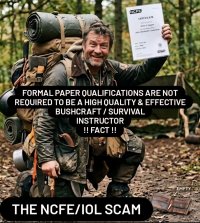
The NCFE & IOL Bushcraft "Qualifications" are simply BS.
Just being a member of BCUK and attending meets with local bushcraft clubs you can learn, for free, everything that is taught on these courses.

The Case for Competence Over Credentials in Bushcraft and Survival

For centuries, the skills required to thrive in the Great Outdoors were passed down through mentorship, observation, and rigorous trial and error.
Recently, however, there has been a significant push towards the formalisation of the industry through NCFE or Institute for Outdoor Learning (IOL) qualifications. While these certificates offer a convenient shorthand for insurance providers and local authorities, they do not necessarily define the quality of an instructor or the depth of their woodsman craft and survival expertise.

The argument against mandatory formal qualifications rests on three primary pillars: the preservation of diverse traditions, the difference between academic testing and practical mastery, and the unnecessary financial barriers to entry for both survival specialists and bushcraft practitioners.

Experience is Not an Exam
A qualification is often a snapshot of a person’s ability to perform specific tasks under supervised conditions over a few days. In contrast, true survival and bushcraft are evolving relationships with the natural world that take years to cultivate.

Fixed Syllabuses vs. Deep Knowledge:
Formal courses often follow a rigid "tick-box" curriculum. A survival instructor who has spent decades navigating extreme environments or a bushcraft expert specialising in primitive fire lighting may have a depth of knowledge that far exceeds the requirements of a Level 3 NCFE, yet their expertise remains technically "unrecognised" by these bodies.

Safety Through Experience: Safety in a survival situation is about judgement, which is forged through time spent in the elements, not just by memorising a risk assessment template provided by an awarding body.

An instructor who has managed real-world emergencies possesses a level of competence that a classroom-based qualification cannot replicate.

Financial and Bureaucratic Barriers
The requirement for specific IOL or NCFE badges creates a "pay-to-play" environment. For many highly skilled survivalists, particularly those with military backgrounds or those who have learnt through non-traditional paths, the cost of these courses is prohibitive.

Monopolising Knowledge:
When bushcract & survival is made into an industry, and that industry decides that only a handful of organisations can "authorise" instructors, it risks creating a monopoly.

This can stifle innovation and lead to a homogenised version of survival training that ignores regional variations and ancient techniques.

Exclusion of Experts:
Many of the most respected figures in the survival and bushcraft world do not hold these modern certificates. Requiring them implies that their decades of field experience and specialised skills are worth less against a week-long assessment.

The Value of Reputation and Lineage
In the outdoor community, an instructor’s reputation used to be built on the quality of their students and the testimony of their peers now its more about social media influence.

Peer Review:
The community is small enough that word of mouth acts as a powerful quality control mechanism. A survival instructor who cannot teach effectively or who operates unsafely will not last long, regardless of the certificates on their wall.

The Apprenticeship Model:
Mentorship allows for a more nuanced transfer of skills than a classroom setting. By prioritising NCFE qualifications, we risk devaluing the traditional apprenticeship model that has served the survival and bushcraft community for generations.

Summary

While formal qualifications may provide a comfortable safety net for large organisations, they should never be viewed as the sole benchmark for excellence. We must ensure that the outdoor industry remains an inclusive space where practical skill, survival instinct, and lived experience are valued more than a printed certificate. The true test of an instructor is found in the field, not in a portfolio of "evidence".Screenshot_20260405_144002_Instagram.jpg
 
While I would agree with a lot that Greg has said, the 'bit of paper' is only a marker on your journey to proven mastery of the skills required in bushcraft. That 'bit of paper' indicates to potential clients that you have undergone some formalised, (one would hope) rigorous training and passed the relevant assessment at the end of it.

I cannot think of any instructor who has left it at the 'bit of paper' stage: usually, the course prompts the individual to develop and hone their skills, particularly their weaker ones, thereby deepening their experience of the myriad subjects under the bushcraft umbrella.

Then, there is the 'teacher factor'. Not every individual can disseminate their knowledge and experience in a meaningful and accessible manner. In many ways, ironically, the true masters of the craft make the worst teachers!

So, there is value in the 'bit of paper'. It does not make you a better bushcrafter per se but it is a stepping stone on that outdoor journey and, one could argue, a necessary one when it comes to attracting punters, getting liability insurance and even securing a patch of woodland in which to practise. Learning how to teach is probably and arguably the more important skill.
 
  • Like
Reactions: Toddy
The original poster has not been on the forum since 12 February. Doubtful they will ever see those last two replies.
Probably so dispirited by the responses that he has given up on the whole idea or just stuck to forestry. That's not knocking the replies, all genuine and meant well.
That they generally hit a bit of a negative note is because it highlights the ramshackle state and value of "QUALIFICATIONS".
The one thing that everybody agrees on, is that you have to get out there and do it, and build up a body of real experience and knowledge.
 
The original poster has not been on the forum since 12 February. Doubtful they will ever see those last two replies.
Well, you never know...!

I was intrigued by Greg's fulsome essay and felt that that, at least, deserved a response, hence my contribution to what is an age-old but nevertheless interesting discussion.
 
  • Like
Reactions: Greg
Show me any industry or trade these days that can escape the deemed requirement to become regulated , documented and someone to charge a fee for producing an assessment of proficiency.

As Bushcraft involves use of Sharp tools in remote places , potentially ingesting fungi and other things I can see why its not escaped the regulation radar.
 
It's not the need for regulation that's an issue, it's 2 other factors:
- the perception of individuals that paper qualifications will keep them safe and remove the need for building real experience and knowledge. Causing them to undertake adventures beyond their true capabilities
- who defines or approves the qualifications/standards. "Standard" in itself a problem, since bushcraft is so diverse and yet many desire to somehow create a fixed one-size-fits-all solution.
In the UK the govt. prefers to distance itself and permit remote qualifying bodies to define qualifications and course standards etc. Within those bodies you can get "god" personalities with unreasonable controls, and financial abuses.
The other real controlling factor, within or outside of that, is the risk-averse insurance industry. They like to tightly specify and control their risk exposure with little understanding or care for diversity or innovation. This then tends to create "group-think" for fear of transgression, and/or their own understanding and knowledge.
 
  • Like
Reactions: Greg
While I would agree with a lot that Greg has said, the 'bit of paper' is only a marker on your journey to proven mastery of the skills required in bushcraft. That 'bit of paper' indicates to potential clients that you have undergone some formalised, (one would hope) rigorous training and passed the relevant assessment at the end of it.

I cannot think of any instructor who has left it at the 'bit of paper' stage: usually, the course prompts the individual to develop and hone their skills, particularly their weaker ones, thereby deepening their experience of the myriad subjects under the bushcraft umbrella.

Then, there is the 'teacher factor'. Not every individual can disseminate their knowledge and experience in a meaningful and accessible manner. In many ways, ironically, the true masters of the craft make the worst teachers!

So, there is value in the 'bit of paper'. It does not make you a better bushcrafter per se but it is a stepping stone on that outdoor journey and, one could argue, a necessary one when it comes to attracting punters, getting liability insurance and even securing a patch of woodland in which to practise. Learning how to teach is probably and arguably the more important skill.
You don't need the piece of paper to start your own business, or gain insurance, and as long as you know how to pass over the knowledge in clear and professional manner you can work for outdoor companies and community groups.

If you're inclined to pay £1000's to get a piece of paper then I would declare that you aren't competent to do it without the course in the first place.

During my time in the forces I spent a total of 20 months on winter deployment in the Arctic Circle, I qualified in Arctic Ski & Survival, qualified as a Military Ski Instructor and Arctic Warfare Instructor (AWI course was under the instruction from Royal Marine MLs) and although I didn't do the Army Combat Survival Instructor course, because of my aurvival knowledge which I demonstrated to my seniors as an NCO I instructed survival in my units.
I have been a Survival Instructor since 1996, and now run my own Wilderness Survival School.
I asked the guy who created the NCFE Level 3 / 4 Arctic Wilderness Bushcraft if it was possible for me to transfer my prior qualifications to the NCFE Level 3 Arctic Wilderness Bushcraft course ..his reply "No, you'll have to do the courses." ie pay the £5k to qualify..so basically saying a Royal Marine ML would have to pay to qualify in Arctic Wilderness Bushcraft :-D ...what an utter load of BS !!
They spend a week glamping in the snow, never go above the treeline and yet the NCFE qualifies them to instruct in Arctic Wilderness Bushcraft...absolute joke !
 
Last edited:
Im with Greg on this one. There are far too many folk now putting themselves on pedestals who have little or no prior experience and are very good at marketing.

I would also like to point out that those NCFE “instructor courses” focus only on personal skills. There’s no framework for teaching or coaching or improving one’s techniques in those areas.
 
  • Like
Reactions: Greg
NCFE Level 3 is supposed to be aquivalent to an 'A' Level..the real qualification that takes 2 years of solid study to accomplish.

How can a week playing and glamping in the snow be equivalent to an A Level qualification lol.

Spend a weekend foraging and you can get another A Level equivalent...even if you have never foraged wild plants before!

And spend another weekend cooking food on a fire and you can have another A Level.

Seriously...does anyone not think this is a complete load of tripe
 
Last edited by a moderator:

BCUK Shop

We have a a number of knives, T-Shirts and other items for sale.

SHOP HERE