Growing edible cover for Pheasants

  • BushMoot: Come along to the amazing Summer Moot 31st July - 5th August (extended Moot : 27th July - 8th August), a festival of bushcrafting and camping in a beautiful woodland PLEASE CLICK HERE for more information.

johnnytheboy

Bushcrafter (boy, I've got a lot to say!)
Aug 21, 2007
2,153
256
47
Falkirk
jokesblogspot.blogspot.com
We have a little pheasant shoot, the cover for the birds in it is terrible, no gorse or ground cover. We have the opportunity to plant cover to help protect the birds. However we thought about planting food stuffs that we could also harvest!

Any ideas on what to plant that would provide good cover?

There is plenty commercial seed packs but we wanted to take an alternative direction.

Any help appreciated!
 
Do you mean edible seeds ? Like quinoa, millet, sorghum, flax, mustard ? or herbs like melissa, mints, tansy, etc., ? those last three are perennials though....
 
Before they closed the factory, sugar beet provided a lot of the cover for local shoots here. So Kale?
 
Where i worked in N.Yorks, as keepers assistant(back in '04/05) Corn was the go to. It was quite literally grown as ground cover. They didn't give a monkeys if they got corn (though often did anyway, normally sold on for dried Maize production). The plant was what they wanted. They had a fair sized buzzard population which would take Pheasants. Spent many an hour with a petrol strimmer, with blades attached mowing beaters paths through it. Fair sized Estate too. 7000 acres at the time... Lots of corn.
 
Last edited:
In the Scottish lowlands (I lived at Airth for 6 years) due to high rainfall , and cool\cold but not normally freezing temperatures, it is more important to have as warm and dry conditions as possible and an accessible automatic feeder every 50 yards with 5 yard wide clearing with wood chips or similar ground covering to encourage scratting, as well as grit pile (smashed up shells make a good source)

The crop should ideally be on a south facing field with protection from SW and NE prevailing winds. Wrapping the fences with wind barrier mesh with pop holes every 5 or 10 yards helps.

As noted above, in Eastern England arable areas (with 75% of the rainfall and 2 to 5c higher average temperatures and less windy), Maize provides good cover, shelter and warmth when planted on a large scale but is a nutrient hungry crop. If you time it right you can manually pick the cobs but they also draw birds of all species.

The height of the crop and foliage intercept 90% of rain drops (especially if driven by wind), leaving calm and relatively dry conditions at pheasant level.

Bit like walking in a woodland for us humans during the rain and wind.
 
  • Like
Reactions: HillBill
I'm not sure your objectives are compatible I'm afraid
Cover and food for pheasants will mean the crop needs to be around from planting (say March/April for sake of argument) to the end of the following season - February.
Harvest for humans should happen in the autumn - before the pheasants need it most.

If you wait to harvest until the following February the crop will have done it's job for the birds and be:
1) flat through weather and or beaters and
2) have very little/ no seed as it will have been eaten through the winter - as intended. Any seed remaining will be difficult to harvest and probably either rotten or germinating.

I think you will need to pick one and go with it.
 
What kind of land is it? Are we talking open fields that could be cultivated or lumpy bumpy heathland? Why is there no cover? Has it been picked bare by sheep or deer for example?
 
There is plenty commercial seed packs but we wanted to take an alternative direction.
Why's that then? I did a quick search on edible cover crops and a few came up that seemed useful, or at least gave a list of plants to consider.

I've often thought of doing something similar here, maybe not a full game cover mix but something for the wild birds as well as us.

Down here they seem to leave strips of forage maize, some mixed patches that contain kale, forage radish etc and a popular plant seems to be chicory of some sort. I'd guess most would be edible but rather bitter.

What I have thought of doing is getting some wild bird mix and adding kale and other brassicas we would normally grow in the veg patch. Come spring many of them will throw out flowers hoots that can be eaten like broccoli (and we tend to grow perennial kales which are more robust).

I also make rows of brash, rather than burning it, and that provides some instant cover.
 
Around here - far western Somerset, and for the shoots at which I beat, all game cover appears to be for game consumption only. IIRC, most cover here consists of strips planted on the eastern edges of large fields, or corners of large fields which are too wet or too difficult to get combines into. Some strips are maize only, some are kale, and some are mixes of plants which include maize, kale, mustard, rape, wheat etc. It may well be that these mixed fields are usually planted with commercial seed mixes, but knowing a couple of farmers ;) they might have used old or end of seed bags to produce the mix.
 
  • Like
Reactions: HillBill
Do you mean edible seeds ? Like quinoa, millet, sorghum, flax, mustard ? or herbs like melissa, mints, tansy, etc., ? those last three are perennials though....
Hi Toddy, sorry been on the drink since I posted, so essentially food for human consumption or the by product could be consumed such as berries etc!

Leafs to harvest above would be good, seeds, harder to harvest but maize probably ok!

Small bushes, trees that will mature also ok!

Lost of good ideas already!
 
I think that it depends a lot on what the land is like, the soil, slope of the land, exposure, and how much time you want to put into planting and pruning.

Blackthorn grows easily and quickly and will give you sloes for sloe gin and winemaking. It grows well where I live, on very sandy soil with chestnut, hazel, birch, robinia, hornbeam and beech trees. Oh, look: chestnuts and hazelnuts. Rosemary will readily grow into a big bush, sage not so big. Thyme and savory grow quite low to the ground.

Hawthorn leaves contain good amounts of vitamins and are tender enough when young. The berries can be made into sauces and jellies and the blossom is edible.

Elder also grows easily and quickly and will give you flowers (for fritters, cordial and wine) and berries (for sauces and wine). Blackberries, likewise, will grow just about anywhere, and cube so much fruit that there's plenty, no matter what wildlife is around.

Shortly bigger fruit trees: quince, damson, cherry, apple and pear.
Linden (lime) doesn't have useful fruit but the wing stretched to the seed is used over here as a herbal tea (known by the tree's name "tilleul") and its wood is often used for sculpture (sometimes sold as "basswood"). The bast of linden and willow can be used to make cordage, and willow is famous for being used for wicker work and basketry.

In my childhood I foraged rhubarb that grew in allotments that had been abandoned for years; those big leaves might give peasants niceb places to hide.

There are varieties of sorrel that grow fairly tall and reseed themselves.
 
Last edited:
Hi Toddy, sorry been on the drink since I posted, so essentially food for human consumption or the by product could be consumed such as berries etc!

Leafs to harvest above would be good, seeds, harder to harvest but maize probably ok!

Small bushes, trees that will mature also ok!

Lost of good ideas already!

What about quick growing, but easily removed trees and shrubs as they get bigger......silver birch, elder, buddleia (though once that's there, it's there :) pretty though and the wildlife loves it....the birch is useful and grows really quickly, it's a pioneer species, but the elder will give flourish and berries, as would sloes. Hazel would be nice but squirrels :dunno:
I'm presuming you don't want brambles, but cherries would be good, and on dwarf stock they're easy to pick. Apples, pears, plums... and underplant with flax and ....you know what would grow a decent mix ? Buy a couple of the big bags of bird seed and just scatter that....ours has sunflowers, wheat, oats, peas, linseed, buckwheat, etc., in the mix. If the birds miss any, up it sprouts.

For leaves, chard, beets, sorrel, the goosefoots like Good King Henry.

I think it really depends on your land and aspect though.

 
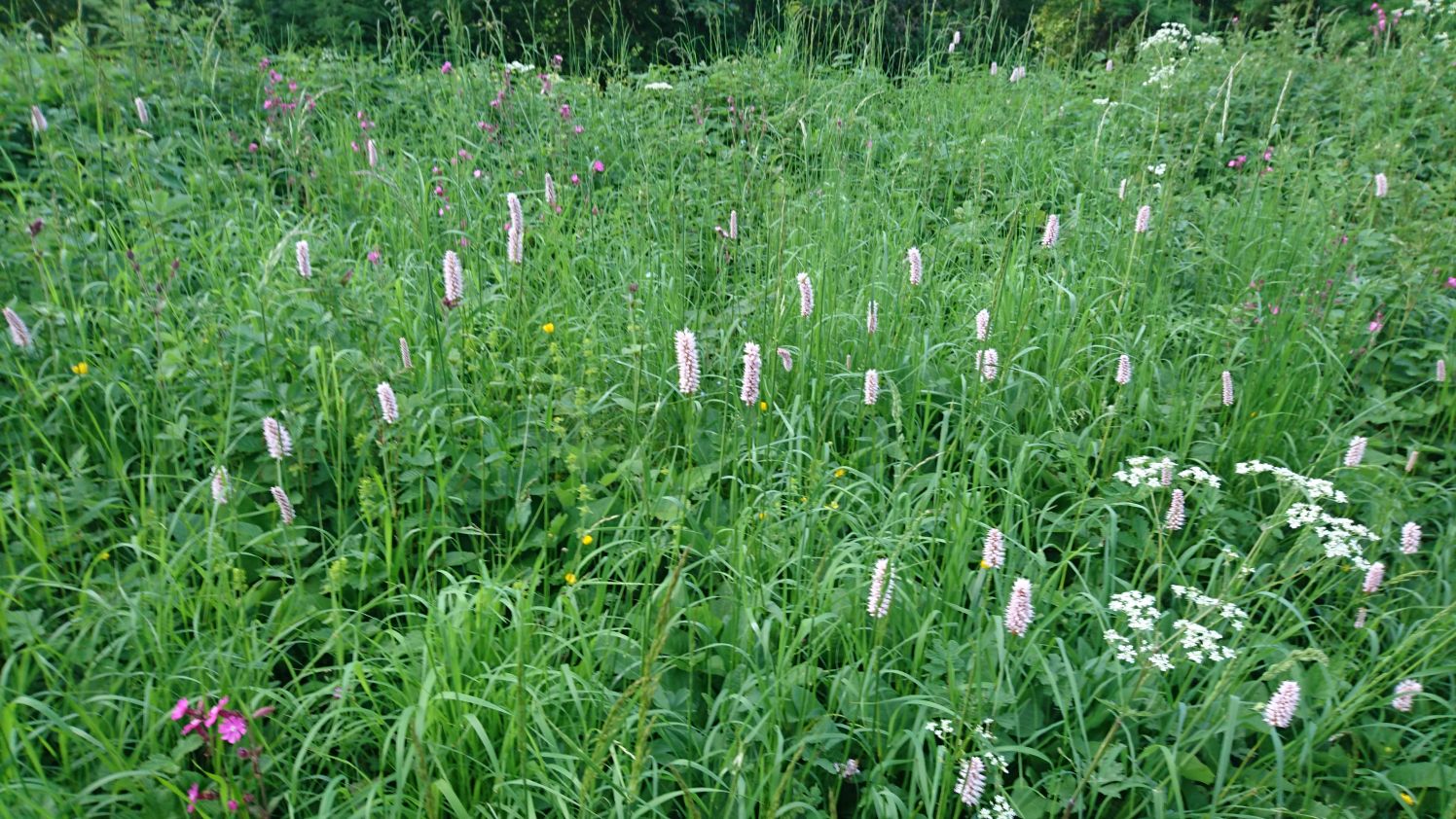
@Toddy could I combine bistort into the above?

I don't see why not...it's native, it's roots hold soil well, it comes up every spring and dies back....like comfrey.....it's not toxic, insects love it, it's good food.
I don't know what pheasants think of it though :dunno:
It's not a particularly 'high' plant, the flowering stems are tall but they wave above the leaves. The leaves come straight out of the ground, they're not up a stem.
It likes damp, and it seems to thrive in a mixed grassland.....nice photos on Wild Food uk.....

 
It’s more just cover the pheasants can hide in we are planting but want to combine stuff we can eat :)

Most leafy things die back with a frost but it’s to hold them until then, stop them walking to the next farm!
 
What you could do is plant the 'meadow' of native plants, like the distort, but deliberately add in something like wheat and oats that grow through Winter. Those come up in clumps and are green right through. Other crops that are hardy, like the brassicas will provide food, if a bit coarse by then, and cover.....a cabbage left to it's own devices grows huge, and wide....let it seed, that's food for the birds too.
The beets are pretty sound as , and we know that those are sown for cover anyway.
Fat hen/Good King Henry's tasty to eat too, again it's native and it'll happily seed. Lesser celandines have peanut sized edible roots, but the birds love the early green growth of them.
The hardiest thing I have is Pendulous Sedge....but once you have that, you have that, it spreads so easily in a couple of years....the seeds are edible, seem to avoid fungal infections, so safe, the triangular stems are useful for basketry, etc., and they have green on them all year round, big clumps of decaying leaves too.
I have wood millet (wee seeds like sesame) and figwort (known as Rosenoble, makes a very good tea, one of the 'cure all' kind.

You have a neighbouring farm ? you might ask what they grow for overwinter crops ?
We can suggest a thousand plants, but we don't know your land, we don't know what might become an invasive pest.
 
  • Like
Reactions: johnnytheboy
It’s more just cover the pheasants can hide in we are planting but want to combine stuff we can eat :)

Most leafy things die back with a frost but it’s to hold them until then, stop them walking to the next farm!
Should have asked this earlier... As you're based in Scotland... What is the general PH level of your soil? Is it more acidic, or alkaline? It makes a massive difference, so humour me if you could please mate.
 
  • Like
Reactions: johnnytheboy
It’s very wet, turns out we have a tractor mounted rotovator so easy to get rid of weeds quick!

I can test the soil and let you know!
Testing the soil before committing would be a very wise thing to do. Not expensive to do, Could save a lot of time and money and will allow you focus on the route you 'need' to go down.

Acidic... Small fir's, pine etc... Think... sell as xmas trees... Also opens the road for Blueberries and Lingonberry.

Alkaline well, most things apart from the above... depending on what grows well where you are.

Wet soil lends itself well to dark colour fruits... Blackberry, blackcurrant etc... They also grow well in shade. Bu the PH is basically your foundation. You can adjust PH, but that really only applies to small areas or on an industrial scale. Can be done in the middle ground, but only if you have money and time to burn
 
Unless you're growing something special as a pure crop I wouldn't be over worried by pH. Worth knowing and considering but it hasn't stopped me growing things over the years. I've happily grown raspberries that like it mildly acid on very chalky soil and brassicas on acid soil for example. Having said that looking round to see what grows best locally is always worth doing.

We're at the time of year where all the unshot local pheasants have moved into our garden and fields. They love our scrubby woodland edges and wide hedges. The cover that they most love is the humble bramble. The stems arch over the ground forming tunnels and many of the stems still have leaves. They also love the bracken where it grows through the brambles and other plants and the old stems are not flattened in winter.
 

BCUK Shop

We have a a number of knives, T-Shirts and other items for sale.

SHOP HERE