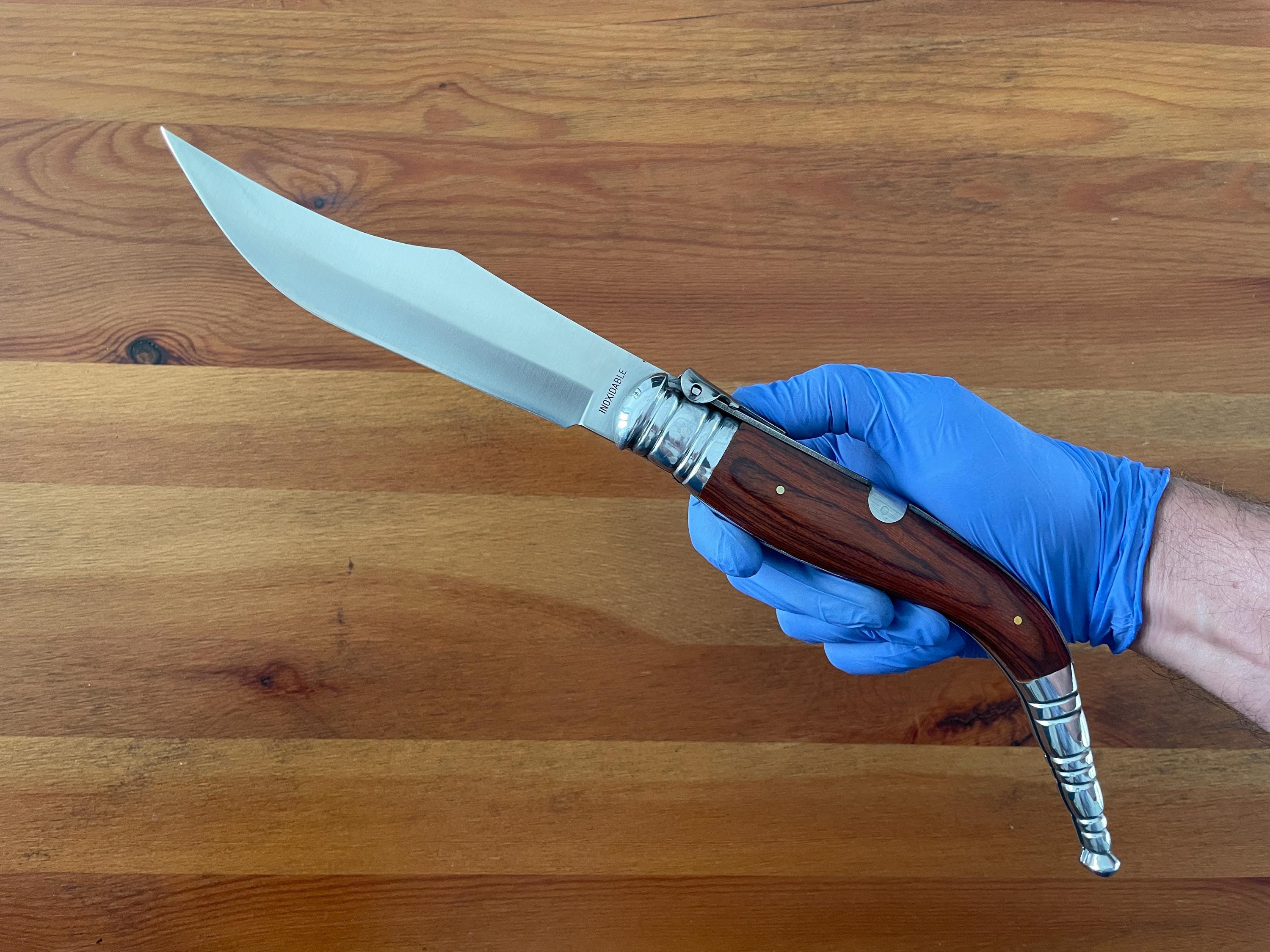
I did some light research:
First an AI search:
why were folding knives originally made
Folding knives were originally made as compact, portable utility tools so people could safely carry a blade for everyday tasks like eating, cutting materials, and grooming, without the danger and inconvenience of an exposed fixed blade.
Early purposes
- The earliest known folding knives from the Iron Age (around 600–500 BCE in Central Europe) were simple friction folders likely used by workers such as salt miners for general cutting tasks.
- In ancient Rome, folding knives served for eating, grooming, and other daily chores, offering a convenient personal tool that could be carried more discreetly than a fixed knife.
Practical reasons for the design
- Folding the blade into a handle made the knife safer to carry on the body or in a bag, reducing accidental cuts and damage to clothing.
- The compact form meant people—especially soldiers, craftsmen, farmers, and travelers—could always have a versatile cutting tool at hand for work, food preparation, small repairs, and sometimes as a last‑ditch weapon when larger arms were restricted or impractical.
I think I found the source of most claims. AI has not written any of the explanations they are quotes from knife manufacturers sites.
Lets see:
The first paragraph claims without a hint of proof that in use folders are safer. I would say that that is pure PS, especially as early folders seem to have been friction folders.
The early find in Hallsattt was in a cemetery of early Celtic culture near salt mines, apparently not found by archaeologists but a foreman who documented his find fairly well. Some comments seem to suggest the context was not a worker burial but a merchant which would make it not so much an everyday object.
There are numerous references to to Roman folders but Romans also knew the small utility knife. As most research articles are behind a pay wall I have no idea about their comments. But almost all sources claim that Romans did not have pockets and how they carried small everyday objects is apparently not well known. So "carried discretely" but where and how, especially as carrying a small fixed blade knife is hardly any less discrete.
Carrying a folder is not any safer than a fixed blade in properly made sheath. "reducing accidental cuts and damage to clothing" this pure PS again, the commenter has apparently never owned or used a good small fixed blade knife. This especially does not hold to early friction folders that could open by themselves.
The last point brings up a point that comes up later often, all fixed blades are seen as weapons and folders are not, several references to that. How can one always have a folder at hand and not a small fixed blade knife, I don't buy that one.
Also what came up was that folders seem to be a southern item, though possibly invented by Celts, the idea was spread around by Celts and Romans. Germanic tribes used a small utility knife much more, folders surely were seen by them.
This all does still not explain why a folding knife was originally invented, the pocket argument is out, pouches were in use but for carrying one on a belt is quite handy, one could as easily hang a small sheath knife from it. So the idea that the shorter length was the reason actually sounds improbable.
The one reason I found interesting was cleaning, a folder is definitely easier to clean than the sheath of a fixed blade. So maybe the use for eating was the reason.
I still hold the original question as unanswered.