New Mora Farnas

  • BushMoot: Come along to the amazing Summer Moot 31st July - 5th August (extended Moot : 27th July - 8th August), a festival of bushcrafting and camping in a beautiful woodland PLEASE CLICK HERE for more information.
Why is that? I understood that ash is used as a handle material often. It barely grows here so I have no experience with it.
This is the very first knife I've ever seen with ash handles, and it's obvious from the pic one of the reasons is the softness and tubules. It's used for pickaxe, axe, adze handles because it's elastic and springy, never seen it on a knife.
 
  • Thank you
Reactions: TLM
Why do you have the need to stabb? Unless you stabb you do not need a handguard.
While in a perfect situation you are completely correct and I agree.

That being said, often times when you slip forward and cut yourself is when you are wet, tired, hungry, amongst other things and make a stupid mistake. I have personally cut my fingers sliding forward using one of my barrel handle puukkos deboning a chicken as well as filleting a fish. Would that have happened if I was feeling fresh? Most likely not.

Point being I think some type of pronounced guard can be really helpful in those situations where you are wet/oily and tired at the end of the day. I often hear people say that only amateurs need a guard however I think that is a silly misrepresentation of real life situations.
 
  • Like
Reactions: fielder1963
I often hear people say that only amateurs need a guard however I think that is a silly misrepresentation of real life situations.
I agree there, being an amateur has little to do with this but I still maintain that having learned early on how to use a puukko in a culture that has used one for a few thousand years might have some effect.

There are archaeological finds of midsize fighting knives apparently without a guard but we really don't know how they were used.

I somebody wants a guard in a small knife I have really no problems with that, I could point out that it put some limitations on how the knife can be used.
 
  • Like
Reactions: Herman30
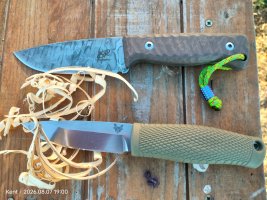
I'm really not sure what mora are aiming for there. The design is neither one thing nor another, the fit and finish is utterly appalling, Ash (unless it's been pumped full of epoxy resin) is a really poor choice for scales, I don't understand whether that's supposed to be a choil or if it someone just had an off day on the grinder....

I really don't get it. How can they produce knifes like the garberg, or the 120, and whatever this is supposed to be, at the same time. It makes no sense.
 
  • Like
Reactions: HorseGuy
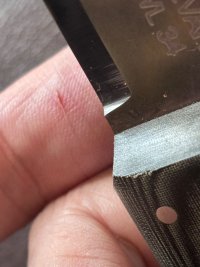
It’s funny. I was agreeing with everyone that you’re not very likely to cut yourself doing woodwork if you’ve not got a guard on a knife like this. Then last night. I did just that. I’d finished cutting and was holding the knife vertically, tip up to examine my work. Just as I was about to go in for another cut I felt it slide downwards out of my hand. Granted it’s a heavy handle compared to most knives of this design. But it shows that it can happen.

IMG_7965.jpeg
 
  • Like
Reactions: fielder1963
But it shows that it can happen.
There is nothing that prevents it physically from happening. Sooner or later it is going to happen with enough tries.

I am trying to think how to say this without giving a wrong impression. I am not sure ...

It is a question of handling the knife in a certain way and with certain grips when doing different things. Yes, they are there to avoid cutting yourself in various ways when working with a knife without a guard. Apparently the guardless knife serves a purpose because it has been in continuous use in northern countries for ages and guards can be found near by in large enough quantities and in various fighting and hunting knives here too.

A puukko (a Saxon loan word apparently, "kuras" in more native language)) or similar all purpose working and every day use knife still was/is mostly guardless.
 

BCUK Shop

We have a a number of knives, T-Shirts and other items for sale.

SHOP HERE