Found Wanting: Get Home Prep Failure

  • BushMoot: Come along to the amazing Summer Moot 31st July - 5th August (extended Moot : 27th July - 8th August), a festival of bushcrafting and camping in a beautiful woodland PLEASE CLICK HERE for more information.
On the essential travel though; we are under a yellow weather warning, as is most of the UK.
However, I have a hospital appointment tomorrow that I really cannot miss.....and I can't drive myself there and back since I am to be anaesthetised, so a driver from the LCC has kindly phoned and agreed to pick me up at 8.30am.....too early really to know if the staff will be able to get into the hospital to deal with me anyway. Right now we have rain, it's supposed to drop below freezing later and then early tomorrow is ice and sleet.

If it weren't a real issue to postpone this appointment, if it was going to be simple to re-schedule, then I'd cancel, but it's neither.

:dunno:

There are all sorts of reasons for folks travelling, even when it might be wiser to stay put.

At this point I'd welcome a 7am phone call saying the hospital has cancelled it, and hope things just get sorted out asap.

M

Definitely essential travel.

But in the rail sector (I work in) there's such a lot if criticism when decisions are made to stop trains for a bit, and day leisure or work trips are cancelled. However, as the wrong decision can these days mean prosecution for companies and individuals, a level of risk aversion happens.

On the subject of preparedness for rail travel......

If a train is stranded in the middle of nowhere in bad conditions, chances are that folk will be on there for a while, rescue in poor weather could take many hours, and involve a diffilcult walk. Not much a person can prepare for except to have a warm coat, wear sensible footware, have some water- but drink as little as possible as toilet opportunities will be extremely limited...... even if there's power, there's only so much water and retention tank space...... also choose the train type carefully- e.g. bimodes instead of electic only, as bimodes have "hotel power" when the overhead wires have an issue- which is a not unusual occurance.

So rail travel preparedness is a bit different.

I think the best preparation is understanding the network- mental map of diversionary routes and recognition of the signs it's going to be bad...... e.g. first ones legging it from Padd to Waterloo to switch onto the SWR service to Reading are the ones who catch the turned back S Wales or West train from Reading. Sometimes the local chuggie will stay ahead of the late express, sometimes not..... knowing the "contingency patterns" and crossover locations helps optimise the choice...... as does laying a bit more for a less restricted ticket and understanding what "any reasonable route" means in practise, and checking for ticket acceptance on other route options. Also useful to recognise what is plausible in what is being announced in terms of onward travel as what will happen in reality may not be what is being said.....

GC
 
I do have a PUFO (Pick Up Leave off) bag that sits by the bed ready to go.

Basically a 20L daysack half full, deliberately so, with some basics plus copies of certain documents. All the kit in it is non contentions for public transport or having to go through a security check. Water, emergency bivi bag, sit mat, mug and bcb fire dragon, energy food etc.
Some warm clothes that look relatively casual. Trousers have vapour barrier liners and non tactical, for example.

Unused space is for anything I decide to grab on the way out or so I can stick my coat in it.

I may be a little paranoid. ;)
A very good subtle point on having excess space in your bag rather than being so full you can't throw in extra stuff for yourself or others.

Hands free at all times, nothing hanging off and non descript bag.
 
  • Like
Reactions: Toddy
A very good subtle point on having excess space in your bag rather than being so full you can't throw in extra stuff for yourself or others.

Hands free at all times, nothing hanging off and non descript bag.

Or - so you can actually search and organise the items in the bag with your hands INSIDE the bag - as opposed to being so full you need to empty it to locate something and then repackit.
 
The ultimate preparedness for a "get home failure" is not going out in the first place.
Right.

Sometimes, conditions change after you've gone out and you hope that you're dressed for the new conditions.

After work last night it took me four hours to get home by train and bus. After arriving, I worked out that I could have walked it in that time. This morning it took me two and a half hours to get in to work.

But a big problem there is that my employer is absolutely incapable of measuring productivity and can only measure physical presence in the office and so wants everybody to turn up.

Yet during the WuFlu episode, when the government (here in France) ordered everybody to work from home whenever possible, productivity didn't drop, and indeed when we didn't have to spend hours each day travelling to work and back we put in more hours and were more productive.

Yes, I know, I've drifted off-topic.
 
Thanks GreyCat, I've just learned something;
"So rail travel preparedness is a bit different." Certainly is, and connecting trains are the most fraught - but I didn't know why the Padd/Reading train got hit so often, now I do.

I didn't realise how the Wales and Devon/Cornwall issues affected Reading, which is generally blessed with milder weather. Your explanation makes perfect sense, and I feel for you when that happens.
 
  • Like
Reactions: John59
Wonder if those folk who got stuck at New Year in a foreign location, due to the Eurostar tunnel closure, had envisaged or prepped for that possibility?
&
Seriously though; how would you ?
My 'bag', fine, but y'know it's limited somewhat.

I'm also thinking about the 2025 Iberian Peninsula blackout.

And I/we could briefly glance at the National Risk Register and Local Risk Register? Then discuss our solutions or reactions to these scenarios. But really the primary objective remains to return home safely.


You prepare for what you can do. Food, water, clothing, sanitation and light, comfort and signalling are maybe the top choices. I would expand these headings to fill out a PACE plan (Primary, Alternative, Contingency, Emergency) where appropriate.


Food would be a few snacks a little cushion to push back a meal for a few hours, or hold out a few 'hours' until I can resupply. If I'm in a group, I'd bring extra food. As a practical measure, with adventure racing or organized running you’re required to have some emergency food. So a couple of bars or gel tubes marked with red flagging tape and the word “emergency”, pack date and use by date written on them.


Water is your immediate hydration needs. If I was facing bigger problems, I’d scale up either passively via storage or passively and actively via Grayl.


Clothing or cover is likely to be a fairly heavy element that will need very careful planning. I don't believe you'll really beat a jacket. I don't get much use of my poncho outside of scouting through forest.


Sanitation and hygiene is pretty simple. Options for cleaning hands prior to handling food and water, toilet, and if you wanted to expand I added a link to a micro grooming kit in a previous post in this thread. Here: #17


With the smallest effort, a 5 lm torch is going to last days… My head torch would run for like 12 days straight. So ~48 hours of darkness over 3 days would be 1/6 of the total battery.


I don’t imagine having too much difficulties with signalling, buy the brick of technology and pay the subscription. Have your own look at different options for these "bricks". I hope I'm not too far off topic with these points: Make sure you actually register the locator beacon. And with satphones you need the full number/s so a waterproof book of contact numbers!

Think cheap, small scale too. I have carry a whistle with my keys. Also my large hi-visibility vest weighs: 100 grams. (Bonus link back to the ponchos TeeDee posted in #24.)


The last topic is maybe personal comfort? So a foam seating mat, ear plugs.


My tips for organisation: Truly tiny items can stored in a 10 pack plastic credit card holder protector sleeves. Small items might fit a dedicated organiser bag (or that's my excess for wanting one!). There are clear 20cm x 20cm TSA approved bags for liquids... not like you couldn't add a double sided print out with a giant title and a table of contents on the front... and maybe lined page on the back or notes or want changes you'd like?

First aid should be in a distinctive pack and accessed by "the red toggle" maybe the biggest most obvious and unique hand grip. A more subdued option is likely red paracord, I might unhook the 'toggle', flag or red anodized carabiner.
 
Last edited:
  • Like
Reactions: Toddy and John59
Thanks GreyCat, I've just learned something;
"So rail travel preparedness is a bit different." Certainly is, and connecting trains are the most fraught - but I didn't know why the Padd/Reading train got hit so often, now I do.

I didn't realise how the Wales and Devon/Cornwall issues affected Reading, which is generally blessed with milder weather. Your explanation makes perfect sense, and I feel for you when that happens.

We used to have a saying "when the Thames valley sneezes, the whole of the Western Route catches a cold."

Railway geography is very different to what people are used to in the way it is presented. We have "Routes" based on the old Railway company areas, and around key lines from London. We measure distance in miles and chains with Line of aroute code or Engineers Line Reference.

All the major Routes have challenging spots, but the GWML (Great Western Main Line) is the one I know best. But equally the WCML is notorious for the canning of anything beyond Preston when it starts to get spicy north of Carlisle.

Knowing how different trains behave in degraded conditions helps..... much better to be on a bimode IET/Azuma if the OLE falls down because the diesel engines provide HVAC, light and toilet power. Whereas the local electric unit will typically have no more than 20 min battery backup before it load sheds by turning off these things to preserve power to safety kit for as long as possible.

Where possible, Control will hold trains in stations so doors can remain unlocked. If there is (say) a fatality in the Hayes area on GWML, trains may be held as far back as Bristol and Newport, there could be several trai s in each major station from Reading westwards.

Yesterday, all trains west of Carmarthen were cancelled after 15:00 then nothing along those lines ran this morning until "Route proving" had taken place to remove the debris, fallen trees etc. No rail replacement buses were provided as the roads were even more hazardous and the bus companies won't do it.

The railway is a complex system and incidents can impact a wide area. Its also possible to be stranded in awkward spots with only what you have with you. No, they are not supposed to just abandon passengers, but it can happen.

Very different thought patterns for rail travel preparedness vs using Road travel.

GC
 
Train service was badly disrupted yesterday evening and this morning.

I've already written that it took me four hours to get home last night and two and a half hours to get to work this morning.

Already 50% service from gare Saint Lazare for the previous three days, IT breakdown at Gare de Lyon, train breakdown at Houilles, followed by a "serious passenger incident" led to my train going no further than Nanterre. I had to get a series of busses. If I'd known just how long it was going to take, I could have walked a much more direct route in less time.

This morning, a tree fallen across the line in my town meant that I had to get a bus to another town on a different branch of the line.

It's not exactly rocket surgery to decide that any tree along the line cannot be of a height that exceeds the distance between that tree and the line.
 
  • Like
Reactions: Toddy
Keeping trees down to height requires regular maintenance, which they are not going to do.
Instead they use blunt thinking and just remove everything on the sides of the rails.

Stupidly, they did that to the deepest cutting in the UK, near Sonning. Ignoring wildlife and environmental protests, they totally cleared all the dense mature trees & vegetation, including the stumps.
Then they were surprised when the banks collapsed over the main Reading/Paddington line, without the roots to stabilise the soil and the trees and bushes to soak up all the water.
 
@Falstaff

Just wondering if , as the OP , the thread has been useful to yourself?

Has it given you an idea of items or maybe reassured you to not dramtically over think certain things and requirements.

The thing with special insurance type items and kits like a GHB/BOB is that to be really useful they have to be minimal enough to be with you.
Unfortunately the pessimistic 'want to be prepared mind set' ( think thats a fair statement ) has issues drawing a line under when to say No. We/It tends to suffer mission creep to a point that it can become detrimental.

So its important to be mindful of size and weight considerations.

In summary - do you now have a list or answered your initial question?
 
  • Like
Reactions: Ozmundo and Toddy
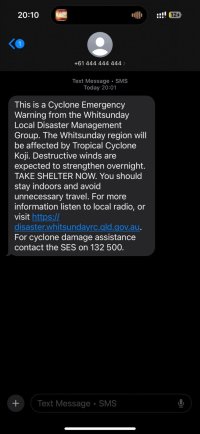
1000040076.jpg

Well this concentrates the mind on holiday. It's changed direction and shifted as we've been watching the prelude winds all day. Sightly connected to this thread I have what I have as a traveller along with knowledge living in a Hurricane zone for a few years. No lovely pre packed go bag.

So, everything outside that can be lifted by the wind put away, bath, buckets, water bottles and jugs filled with drinking and using water, everyone with a torch next to their bed, blinds all closed in front of glass, power banks, phones and laptop's all charged and biggish final shop at the Woolworths.

No-one to go outside and one room with sheltered window chosen to decamp to if needed.

All the sexy gear 10000 miles away so what are my top 5 things I have with me?

Nitecore LR70 lantern/torch/battery bank
Yeti/Owala/ Hydrapak water bottles
One Swiss Card
Haglofs LIM packable goretex jacket
Little vacuum pump for my compression bag which has a lantern built in....bonus!

In the rental house:

Kitchen knives
Water storage
No method of cooking post power cut as all electric
Aussie SIM so we received the warning text. UK phones ...nothing.

A few blue lights and sirens but all battened down and Uber quiet streets
 
Absolutely connected to this thread! You seem to be pretty well prepped - may I suggest you pack all your bags - protects your stuff if the wind and water gets in, and enables a fairly quick departure if you need to decamp afterwards.
If there's time, gather some potential fuel and something to make a hobo stove? No doubt the local residents will be able to advise post- hurricane.
Good luck and I hope it all goes well for you and your family.
 
Eye passed over about 0700 and trailing winds now hitting but moving down from a Force 2.. We're living out of suitcases so remained packed. Hire car lightly planned for as well as a trip to Anaconda for a stove but power still on and effects weakening. Airport shut.

Flooding next but we're high up. Other bits of FNQ had half a metre(!) of rain.
 

BCUK Shop

We have a a number of knives, T-Shirts and other items for sale.

SHOP HERE