Sharpening steels

  • BushMoot: Come along to the amazing Summer Moot 31st July - 5th August (extended Moot : 27th July - 8th August), a festival of bushcrafting and camping in a beautiful woodland PLEASE CLICK HERE for more information.

Pattree

Full Member
Jul 19, 2023
4,246
2,976
79
UK
You might have seen that I recently moved on a 1950’s butcher’s knife.

I didn’t sharpen it but if I had I would have used a sharpening steel as would its original owner.

I use a sharpening steel on my kitchen knives and on the big carving knife.

Opinel recommend a sharpening steel for their knives and sell both domestic and camping versions of a steel. (I do find the little sheath version awkward in my big hands. Can’t maintain the angle that I want)

The only reason that I don’t use a sharpening steel outdoors is that the axe puck packs much more easily.

Does anyone else use a steel?
What might I gain from a more advanced system for sharpening?

pee ess
While I can strop perfectly well on my belt; I sometimes strop on my palm but that’s as much a habit from days gone by, as a practice.
 
  • Like
Reactions: plastic-ninja
Stones are sharpeners for removing material, reprofiling bevels and for sharpening knives from blunt to sharp.

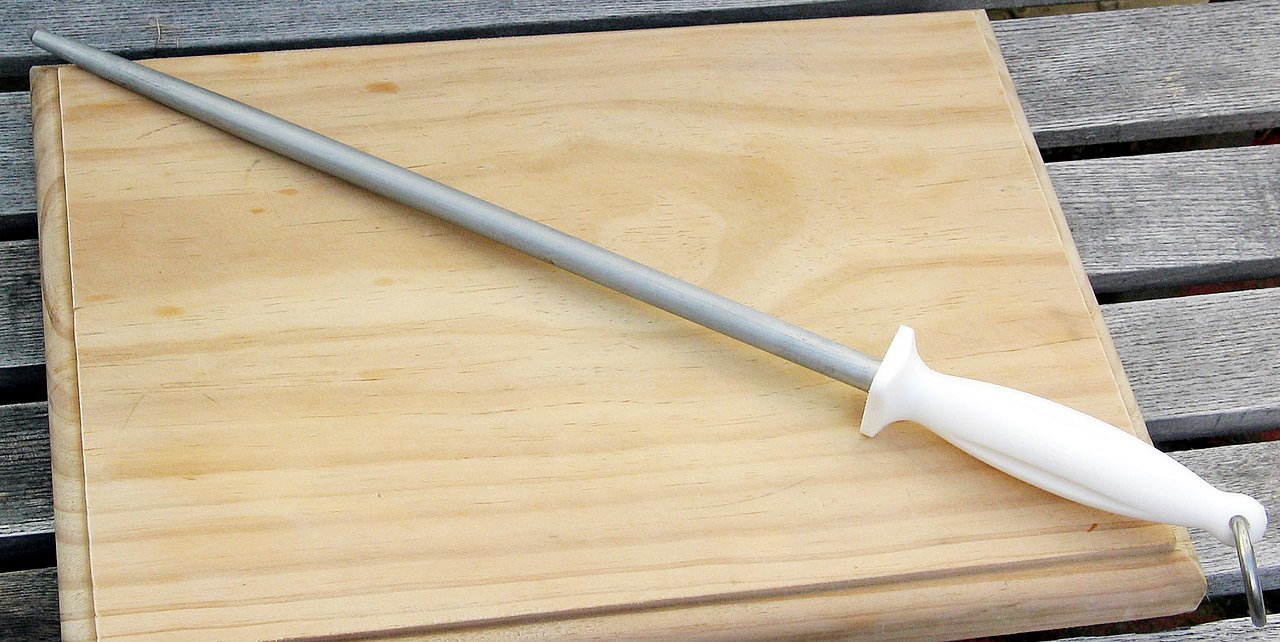
Steels are hones designed to realign edges and return sharp edges which are failing to good form (such as when an edge rolls at the microscopic level or the very apex of the edge is rounding off due to use) and whilst they may remove a very small amount of material, they are not designed to sharpen a blunt edge or significantly remove material.

Effectively stones to get a knife sharp and hones to keep it sharp.
 
Stones are sharpeners for removing material, reprofiling bevels and for sharpening knives from blunt to sharp.

Steels are hones designed to realign edges and return sharp edges which are failing to good form (such as when an edge rolls at the microscopic level or the very apex of the edge is rounding off due to use) and whilst they may remove a very small amount of material, they are not designed to sharpen a blunt edge or significantly remove material.

Effectively stones to get a knife sharp and hones to keep it sharp.
Absolutely, I was going to post similar.
There are a handful of exceptions where the 'steels' are made of ceramic, or coated in an abrasive, so they look like normal steels but are actually sharpeners dressed up like steels, but they are very much not the usual.
 
  • Like
Reactions: stonepark
I use a fine mill-saw file to repair or reshape a working knife blade. Fine it down with a carborundum block or puck. I finish it off with a good quality steel. Then use the steel regularly.

It doesn’t remove metal but it does move it. The strop cleans the teeth.
 
I use a fine mill-saw file to repair or reshape a working knife blade. Fine it down with a carborundum block or puck. I finish it off with a good quality steel. Then use the steel regularly.

It doesn’t remove metal but it does move it. The strop cleans the teeth.
The strop is abrasive though, so isn't just cleaning teeth, it's removing metal? Unless you're not using any compound on it?
 
  • Like
Reactions: Pattree
Please excuse my noob question here. :)

Would a sharpening rod be the easiest tool to use on a long curved blade such as a billhook?
 
Please excuse my noob question here. :)

Would a sharpening rod be the easiest tool to use on a long curved blade such as a billhook?
The best results I've had on billhooks has been to take a round stick like a dowel and wrap wet and dry paper around it to mimic a cylindrical sharpening stone. I use soft backed abrasives like micro-mesh. Billhooks are often quite thick and you'll need to remove material to get a dull edge back. I usually start around 240 grit with my billhook to get it apexed and then work down to lower grits depending on how fine you want the edge.
 
  • Thank you
Reactions: HorseGuy
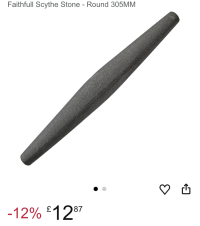
Long ago I worked for the Forestry Commission. We routinely used bill hooks sickles and scythes . We carried dual tapering carborundum stones just over a foot long.
1780935836627.png
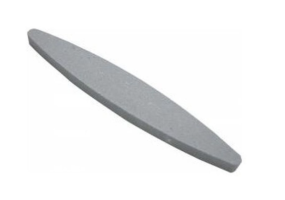
Now I use a similar stone but it is flat on two faces.

1780935941245.png

It soon develops curved edges.
 
  • Like
  • Thank you
Reactions: Broch and HorseGuy
Stones are sharpeners for removing material, reprofiling bevels and for sharpening knives from blunt to sharp.

Steels are hones designed to realign edges and return sharp edges which are failing to good form (such as when an edge rolls at the microscopic level or the very apex of the edge is rounding off due to use) and whilst they may remove a very small amount of material, they are not designed to sharpen a blunt edge or significantly remove material.

Effectively stones to get a knife sharp and hones to keep it sharp.
This is the answer. Very few people appear to be aware of it, though.
 
I would agree to an extent but it isn’t quite as clear cut as that.
My Prestige steel (part of a meat carving set) has longitudinal groves and is magnetic. It works like a very shallow file and I can see the material that it has removed when I wipe it with a paper towel.
 
  • Like
Reactions: Seagull

BCUK Shop

We have a a number of knives, T-Shirts and other items for sale.

SHOP HERE