Sharpening steels

  • BushMoot: Come along to the amazing Summer Moot 31st July - 5th August (extended Moot : 27th July - 8th August), a festival of bushcrafting and camping in a beautiful woodland PLEASE CLICK HERE for more information.

Pattree

Full Member
Jul 19, 2023
4,286
3,010
79
UK
You might have seen that I recently moved on a 1950’s butcher’s knife.

I didn’t sharpen it but if I had I would have used a sharpening steel as would its original owner.

I use a sharpening steel on my kitchen knives and on the big carving knife.

Opinel recommend a sharpening steel for their knives and sell both domestic and camping versions of a steel. (I do find the little sheath version awkward in my big hands. Can’t maintain the angle that I want)

The only reason that I don’t use a sharpening steel outdoors is that the axe puck packs much more easily.

Does anyone else use a steel?
What might I gain from a more advanced system for sharpening?

pee ess
While I can strop perfectly well on my belt; I sometimes strop on my palm but that’s as much a habit from days gone by, as a practice.
 
  • Like
Reactions: plastic-ninja
Stones are sharpeners for removing material, reprofiling bevels and for sharpening knives from blunt to sharp.

Steels are hones designed to realign edges and return sharp edges which are failing to good form (such as when an edge rolls at the microscopic level or the very apex of the edge is rounding off due to use) and whilst they may remove a very small amount of material, they are not designed to sharpen a blunt edge or significantly remove material.

Effectively stones to get a knife sharp and hones to keep it sharp.
 
Stones are sharpeners for removing material, reprofiling bevels and for sharpening knives from blunt to sharp.

Steels are hones designed to realign edges and return sharp edges which are failing to good form (such as when an edge rolls at the microscopic level or the very apex of the edge is rounding off due to use) and whilst they may remove a very small amount of material, they are not designed to sharpen a blunt edge or significantly remove material.

Effectively stones to get a knife sharp and hones to keep it sharp.
Absolutely, I was going to post similar.
There are a handful of exceptions where the 'steels' are made of ceramic, or coated in an abrasive, so they look like normal steels but are actually sharpeners dressed up like steels, but they are very much not the usual.
 
  • Like
Reactions: FIU and stonepark
I use a fine mill-saw file to repair or reshape a working knife blade. Fine it down with a carborundum block or puck. I finish it off with a good quality steel. Then use the steel regularly.

It doesn’t necessarily remove metal but it does move it. The strop cleans the teeth.
 
Last edited:
  • Like
Reactions: FIU
I use a fine mill-saw file to repair or reshape a working knife blade. Fine it down with a carborundum block or puck. I finish it off with a good quality steel. Then use the steel regularly.

It doesn’t remove metal but it does move it. The strop cleans the teeth.
The strop is abrasive though, so isn't just cleaning teeth, it's removing metal? Unless you're not using any compound on it?
 
  • Like
Reactions: FIU and Pattree
Please excuse my noob question here. :)

Would a sharpening rod be the easiest tool to use on a long curved blade such as a billhook?
 
  • Like
Reactions: FIU
Please excuse my noob question here. :)

Would a sharpening rod be the easiest tool to use on a long curved blade such as a billhook?
The best results I've had on billhooks has been to take a round stick like a dowel and wrap wet and dry paper around it to mimic a cylindrical sharpening stone. I use soft backed abrasives like micro-mesh. Billhooks are often quite thick and you'll need to remove material to get a dull edge back. I usually start around 240 grit with my billhook to get it apexed and then work down to lower grits depending on how fine you want the edge.
 
  • Thank you
  • Like
Reactions: FIU and HorseGuy
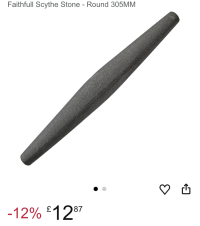
Long ago I worked for the Forestry Commission. We routinely used bill hooks sickles and scythes . We carried dual tapering carborundum stones just over a foot long.
1780935836627.png
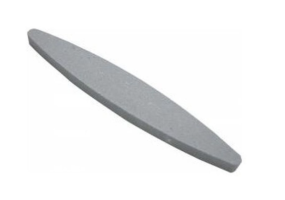
Now I use a similar stone but it is flat on two faces.

1780935941245.png

It soon develops curved edges.
 
Stones are sharpeners for removing material, reprofiling bevels and for sharpening knives from blunt to sharp.

Steels are hones designed to realign edges and return sharp edges which are failing to good form (such as when an edge rolls at the microscopic level or the very apex of the edge is rounding off due to use) and whilst they may remove a very small amount of material, they are not designed to sharpen a blunt edge or significantly remove material.

Effectively stones to get a knife sharp and hones to keep it sharp.
This is the answer. Very few people appear to be aware of it, though.
 
  • Like
Reactions: FIU and HorseGuy
I would agree to an extent but it isn’t quite as clear cut as that.
My Prestige steel (part of a meat carving set) has longitudinal groves and is magnetic. It works like a very shallow file and I can see the material that it has removed when I wipe it with a paper towel.
 
  • Like
Reactions: Seagull
Steels are for realignment of the cutting edge. They do not remove material. Sharpening removes material.

If we are going to talk strictly about knife steel for honing, I like the flat or ovoid shaped rods. Makers all seem to be German. Now defunct Emil Gustav Erm, current manufacturer F.Dick make these sort of steel for use with kitchen knives but they certainly can be used for any knife.

I see cooks slamming knives rapidly up and down on the steel and I honestly think that this person is an idiot who fundamentally does not know what they are doing. The correct use of a steel is similar to sharpening. Imagine slicing thin pieces off of a piece of wood, like would be done to make wood curls for a fire. This is the action and is best done with slow, deliberate motions on both sides of the blade. I use the back of my thumb nail to feel if the cutting edge is bending one way or the other so I can adjust the bead into place.

I also like to use a ceramic rod to polish the cutting edge once the knife has been steeled. Ceramic does remove a smear of steel so it is technically sharpening the blade.
 
  • Like
Reactions: Aristotle
I see cooks slamming knives rapidly up and down on the steel and I honestly think that this person is an idiot who fundamentally does not know what they are doing.
Sorry mates but that is nonsense.

Some steels do remove metal. They act like very fine files. If you’ve ever seen a well used butcher’s knife you will see that exactly that kind of sharpening has worn away as much as a third of the blade.

2. Don’t you think that it’s a bit arrogant to suggest that the practice of an entire profession for centuries is performed out of ignorance?

What a steel will not do is to produce the tissue paper cutting edge that some folk seem to want. If I want to cut paper I use scissors.

I have no time for so called super steels and no time for “shaving edges” on my working knives. To me (and not anyone else) sharp is simply sharp enough to do the job. For the knives that I take to camp; I can achieve that with an axe puck and spit. I can achieve it on my kitchen knives by “slamming knives rapidly up and down on the steel”.
 
The butcher/kitchen steels that I have encountered, including those that have been around for 70+ years, all have grooves along the length, which makes them bite on the blade a bit more. The newest (a mere 50+ years old) has the coarsest grooves and definitely removes metal from the relatively soft kitchen knives it was used on.
My understanding was that these steels participate in forming the burr and maintaining it. If they were not meant to remove metal, they could be made smooth, which would certainly have been cheaper. If they were smooth, like the burnishing tools used for forming the hook-burr on cabinet scrapers, they would not remove metal, just push it around.

That is not to say that people who swash their blades vigorously up and down a steel are using optimum technique for best possible results. Plenty of people achieve edges that they are satisfied with using far from ideal technique, and those edges are not as good as what they could achieve with more refined technique....but they get the job done for them.

Regarding ignorance. Lots of people that have been doing things for years can be quite ignorant. You find a way that works, that you are comfortable with, and you stop thinking about doing it better, or even that it could be better.
I have taught sharpening at the Moot for years. I rarely had any trouble getting a shaving sharp edge on my bushcraft knives or those that people brought me, using water stones, ceramics, diamond or various strops. I was not really satisfied though with the edges I achieved on several powder super-steels...until this year, when I refined my technique, made some harder higher quality strops and purchased some diamond stropping spray. I was ignorant of the difference these factors could make, to the point I rather thought some of the materials and techniques were a bit of an affectation when I saw them demonstrated by others. Now I am happy that my super steels can whittle hairs! :bigok: They also keep these edges longer than the edges I used to achieve.
The young can be naive, but to display real ignorance, you have to have lived long enough to gain some experience!:lmao:

Chris
 
Totally agree. It is amazing what you can achieve and survive using seventy plus years of ignorance.

Perfection can wait. Adequacy Rules.
 
Sorry mates but that is nonsense.

Some steels do remove metal. They act like very fine files. If you’ve ever seen a well used butcher’s knife you will see that exactly that kind of sharpening has worn away as much as a third of the blade.

2. Don’t you think that it’s a bit arrogant to suggest that the practice of an entire profession for centuries is performed out of ignorance?

What a steel will not do is to produce the tissue paper cutting edge that some folk seem to want. If I want to cut paper I use scissors.

I have no time for so called super steels and no time for “shaving edges” on my working knives. To me (and not anyone else) sharp is simply sharp enough to do the job. For the knives that I take to camp; I can achieve that with an axe puck and spit. I can achieve it on my kitchen knives by “slamming knives rapidly up and down on the steel”.
The grooved or ribbed hones may produce steel residue. This is caused by the softer blade steel shedding debris on to the hone. Western knives are traditionally not heat treated to hardness level of quality Asian knives so they tend to produce microchips and flake off pieces of steel during honing, especially if you are touching the cutting edge on bones, wood knots, etc. Japanese blades are almost always honed on a wetstone due to the hardness of their tempering.

Smooth hones were and are made. I cannot sort out how to post photos here but I can send photos of smooth hones if someone will post them. I actually prefer the smooth hones as they do a better job of the business.

If you are shedding similar amounts of steel debris/smears/dust onto a hone as you find on a diamond or ceramic rod than something is wrong. Perhaps try radically reducing the angle of attack that the blade is run down the hone. I will restate, a hone is for restoring the alignment of the cutting edge. This is particularly needed on western knives that have, in the past been tempered to a lower level of hardness. Most good quality kitchen knives are still tempered lower than the current trend with bushcraft knives for higher tempered steel blades. There is a distinction between honing and sharpening. Sharpening is the act of actively removing blade material to create a new cutting edge.

Oh, I agree, that I own 1940s Dexter chefs knives that indicate heavy cutting edge wear. I cannot know for certain what caused that wear but I too have observed it. If used correctly, a knife blade will long outlast the handle scales. Cooks, often know as much about their knives as I know about how a my liver works. Just because a person uses a tool everyday does not make them an expert in those tools or how to correctly maintain them. For instance, there is some impressive expertise, on this site, on the subject of torches. Ask almost any law enforcement officer about their their torch and most of you will have more knowledge than they do. The cops use these items every day but to them, they just a tool.

I will attach the Wikipedia article on the subject of hones. Perhaps this will provide a more comprehensive explanation.

 
The strop is abrasive though, so isn't just cleaning teeth, it's removing metal? Unless you're not using any compound on it?
A strop, without any abrasive compound is acting to push tiny flakes of steel off the cutting edges, that if not removed will fold over and damage the cutting action. The strop also pushes the cutting edges back into place in a more gentle fashion than a hone. The leather strap in itself does not and cannot sharpen unless it has been impregnated with an abrasive compound.
 

BCUK Shop

We have a a number of knives, T-Shirts and other items for sale.

SHOP HERE