
Inuit fire drill
- Thread starter atlatlman
- Start date
-
The awesome MakerMoot is coming up (13-15th Nov 2026), Visit the TORM & ARM markets,and have space back at camp to work on projects and enjoy great company. PLEASE CLICK HERE for more information.
You are using an out of date browser. It may not display this or other websites correctly.
You should upgrade or use an alternative browser.
You should upgrade or use an alternative browser.


Thanks mate. It's a damn sight easier than the hand drill. See you in July fingers crossed. Good talking to you today.
Have you tried using thumb loops on a hand drill?
I was practising yesterday and found that for me at least it made things much much easier.
A triple clove hitch round the drill holds it plenty tight and even a piece of fresh root cordage would do the trick.
Good luck with the fire plough; I have tried it and just don't have the strength or endurance to make it work.
I've done the bamboo fire saw and that works really well with two people sawing; some of these friction methods are definitely team events.
I've done the bamboo fire saw and that works really well with two people sawing; some of these friction methods are definitely team events.
Brilliant, that seems a much better way to go. Great vid.
Thanks mate. I know I said I wasn't going to bother with the hand drill anymore but I found some curly dock stalk in my garden two days back and wondered if that would work. I used a small piece of willow as the hearth board and inserted a piece of the dock stalk into my spindle. 30 secs after drilling I had a coal. One of the easiest hand drill combinations I have used. I also have a piece of bramble which I am going to try tomorrow.


Thanks for posting that, watched the whole thing, very interesting and the film is from my year of birth which adds an interest of its own.
Also of interest was the lack of notch or second hole for the ember to form in...or did I miss it?
Rob.
Also of interest was the lack of notch or second hole for the ember to form in...or did I miss it?
Rob.
Thanks for posting that, watched the whole thing, very interesting and the film is from my year of birth which adds an interest of its own.
Also of interest was the lack of notch or second hole for the ember to form in...or did I miss it?
Rob.
I think you are right Rob. I couldn't see a notch on the board. God knows how they did it.

Some Inuit use pounded moss and fine feather down for tinder.
If that was so, would have been very hard to see.
They have no trees. Tundra & Polar desert.
Wood, as driftwood, is a rare and very valuable commodity.
Trivia: The common hypothesis is that sea levels rose by as much as 200' after the last glacial period.
So fast in fact that the Haida Gwaii village that you were born in might be under water by the time you died.
So, Parks Canada sent a team of scuba divers to follow submeged river courses out into what is now the ocean.
Lo and behold! Stone fish weirs at 70+ feet, identical to the modern ones in use this year.
I can't recall if they said how far off shore the discovery was made.
If that was so, would have been very hard to see.
They have no trees. Tundra & Polar desert.
Wood, as driftwood, is a rare and very valuable commodity.
Trivia: The common hypothesis is that sea levels rose by as much as 200' after the last glacial period.
So fast in fact that the Haida Gwaii village that you were born in might be under water by the time you died.
So, Parks Canada sent a team of scuba divers to follow submeged river courses out into what is now the ocean.
Lo and behold! Stone fish weirs at 70+ feet, identical to the modern ones in use this year.
I can't recall if they said how far off shore the discovery was made.
Some Inuit use pounded moss and fine feather down for tinder.
If that was so, would have been very hard to see.
They have no trees. Tundra & Polar desert.
Wood, as driftwood, is a rare and very valuable commodity.
Trivia: The common hypothesis is that sea levels rose by as much as 200' after the last glacial period.
So fast in fact that the Haida Gwaii village that you were born in might be under water by the time you died.
So, Parks Canada sent a team of scuba divers to follow submeged river courses out into what is now the ocean.
Lo and behold! Stone fish weirs at 70+ feet, identical to the modern ones in use this year.
I can't recall if they said how far off shore the discovery was made.
Interesting stuff about the submerged fish weirs. Thanks.
Thanks for posting that, watched the whole thing, very interesting and the film is from my year of birth which adds an interest of its own.
Also of interest was the lack of notch or second hole for the ember to form in...or did I miss it?
Rob.

Just found this image. This Inuit set has a second hole and a small groove.
Had some time to spare and took another look then took a screen shot....there appears to be a small slot forward of the drill hole....I think you are right Rob. I couldn't see a notch on the board. God knows how they did it.
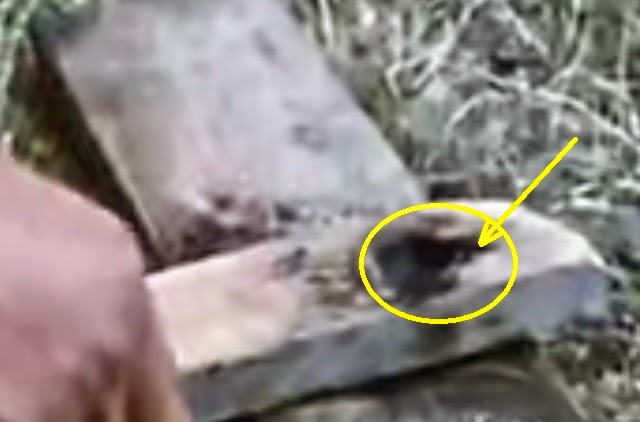
which would make sense as the other methods I have seen described require either a second hole or a rebated shelf to gather the ember. As this is the first hole in the base board it would make sense to have a means of ember capture that required less work than drilling a prior deep hole, particularly as wood is a rare commodity in that region (each hole making perhaps one or two embers before being the next ember receiver).
Ta again, Rob.

I had a go at this earlier today and got a couple of heavily smoking embers. Unfortunately none formed into full coals as I think I made the baseboard too thick & the drill wasn't straight enough for a smooth run. I had to give up as it stared sleeting!
I don't think I'm too far off though, might have a go with some Chaga and a new drill next. Thanks to Atlatlman for such a great thread.
I don't think I'm too far off though, might have a go with some Chaga and a new drill next. Thanks to Atlatlman for such a great thread.
Limaed: Don't quit. Clearly, there is considerable finesse in using a fire drill.
You must attempt success with local materials.
Sleet, schmeet. When you get a dump of 36-44" in 36 hrs, let's discuss it!
Inuit cannot afford to waste wood in fire drills. There are no trees and driftwood
in useful pieces must always be used for something else. Bone and animal fiber
they have in abundance.
At much lower latitudes like my place at just 53N, of course we have forests in the mountians.
Ignorancy claim that they do have "trees" some of 300+ years in age, but, the root stocks are measured
while the tops are never more than 8-12" above ground, buried from the advances of grazing herbivores in winter.
Browsed heavily enough by rabbits in winter, the wound response from the shrubs is an effective birth control
for the herbivores.
You must attempt success with local materials.
Sleet, schmeet. When you get a dump of 36-44" in 36 hrs, let's discuss it!
Inuit cannot afford to waste wood in fire drills. There are no trees and driftwood
in useful pieces must always be used for something else. Bone and animal fiber
they have in abundance.
At much lower latitudes like my place at just 53N, of course we have forests in the mountians.
Ignorancy claim that they do have "trees" some of 300+ years in age, but, the root stocks are measured
while the tops are never more than 8-12" above ground, buried from the advances of grazing herbivores in winter.
Browsed heavily enough by rabbits in winter, the wound response from the shrubs is an effective birth control
for the herbivores.

Similar threads

- Replies
- 1
- Views
- 183

- Replies
- 6
- Views
- 192


- Replies
- 2
- Views
- 280

- Replies
- 2
- Views
- 171