What are you growing?

  • BushMoot: Come along to the amazing Summer Moot 31st July - 5th August (extended Moot : 27th July - 8th August), a festival of bushcrafting and camping in a beautiful woodland PLEASE CLICK HERE for more information.
Ace. We have tomatoes and courgettes here enough to supply a chain of Italian restaurants. Beans are starting up. Aubergines had an early spurt, but are now having another go. Everything here is just about a month later than in the UK
 
Last edited:
  • Like
Reactions: Toddy and slowworm
For us it's been a very early year, thankfully a wet winter but then a dry spring, dry summer with the odd decent shower and we now seem to be going into an early dry autumn. The odd heat wave along the way which has made many things look thirsty.

Where I can look after things and water them, from our spring water, they're done very well.
 
  • Like
Reactions: Toddy
We've been picking many of our apples and quinces before the storms. Again it's been a variable year with the good spring ensuring excellent pollination but the dry summer, wet and windy autumn affecting some trees more than others.

One of the best finds of the year though was a lovely russet apple that's probably grown from a discarded core, possibly the best apple I've tasted and a tree to look after.

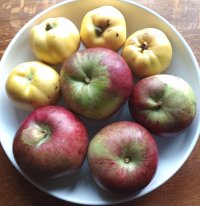
Here's a pic of a couple of interesting things we've planted, quince 'Serbian Gold' which is the size of a good eating apple and apple 'Howgate Wonder' which is a very large dual purpose apple.


IMG_20251005_170219010~2.jpg
 
We picked our apples before the wind took them too. I'm rather swamped with apples to deal with just now, and Son1 and his girlfriend have just bought a house across the river from us, and it has a small orchard dripping full of pears and apples :)....funnily enough there's a Russet, I recognised it right off. His girlfriend is Italian, and didn't know the Russet...I told her it was the loveliest eating apple, even if relatively small. We're in agreement :)
 
We picked our apples before the wind took them too.
What are your plans for them? We're just storing and freezing most of ours at the moment and OH has made some really nice quince jelly today. We need to sort out a method of juicing our apples as we've planted a good number of trees over the years and are getting a decent number each year.
 
I Have a small apple press (a bit like this https://amzn.eu/d/fCmvngn but not that specific model). The secret for me was how to get the apples into mush before going into the press. The old method of bashing them in a bucket/bin/barrel was very hard work. So, I washed and sterilised my garden shredder and put quartered apples through that - result was nice mush that went into the press.

Just the plain juice is delicious :)
 
  • Like
Reactions: slowworm and Toddy
What are your plans for them? We're just storing and freezing most of ours at the moment and OH has made some really nice quince jelly today. We need to sort out a method of juicing our apples as we've planted a good number of trees over the years and are getting a decent number each year.

I have a pretty good idea of what we'll use. So, I do dry apples, but I peel and core carefully and those peelings get boiled up and then strained really well. Then I simmer that down to make apple spread...like Sunwheel spread. Nothing but apples, but lovely stuff and it keeps right through until the next crop without fridge or freezer.

I also peel and slice them in thickish chunks, and then I fry those in butter, as they soften down I add some soft brown sugar, sometimes spice, but usually just apples, butter and sugar. That is then hot packed into Kilner jars and given a quick pressure cook...just up to 15lbs, then taken off the heat and left sitting until the lid frees.
That stuff is apple gold :) it's the fillings for apple pies, sponges, tarts, crumbles, etc., through the year.

I make apple and rowan jelly too.

I make apple chutney using the last of the mild chillis from the greenhouse, and I grate up some of the apples to add to the homemade mincemeat.

I make apple sauce that's really like an apple jam, but is awfully good on puddings, on yoghurt, as the filling in doughnuts. My friend loves it with her scrambled eggs.

Apples and pears are good things :D I wish I had a way to make apple juice and preserve it easily to keep, but it always seems to ferment.
Busy time of it though :) but I love seeing it all done, and the jars tidy in the pantry. Like sweet jewels of Summer stashed away to be used in Winter.

 
  • Like
Reactions: ged and slowworm
I'm sure that one of my old home-brew books explains how to make an apple crusher... I seem to remember that it is something like an old mangle with two rollers (made from beechwood rolling pins) with a gap of about a half or three quarters of an inch between them.
 
I'm sure that one of my old home-brew books explains how to make an apple crusher... I seem to remember that it is something like an old mangle with two rollers (made from beechwood rolling pins) with a gap of about a half or three quarters of an inch between them.
If you were looking to make a crusher, I would look to Matthias' work

One bonus of commercial bottling is the pasteurising gives a good shelf life.
 
... Busy time of it though :) but I love seeing it all done, and the jars tidy in the pantry. Like sweet jewels of Summer stashed away to be used in Winter.
Poetic! With you all the way on that. For anyone struggling with the harvest, I find I can bottle fruit about three times quicker than I can make jam with the same amount of fruit, and it keeps just as well in used jam jars as it does in the relatively expensive, usually bigger and always more unwieldy Kilner and similar jars. This year it took me about three weeks to make about 50kg of plum jam, but only a week to bottle the same amount of fruit. If you're paying for commercially supplied energy, getting jam to the setting point is expensive too. Once it's bottled it sits on a shelf at zero storage cost - you're not paying for the electricity for the freezer.

The one thing to be careful of with bottling is botulinus toxin, but (1) although the bugs are very common and they aren't killed by boiling (so they're probably present in anything you eat), they don't grow in acid media (pH less than about 4.5 for the scientists out there, most fruit will be more acid than that) and (2) the toxin that the bug makes, although it's more or less the most poisonous substance known to man, is destroyed fairly easily by heat (85C is enough, for between five and ten minutes depending on what you read). Whatever the literature, if you're going to use a bottle of fruit in a crumble any risk of botulism is eliminated if it's thoroughly cooked.
 
  • Like
Reactions: Toddy
I'm always reluctant to post about re-using jam jars and bottles, but it works, it works well, and I've been doing it for years with no one ill. But t'internet is full of NO NO NO youtube folks (did you know that Americans actually believe that our jam is full of botulism ?? who knew ? the reality is that the only cases of botulism in the UK came from imported meats, and once from improperly cooked mushrooms) screaming don't do this.

The Italians use every jam jar and bottle they can get their hands on to sort out the annual glut of tomatoes that makes their 'red sauce'. GFSon1 is Italian, she has no qualms. Romanians, Turkish, Greek folks, they too do this.

I think be clean, think about hygiene and make sure things are properly cooked and it'll do very well indeed :)

And you're right. Kilner jars are too damned expensive, especially when jam jars are industrially processed and more evenly made.
 
We (the Royal we) re-use jam jars all the time (jam and pickle jars are kept separate). They go in the oven at over 150C to sterilise, and the boiling jam/pickle goes straight in, and the lids put straight on and tightened. Lids are sometime the difficult bit to get sterilised because they have seals so, if they don't scrub up clean, we do buy new lids.

For clarity, and to clear up why boiling is not good enough, some bacteria are cyst forming (think of them like seeds). Whereas the bacteria are destroyed with boiling (in fact, some as low as 70C) the cysts are not destroyed until you get to 137C - hence the value of boiling in concentrated sugar solution (up to about 160C) or pressure cooking. Cysts can have a cascade 'hatch' after only 24 hours in the right conditions.
 
  • Like
Reactions: Toddy
For clarity, and to clear up why boiling is not good enough, some bacteria are cyst forming (think of them like seeds). Whereas the bacteria are destroyed with boiling (in fact, some as low as 70C) the cysts are not destroyed until you get to 137C - hence the value of boiling in concentrated sugar solution (up to about 160C) or pressure cooking. Cysts can have a cascade 'hatch' after only 24 hours in the right conditions.
Yeah, there are regulations which require temperatures over 130C in commercial canning plants. You probably won't get that sort of temperature with a domestic pressure cooker (probably only 120C or just over, even at sea level - and the boiling point of water is reduced by almost 2C for every 500m above sea level). Many jam recipes will give you less than 105C (60% sugar solution boils at around 103C; if your solution boils at more than 130C it probably means you're making toffee, which will be very safe but ruin your teeth).

So even if your jars have been in the oven at 150C, what you're putting in them is probably contaminated. It's important then not to provide the conditions for the bugs to grow - store in a cool place - and, if there might have been a risk, to cook it thoroughly after opening or throw it away. For anything that I've made myself other than jam, I tend to cook it again in any case. But I'm happy to eat Argentinian corned beef straight from the tin. :D
 
  • Like
Reactions: Toddy
We have a local company that will juice and bottle your apples for you. The stuff is amazing, no matter the mix of apples I've tasted.
I forgot to say thanks for the suggestion. There's a few people around us we could use but have enough to justify buying/making our own press. Just need to decide what we need, trying not to get something too big as there's only so much juice, cider and mead you can drink. Something that would juice other fruits would also be useful.
 
I made a honeycomb press a few year ago for frameless combs with a bottle jack - copied it from the old Saxony Skep beekeeping videos. It worked well for combs and chopped apples.
The trick is to have lots of pressing boards in the stack so that you are not trying to press too thick a layer between each board. I don't see why you could not do the same with a standard cider press for anything being pressed. I made mine out of thin ply and sterilised them with weak bleach.
 
  • Like
Reactions: TeeDee

BCUK Shop

We have a a number of knives, T-Shirts and other items for sale.

SHOP HERE