Making Fire From Ice, the movie

  • BushMoot: Come along to the amazing Summer Moot 31st July - 5th August (extended Moot : 27th July - 8th August), a festival of bushcrafting and camping in a beautiful woodland PLEASE CLICK HERE for more information.

Pict

On a new journey
Jan 2, 2005
611
1
Central Brazil
clearblogs.com
The thread here about fire from ice got me thinking. I had never tried it and wanted to give it a go. My first attempt was dismal. My lens wasn't aggressive enough.

Over the past two days I shot two videos that cover making fire from ice. I figured I would attempt it with natural ice, making the lens under field conditions, and only a SAK to shape the lens.

To give credit where credit is due I got much of this information from the excellent article Fire From Ice found at the Wildwood Survival website, written by Rob Bicevskis.

The idea is to make a sphere of ice and use that to concentrate a beam of sunlight to form a coal. Much of the discussion surrounding this idea seems to center on how to make clear ice. I figured that if you can't find clear ice in nature the point is moot. The other day I found a large supply of clear ice on the creek behind my house and figured I'd have to give it a try.

The first video is about making the ice sphere. In the article, Rob B shows how to use a cut off pipe to shape a perfect sphere. I didn't use that method, mainly because I never have a little section of pipe with me.

Shaping an Ice Lens

The second video is all about fire.

Ice Fire

I had alot of fun doing this project. I'll let you decide whether I succeeded or not.

Mac
 
Great videos and honest test. Cheers for the effort.
You still got a grin with the charcloth working, so must have been worth it.
 
Well done that man! A high degree of curvature is definitely the key to making this work.

So, would you say it's potentially a practical technique, or is it just a party trick? How much work was it? (Haven't watched the vids in full yet, I'm at work...)
 
So, would you say it's potentially a practical technique, or is it just a party trick? How much work was it? (Haven't watched the vids in full yet, I'm at work...)

The other day I saw a program on TV that recommended the ice lens in sort of a flip way, "just take a piece of ice and create a lens to make fire". I thought, good night it can't be as easy as they make it out. Then here there was a thread about it and there seemed to be some debate as to if it was even possible or not. Most of the discussion I could find about it revolved around making clear ice in a freezer and that is nearly impossible. It seems lots of people get stuck at that point and give up. My point in that thread was that if you can't find clear ice in nature that it can't be considered at all, but nature forms clear ice quite often. I've found massive formations of clear ice beside waterfalls here in PA. Icicles often form large chunks of clear ice.

With all the cold weather here recently I took a short walk along the creek behind the house and found it covered with clear ice. At first I discounted it as skim ice but then my son walked right across it. I checked it out and it was about four inches thick in places. We were out there to collect sticks for a bird trap but my A.D.D brain went into overdrive and I had to try this.

Testing this method "in the shop" so to speak has already been done. The Wildwood article covered that extensively. I wanted to see if it could be done under the kind of conditions that a lost person might attempt it given that awful advice from the TV program (and no it wasn't Bear G). I figured, out for a winter walk, sunny, dry/cold conditions, SAK in the pocket. I set about it and then got snowed in with no possible way to make the thing work.

If I had relied on this method, and I started it in the sun, I would have spent a 13 degree night in the woods getting snowed on. It only worked the following day. I'm pretty sure I could have coaxed a coal out of that woods with a bow drill, at least I could have kept working past noon when it became overcast. The tinder resources were there, I just needed a coal.

If you're planning on doing this as a party trick, make the ice ball in advance. I estimate that it took me about an hour and a half to get a workable iceball, maybe two hours and change if you include harvesting the ice from the creek. It is hard to gauge the time because I was filming as well. I spent about a half hour collecting fire materials in the woods. If I had started at dawn on a clear cold day I would have had a working ice ball by noon and maybe a fire for lunch. I had tested it at 9:30 AM with no real heat against my hand, but it was focusing.

There is a serious logistical problem with this method for survival. You have to recognize that you are in a survival situation at dawn on a clear, cold, dry day with a nearby supply of very thick, crystal clear ice. You have to have a method for harvesting that four inch thick ice. A SAK won't cut it, I had to use repeated smashings with a large rock. You have to get that iceball done before you lose the correct sun conditions necessary to make it work. You have to collect or create dry tinder in a winter woods.

This method is certainly fun to try but it really does rank very low in practical terms. It's just too dependent upon conditions you have no control over, too many planets have to line up to make it happen. Char cloth is the real hero in this story, you can even light it at 20 degrees F with a crude lens made of ice. Mac
 
Sounds like a reasonable appraisal to me - if you've got the fuel for a fire in the first place, you can probably make a bow drill with much less effort.

It's still a nice party trick. Although I'm not sure what sort of parties you'd use it at... ;)
 
Great video´s Pict!

I´ve lighted chaga (Inonotus obliquus) and cramp balls (Daldinia concentrica) with small glass lenses and with a small parabolic mirror off my mini torch in sunny (and warm) spring conditions. Both lighted equally easy and as this thread on Paleoplanet shows, chaga can be lighted with an ice lens so I suspect dry cramp ball fungus will work too, unfortunately both fungi are not easy to find:

http://paleoplanet69529.yuku.com/topic/16756/t/fire-with-an-icicle.html

Cheers,

Tom
 
That was a very cool post. It is amazing that such a small lens will get the job done. It really is a matter of how well it is formed. The cut off pipe trick is a great way to shape the lens. I didn't use it because I don't normally carry a pipe like that, but upon examining the kit I normally have I found my metal match case could possibly work to shape ice.

The weather warmed up here yesterday. I took a look at that huge chunk of ice I had harvested and it had degraded severely. I'll have to wait for Canada to get its act together and send us another Alberta Clipper. I only get to play at winter skills every four years so every time the weather turns bad here I start getting happy. Mac
 
That was a very cool post. It is amazing that such a small lens will get the job done.

Yeah, pretty impressive. The magnification of a lens increases as it becomes more heavily curved, so for a spherical lens the smaller the sphere is, the greater the magnification. (There was some Dutch bloke did some really impressive early microscopy with tiny spheres of glass using this principle.) But to light a fire, I think you've still got to have a big enough lens to collect enough light...
 
Excellent bit of experiment and reporting there Pict.

Something that needs considering is the colour of what your focusing on, the darker the object the more heat it'll absorb. I'd sugest crampballs as possibly the best natural firestater for this method.
 
This morning I took a short walk in the same woods looking for other fire resources. I was able to harvest some punky wood and various tree fungi, no true tinder fungus. I'll test these out with a regular lens later.

I was also able to locate a shattered cedar tree and harvest a fire board and spindle easily with the same SAK. I have yet to make a drill out of it but the resources were right there for friction fire. Mac
 
Nice lens there and good videos. I have played with lens fire starting on and off for a while. I found that a fibrous tinder is very difficult to light. I have had much more success with granular tinders - starting with deciduous leaves or pine bark and rubbing them down to small particles with my hands.

I agree that the smaller lenses can only light special tinders. Larger lenses can directly light your granular tinder bundle - you have to blow while still focusing the light for a while until the tinder takes off on its own.

If the weather gets cold enough again I might have a go at an ice lens. I have some ideas on using a large piece of relatively thin ice - shaping by spinning it on more ice - theory is one thing, doing it is another.
 
If the weather gets cold enough again I might have a go at an ice lens. I have some ideas on using a large piece of relatively thin ice - shaping by spinning it on more ice - theory is one thing, doing it is another.

The problem is that the low refractive index of ice means that you need a much higher curvature (and hence a thicker lens) than with glass. I think that's where a lot of people go wrong...
 
Thanks, that was a great pair of videos.

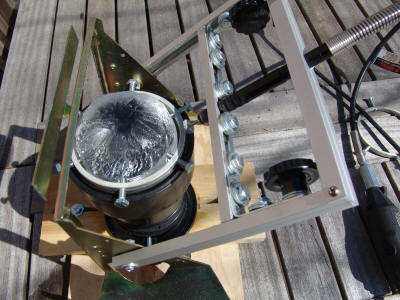
I love Rob Bicevskis' early jig:

RB3machine.jpg
 

BCUK Shop

We have a a number of knives, T-Shirts and other items for sale.

SHOP HERE