Making a Low Whistle

  • BushMoot: Come along to the amazing Summer Moot 31st July - 5th August (extended Moot : 27th July - 8th August), a festival of bushcrafting and camping in a beautiful woodland PLEASE CLICK HERE for more information.

William_Montgomery

Full Member
Dec 29, 2022
962
1,431
East Suffolk
I thought I'd have a crack at making a traditional low whistle this weekend, (a larger version of an Irish/tin whistle, but lower in tone).

I found a nice looking piece of spalted elder which seemed a good size for the project.
20250606_225758.jpg

First step was to hollow it out. Not having an auger, I used whatever was to hand. A modified carving fork, a skewer and some doweling wrapped in sand paper did the bulk of the work.
20250608_142906.jpg

Then make the fipple/blade. It looked all right at this point, unfortunately I was tempted to adjust it later on and ended up making the hole a bit too big.
20250607_112501.jpg
20250607_122929.jpg

Create a notch at the top for the air to travel down and carve and fit a dowel for the mouthpiece.
20250607_122955.jpg
20250607_171550.jpg

Once the mouthpiece is done and producing a decent tone, it needs to be tuned. Slowly remove material from the bottom until you hit the desired note. In this case F.
20250608_104713.jpg

Then place and tune the finger holes. Start from the bottom and widen each hole until you get what you're after. This one is tuned to F Major.
I positioned the holes as you would get on a flute.
20250607_200359.jpg

A final sand down and oil and it's good to go.
VideoCapture_20250607-214302.jpg

This was a first attempt. The sound isn't as clean as it could be and the walls are a bit thick. But it plays a tune and spans a couple of octaves. All in all, I'm pretty happy with how it turned out.
20250608_104522.jpg
20250608_104342.jpg
 
If you are getting two octaves you are doing very well.

The wall thickness may affect the tone but it won’t affect the fundamental note as long as the exit from the fipple is not restricting escape to outside pressure.

Looking at pic #5 I can see a whisker of swarf in the wind-way. That might be breaking up the flow to the blade.

Your upper notch is deeper than I would make but again it shouldn’t affect the production of a clean cycle. If in doubt and it matters enough AND if the block comes out easily try a thin piece of card tight in the notch. It’s not any sort of permanent fix but if it changes things for the better just for a few breaths then at least you have information.

It looks lovely.
 
  • Like
Reactions: William_Montgomery
Neat.
How do you decide on the finger hole positions?
I used a method for making flutes. Take a measurement from the sound hole (on top, where the blade is) to the bottom of the flute/whistle. With that as your overall measurement, you then work out percentages to place the finger holes.

The first percentage is the distance from the bottom of the flute to the centre of the first hole. Each percentage after that is the distance measured from the previous hole.

1st hole - 17.8%
2nd hole - 7.5%
3rd hole - 5.9%
4th hole - 9.8%
5th hole - 6.9%
6th hole - 6.9%

This is just how I did it, but I don't think it needs to be that precise. You could probably be fairly free with it.
 
  • Like
Reactions: GreyCat
That’s interesting.

I tend to space them evenly for each hand. The gap between hands of course isn’t critical for reach.

I haven’t made a ditonic (do, ray me fa so la te do) for quite a while. I used to make most of them from bamboo.

These days I make five hole flutes. They are either typically 1st Nation flutes (pipes) or a hybrid version that I’ve developed myself.
In either case the hole spacing is simple fractions of the fundamental (foot to back of window.). As you say, it’s not critical, you can always alter the size of the hole.

This was interesting

 
  • Like
Reactions: William_Montgomery
@forrestdweller
Take a look at the local instruments wherever you are.
Play your own music. Don’t try and play tunes you’ve heard before.
Play as if no one is listening - most of them aren’t most of the time anyway.
 
@forrestdweller
Take a look at the local instruments wherever you are.
Play your own music. Don’t try and play tunes you’ve heard before.
Play as if no one is listening - most of them aren’t most of the time anyway.
the only (indigenous) instrument of this area i know of is a whistle made from the seed of the "corazon de mono" vine (=literally "monkey heart" due to their shape)
to like the local music you have imho to be brain dead...
 
  • Like
Reactions: Pattree
I thought I'd have a crack at making a traditional low whistle this weekend, (a larger version of an Irish/tin whistle, but lower in tone).

I found a nice looking piece of spalted elder which seemed a good size for the project.
View attachment 95598

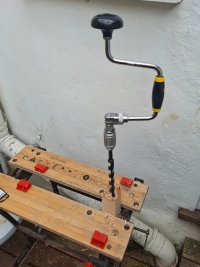
First step was to hollow it out. Not having an auger, I used whatever was to hand. A modified carving fork, a skewer and some doweling wrapped in sand paper did the bulk of the work.
View attachment 95599

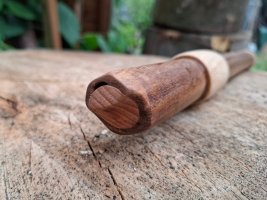
Then make the fipple/blade. It looked all right at this point, unfortunately I was tempted to adjust it later on and ended up making the hole a bit too big.
View attachment 95600
View attachment 95601

Create a notch at the top for the air to travel down and carve and fit a dowel for the mouthpiece.
View attachment 95603
View attachment 95602

Once the mouthpiece is done and producing a decent tone, it needs to be tuned. Slowly remove material from the bottom until you hit the desired note. In this case F.
View attachment 95604

Then place and tune the finger holes. Start from the bottom and widen each hole until you get what you're after. This one is tuned to F Major.
I positioned the holes as you would get on a flute.
View attachment 95605

A final sand down and oil and it's good to go.
View attachment 95608

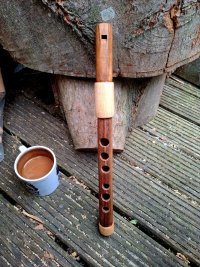
This was a first attempt. The sound isn't as clean as it could be and the walls are a bit thick. But it plays a tune and spans a couple of octaves. All in all, I'm pretty happy with how it turned out.
View attachment 95609
View attachment 95610
That all rather excellent and inspirational as I too have designs on the Elder production of some low Whistles through having already whetted my appetite on a plastic Dixon Low D and not just the tenors as there's some altos I'd like to try after finding delight in the tone of my Generation B flat.

But interesting on your hollowing method as I myself was wondering about augers and extending them to have also wondered about beating out a crude gimlet drill
 
  • Like
Reactions: William_Montgomery
That all rather excellent and inspirational as I too have designs on the Elder production of some low Whistles through having already whetted my appetite on a plastic Dixon Low D and not just the tenors as there's some altos I'd like to try after finding delight in the tone of my Generation B flat.

But interesting on your hollowing method as I myself was wondering about augers and extending them to have also wondered about beating out a crude gimlet drill
Nice. It'd be great to see what you make. If you could knock up a gimlet, that would make life a lot easier.

I picked up a 20mm auger and some timber to see what further results I could get. Ended up making this low G (not quite finished yet). Due to it's stocky nature, the finger holes are pretty large, but it sounds really nice. It's got a clarinet type quality to it.

20250622_143512.jpg
20250705_165702.jpg
20250705_165625.jpg
 
  • Like
Reactions: Silverclaws2
Oh wow, I see what you mean about the finger holes my fingers would fall in them, but again excellent, you're doing it for experimentation is the route to success.

Inspired also by your work bench thus reminding me I have one of contraptions that can be used in lieu of the workbench and vise I haven't got.
 
  • Like
Reactions: William_Montgomery
If your finger pads don’t cover the holes, try the Pipers grip. Cover the holes with the second joint of your fingers.

Any flute makers going to the Summer Moot?
 
  • Like
Reactions: William_Montgomery

BCUK Shop

We have a a number of knives, T-Shirts and other items for sale.

SHOP HERE