

Keela Ventile Heritage Smock long-term review
- Thread starter photonician
- Start date
-
The awesome MakerMoot is coming up (13-15th Nov 2026), Visit the TORM & ARM markets,and have space back at camp to work on projects and enjoy great company. PLEASE CLICK HERE for more information.
You are using an out of date browser. It may not display this or other websites correctly.
You should upgrade or use an alternative browser.
You should upgrade or use an alternative browser.


I was on the phone to Keela today after looking at the range and seeing the waxed cotton stuff that's won eco awards and is U.K. made. As I've been using the same Keela Falkland Advanced jacket for 15 years now I thought I'd see if they'd offer any loyalty discount on a waxed one as I don't want and can't really afford a Ventile.
They said they couldn't offer anything off UK made stuff but offered me 20% off anything else, including the Heritage smock as it's outsourced and made elsewhere.
Undecided on the waxed cotton, it's preferable to the Paramo material, seems to suit most shooters, farmers, gamekeepers, and many bikers. If the Keela stuff is anything like Barbour of old, then I might grab one.
They said they couldn't offer anything off UK made stuff but offered me 20% off anything else, including the Heritage smock as it's outsourced and made elsewhere.
Undecided on the waxed cotton, it's preferable to the Paramo material, seems to suit most shooters, farmers, gamekeepers, and many bikers. If the Keela stuff is anything like Barbour of old, then I might grab one.

I am still wearing mine, I have had to do some minor repairs to tears and the cuffs are now reinforced with suede but it is still as functional as it ever was.How is this holding up, for those of you still wearing this jacket?
It's been on my pondering list for a fair while now.
Best thing to do is ignore that and let it act like it was always supposed to, proofing it defeats the very object of ventile. It is the weave just as it was with gaberdine and tent canvas. The Keela smock has an artificial inner layer so you really should not worry about the outer, it is the best of both worlds. Apart from the Keela smock I have a waxed cotton drovers coat and I can't recall ever having rewaxed that. The point is you cannot have breathability and waterproof at the same time, it goes against nature. Everything is a compromise and to me goretex and it's imitators are the worst of all possible compromises, they have never worked for me.Yes, Hilltrek are correct, there is a DWR applied to Ventile (which is rebadged etaProof made by Stotz in Switzerland, has been for a long time now: https://ventile.co.uk/history-copy/). You will need to reproof it given time. The negatives of the old PFC DWRs being terrible for the environment did mean though that reproofing wasn't required nearly as often. It's the more recent PFC-free DWRs which lose their efficiency much more quickly and so need reapplying more frequently.

A mark of how good I think the Keela ventile smock is: I’ve just bought it again in the next size up. A few years ago I found one in XS at a crazy good price, so I bought it. I’m pretty small (5’8, 11 stone, 38 chest and 30 waist), so it fits me well but it’s tricky to get 2 chunky wool layers underneath it when it’s really chilly.
So, I’ve just bought an S as well, to see if that works to give me a little more room for layering.
So, I’ve just bought an S as well, to see if that works to give me a little more room for layering.
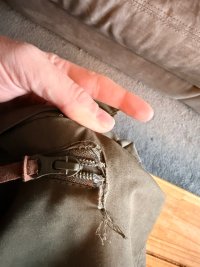
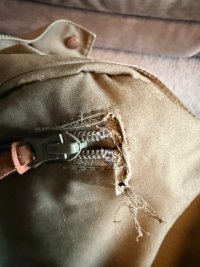
This has been a slight disappointment after less than 2 months of ownership.
Going to see what their warranty does about it.


Keela have agreed it is faulty and are going to replace it with a new one, as a repair wouldn’t look as good. Fair play to them.
Outdoor Action have been good to deal with and prompt to reply as well, so good on them too.
Outdoor Action have been good to deal with and prompt to reply as well, so good on them too.
Keela have agreed it is faulty and are going to replace it with a new one, as a repair wouldn’t look as good. Fair play to them.
Outdoor Action have been good to deal with and prompt to reply as well, so good on them too.
They're a great company to deal with. I phoned a couple of times during the day a while ago and was asking about the waxed jackets. Second time the person at the other end immediately said, "Ah yes, we chatted earlier didn't we?" Small company friendliness.

You are right in that it swells, but you may have got it wrong on the tightly spun part; ventile is actually extra long fibres with very little spin. Because the fibres are so much longer than 'standard' cotton fibres, they are strong with very little spin needed to make the yarn. It's that very low spin on the yarn that allows the yarn to swell so much when it wets.That's the entire point of it! It has to swell. You may as well get waxed cotton.
Longstaple cotton is high grade, long fine threads, spun so tight that when water gets on the cloth it swells and seals. Anything that prevents that happening is going to ruin a very expensive jacket.
It's then woven very tightly, and the swelling -as you correctly say- blocks further water from passing.
That swelling though also adds a lot of stiffness, which is the price to pay for the waterproof element.
But here's my gripe about this Keela Ventile with a waterproof/breathable liner: on warmer days or when I am working hard while wearing the jacket, the breathable liner works well at taking away the moisture vapour I produce. All well and good. However, when the vapour meets the Ventile outer, it condenses, prompting the cotton fibres to swell and impeding the progress of the vapour to the outside world.
Similarly, when it is raining, as it has done with monotonous regularity of late, the Ventile fibres swell, again impeding the flow of moisture vapour to the outside. In both situations, the 'breathability' of the smock is compromised markedly.
In both situations, the now-stiffened garment becomes uncomfortable to wear because of its stiffness and because it becomes a little like wearing a plastic bag.
My experience of this particular garment has shown me that, while it might suit a largely static wearer, the combination of Ventile + a waterproof/breathable liner simply does not work effectively and efficiently. Maybe a polycotton outer with a DWR finish would work better; it would certainly dry out more quickly!
Similarly, when it is raining, as it has done with monotonous regularity of late, the Ventile fibres swell, again impeding the flow of moisture vapour to the outside. In both situations, the 'breathability' of the smock is compromised markedly.
In both situations, the now-stiffened garment becomes uncomfortable to wear because of its stiffness and because it becomes a little like wearing a plastic bag.
My experience of this particular garment has shown me that, while it might suit a largely static wearer, the combination of Ventile + a waterproof/breathable liner simply does not work effectively and efficiently. Maybe a polycotton outer with a DWR finish would work better; it would certainly dry out more quickly!
I think you nailed the problems. Any 2-layer jacket, no matter of how 'breathable' the waterproof fabric is, will be too hot for anything but mostly static conditions. Add rain on the outside, and you are soon swimming in your own sweat.But here's my gripe about this Keela Ventile with a waterproof/breathable liner: on warmer days or when I am working hard while wearing the jacket, the breathable liner works well at taking away the moisture vapour I produce. All well and good. However, when the vapour meets the Ventile outer, it condenses, prompting the cotton fibres to swell and impeding the progress of the vapour to the outside world.
Similarly, when it is raining, as it has done with monotonous regularity of late, the Ventile fibres swell, again impeding the flow of moisture vapour to the outside. In both situations, the 'breathability' of the smock is compromised markedly.
In both situations, the now-stiffened garment becomes uncomfortable to wear because of its stiffness and because it becomes a little like wearing a plastic bag.
My experience of this particular garment has shown me that, while it might suit a largely static wearer, the combination of Ventile + a waterproof/breathable liner simply does not work effectively and efficiently. Maybe a polycotton outer with a DWR finish would work better; it would certainly dry out more quickly!
A single layer Ventile soon gets a bit uncomfortable, once it 'wets' and becomes stiff and cold-feeling. A two-layer one is more waterproof, but it's also less breathable and too hot for most occasions on the move.
Nothing beats something like the goretex-like laminates on that front; the only reason you might want Ventile is that it's not plastic, it won't end up with very expensive burn-holes next to a fire, it doesn't delaminate, it repairs pretty easily... and the list goes on
 Personally, I am a big fan of Ventile, but I have settled on having two identical smocks in single-layer. They are a lot easier to dry, you can layer with one or both, you can have them in two different shades and layer on the outside what's most appropriate, and if one gets damaged or looks pretty tattered after lots of use it doesn't matter too much as you can wear it on the inside when you need both.
On the inside, I use layers of merino baselayer, wool shirt, loden smock. I will usually layer these as required when on the move (on the move, I'll usually actually be just on the baselayer or at most adding the shirt for most conditions), only putting the ventile on if it's breezy and cold or it's raining cats and dogs.
The two-layer smocks -Ventile or otherwise- are probably too much for anything but static or very heavy winter.
Similar threads

- Replies
- 2
- Views
- 251

- Replies
- 11
- Views
- 501

- Replies
- 7
- Views
- 368

