Emergency Bleed Kit

  • BushMoot: Come along to the amazing Summer Moot 31st July - 5th August (extended Moot : 27th July - 8th August), a festival of bushcrafting and camping in a beautiful woodland PLEASE CLICK HERE for more information.

Stew

Bushcrafter through and through
Nov 29, 2003
7,112
1,885
Aylesbury
stewartjlight-knives.com
Along with a few others, I've been tasked with looking into an emergency bleed kit for the workplace.

Realistically it's to offset against the possible risk of stabbings and is something that was seen in a tv fly on the wall series (I don't know which one). Hopefully it's never to be used.

I'm slightly wary as I worry if it goes too specialist then does it limit usage and also mindset. Pressure on it's own goes a long way. I'm assuming that there would likely be a quickclot type product in there and I'm sure it's come a long way but I do recall some years ago it being said that pressure is still good. However, we'll be buying something.

So anyway, I know there are some great minds here that know lots.

What do I need to know? What should I avoid? What should I prioritise? Is there any particular ready made kit that is the right answer? Do people need specialist training?
 
  • Like
Reactions: Toddy
OLAES bandages (plenty of)
Haemostatic z fold gauze (some of)
Standard z fold packing gauze (plenty of)
Chest seals
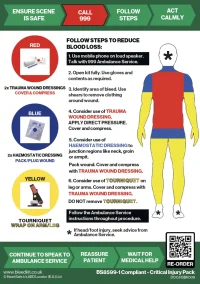
CAT (tourniquets, do not cheap out on these) (minimum of 2)
Nitrile gloves

Most importantly: Training on how to use it all. You need to pack a wound as well as applying pressure on it. Haemostatic gauze can stop arterial bleeds quite effectively, but I don't think most people would realise just how much you have to pack into a wound, and how much the injured person isn't going to enjoy that. Tourniquets require training, as do chest seals, but managing traumatic bleeds is also well worth training on as I think a lot of people get their idea of bleed management from TV, where you place a bandage over the external wound, hold your hand down on it and then the person's back to rollerblading the next day.

These days people are far more likely to die of a cardiac event or something, the chance of a stabbing or shooting is quite unlikely for most of us so whilst it's good to have a kit around and trained people, there should be some risk assessment done when it comes to prioritising the kit bought for a workplace. For a standard office workplace I'd probably prioritise a defib and aspirin, for example.
 
These days people are far more likely to die of a cardiac event or something, the chance of a stabbing or shooting is quite unlikely for most of us so whilst it's good to have a kit around and trained people, there should be some risk assessment done when it comes to prioritising the kit bought for a workplace. For a standard office workplace I'd probably prioritise a defib and aspirin, for example.

It's not an either or situation here.

We have a defib and pain med already. We change and add to what we have from learnings - I've just bought shelter kit after having someone laying waiting for assistance on cold wet ground for a number of hours with rain on it's way then again because of someone injured and knocked into a ditch. For this one it's probably worth not waiting for the learning case.

Thanks for the other bits. I'll have a look.
 
  • Like
Reactions: Falstaff and Chris
One of the F.A. courses I did was kind of specialised. The Instructor said that there were massive differences in appropriate reponses depending on the site/situation.

In a school ? or in a jungle ? or warzone ?

At the end of the day, make sure they're breathing or being breathed for, and stop any bleeding.....and in suburbia, that means just binding it tightly enough (so long as it's not the throat when you have to protect as well as pressure agin the wound) to keep enough blood inside the person until an ambulance gets to you...which in the case of a knife wound and presumably police involvment would be pdq.

I think it's definitely a keep it simple scenario.

Perhaps the relevant kit might be something like one intended for workshops, like joiners, or glaziers, or even mechanics ?

I thought about the Arco kits we had in the boatyard years ago, so I went looking for what they had now.
They have PAcT kits.
These are

"Public access trauma kits (PAcTs) are designed by counter-terrorism police and trauma specialists for venues where members of the public are present. Facilitating access to one of these kits could save lives if the worst was to happen, as it allows users to stop blood loss and aid in stabilising wounds. This cabinet is designed to hold PAcT kits, ensuring they are safe and easy to find."

Perhaps suitable for your situation ?
 
  • Like
Reactions: GreyCat
OLAES bandages (plenty of)
Haemostatic z fold gauze (some of)
Standard z fold packing gauze (plenty of)
Chest seals
CAT (tourniquets, do not cheap out on these) (minimum of 2)
Nitrile gloves

Most importantly: Training on how to use it all. You need to pack a wound as well as applying pressure on it. Haemostatic gauze can stop arterial bleeds quite effectively, but I don't think most people would realise just how much you have to pack into a wound, and how much the injured person isn't going to enjoy that. Tourniquets require training, as do chest seals, but managing traumatic bleeds is also well worth training on as I think a lot of people get their idea of bleed management from TV, where you place a bandage over the external wound, hold your hand down on it and then the person's back to rollerblading the next day.

These days people are far more likely to die of a cardiac event or something, the chance of a stabbing or shooting is quite unlikely for most of us so whilst it's good to have a kit around and trained people, there should be some risk assessment done when it comes to prioritising the kit bought for a workplace. For a standard office workplace I'd probably prioritise a defib and aspirin, for example.
The ones we have at work are pretty much what @Chris has said, with the addition of some blast bandages. some T4 and T6 dressings are pretty useful as are vented and non vented chest seals. probably worth having a ten second triage aide memoir/tally and smart tags. along with training and continual exercising.
 
  • Like
Reactions: Toddy
Funnily enough, my stepdaughter who lives in a large city contacted me after the train incident in a bit of a fluster and was asking me how she could be prepared for such an incident, or something similar. I suggested, as she is a nurse, she should always carry a severe bleed kit with her, provide one to be carried by each of her family at all times, and train them in its use.
Contents I've suggested so far.
At least one Israeli bandage.
Tourniquet,
haemostasic gauze,
note book pen and sharpie, chest sealer for stab wounds in chest to stop collapsed lungs
.extra gauze and bandages.
Gloves .
Emergency blanket
Have I missed anything?
 
Last edited:
Funnily enough, my stepdaughter who lives in a large city contacted me after the train incident in a bit of a fluster and was asking me how she could be prepared for such an incident, or something similar. I suggested, as she is a nurse, she should always carry a severe bleed kit with her, provide one to be carried by each of her family at all times, and train them in its use.
Contents I've suggested so far.
At least one Israeli bandage.
Tourniquet,
haemostasic gauze,
note book pen and sharpie, chest sealer for stab wounds in chest to stop collapsed lungs
.extra gauze and bandages.
Gloves .
Emergency blanket
Have I missed anything?
May I respectfully suggest you read the Resuscitation Council UK (RCUK) on treating an open chest wound.
 
May I respectfully suggest you read the Resuscitation Council UK (RCUK) on treating an open chest wound.
Thank you, I will for myself as my fa qualifications are well out of date, but I'm sure that L has the knowledge due to her profession. As I said, she is a nurse,, but I will check with her.
More about have I forgotten anything to put in a small kit to carry around daily.
 
  • Like
Reactions: Pupers
Trauma shears are cheap and worth having. I'd also suggest looking at OLAES bandages as an upgrade to the Israeli bandages. They add a level of versatility, worth having a read up on them. :)
Thanks. I'm not sure why she should ask me such a question given her profession, maybe it's a subtle hint to me. :)
She knows I hate to be fussed over too much.
I had forgotten trauma shears.
Olaes bandages I've not heard of so will look into that. Cheers.
 
Funnily enough, my stepdaughter who lives in a large city contacted me after the train incident in a bit of a fluster and was asking me how she could be prepared for such an incident, or something similar.

I suggested, as she is a nurse, she should always carry a severe bleed kit with her, provide one to be carried by each of her family at all times, and train them in its use.
Contents I've suggested so far.
At least one Israeli bandage.
Tourniquet,
haemostasic gauze,
note book pen and sharpie, chest sealer for stab wounds in chest to stop collapsed lungs
.extra gauze and bandages.
Gloves .
Emergency blanket
Have I missed anything?
Thanks. I'm not sure why she should ask me such a question given her profession, maybe it's a subtle hint to me. :)
She knows I hate to be fussed over too much.
I had forgotten trauma shears.
Olaes bandages I've not heard of so will look into that. Cheers.

I don't know much about the hierarchy of Nursing and the relevant training but do they actually get taught a level of first responder first aid skills??

I'm sure you'd acquire them with a stint or two on an emergency ward but as standard?? maybe / maybe not.

Never looked into Nursing as I felt it would be a waste of my people skills. < jk >
 
I think probably the best thing I could do in such a situation is not interfere with anyone who knows what they are doing and be willing to take instructions.
 
  • Like
Reactions: Falstaff
I don't know much about the hierarchy of Nursing and the relevant training but do they actually get taught a level of first responder first aid skills??

I'm sure you'd acquire them with a stint or two on an emergency ward but as standard?? maybe / maybe not.

Never looked into Nursing as I felt it would be a waste of my people skills. < jk >
Absolutely no idea. I'd have assumed some sort of trauma instruction, but I havnt realy spoken to her about her training.
I'm thinking with today's atmosphere and the two explosions today(barely reported in msm,) and the possibility of xmas disruption by a certain group of people, it might be a good, and practical idea to carry a basic kit anyway in case it's needed by those who know how to deal with things, but don't have the nessasary items on them. Especially if living in a large town or travelling by public transport. Be prepared etc, and pray it never needs use.
 
There is a charity , no affiliation, the Daniel Baird Foundation that have a bleed kit for public access or personal use. It's £85 and may cover what you are looking for.

Cheers
JFW
Now that is valuable info and a great idea. A great charity to get behind, and purchase a kit for oneself or your workplace or community.. maybe all three!
Thank you.
 
I was listening to the wireless, I think towards the end of last week; the mother of a young teenage who was stabbed in school was interviewed about a charity that she started to fund bleed kits and training in secondary schools.

From what I remember hearing, the training is every bit as important as the availability of the kit.
 
Last edited:

BCUK Shop

We have a a number of knives, T-Shirts and other items for sale.

SHOP HERE