
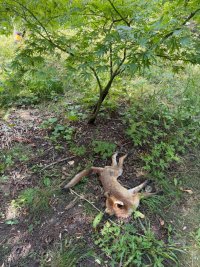
What might have killed this fox cub?

  • BushMoot: Come along to the amazing Summer Moot 31st July - 5th August (extended Moot : 27th July - 8th August), a festival of bushcrafting and camping in a beautiful woodland PLEASE CLICK HERE for more information.

C_Claycomb

Moderator staff
Mod
Oct 6, 2003
8,205
3,471
Bedfordshire
My mum volunteers in an arboretum attached to a school, just round from where she lives. The area is surrounded by private homes, separated by a tall fence, and bordered by school playing fields, also fenced from surrounding area. There are no dog walkers, and we have never had a dog get into the arboretum, that we know of, and no other random access. Gated access through the school.

There have been badgers, but have not seen sign lately (their rooting is usually obvious on the paths). It being school land,

The other day, one of the volunteers found this cub dead. Foxes have raised litters in the arboretum for a number of years, but never seen anything like this before. Mum mentioned that the day before, there was a right to do with crows and magpies shouting in the spinney that borders the arboretum behind her house…wondered if it was connected.

I have heard foxes do sometimes kill cubs, but this one seems rather big. Could it be a food shortage? Lack of rain, lack of worms?
253035d7-8845-4f1e-8f19-bf7c8cf1b9d9.jpeg
 
Agree with @FIU that positioning of the neck is not natural. I have had to break a foxes neck before and it was not an easy task, compared to rabbits.

Where I have seen dogs kill a fox, the body was a bit for roughed up, and you could tell that a dog had done it. If the body is still there put some gloves on and examine for puncture wounds and feel for an breaks....it is quite obvious.

@Macaroon said, is more likely cause, as animals tend to thrash, convulse, and die in rigid, unnatural postures, such as an arched back or thrown-back head when dying from poisons that typically attack the nervous system.

When thinking about pesticides, it could be any of these, but not limited to the following: Strychnine, Bromethalin, Organophosphate, Carbamate.

But also can be naturally occurring toxins: Tetanus (Clostridium tetani) or Plant Toxins, particularly alkaloid-rich plants like Brunfelsia ornamental garden plants. The strange part is that local wildlife tend to know what to eat and what not too, so this doesn't fit well.

....on that note, there are so many toxic plants around us, and I have a real issue with my children's local school not listening to me about plants in there grounds...so might be worth having a botanist walk the area?

Either way, I would be concerned as it is near a school, and I would isolate the body, and even ring a Vet for advice.
 
  • Like
Reactions: FIU
Did you examine it Chris? If there was a ruckus, it may well have been a badger. But the positioning of the cub looks more like it was tossed there rather than died in battle. If there was a road nearby, that's exactly what I'd assume.

As an afterthought, nothing makes crows and magpies clamour more than a large bird of prey doing the rounds. Wonder if your fox was mobbed and a buzzard or kite dropped his dinner?
 
Last edited:
  • Like
Reactions: FIU and Toddy
More info.
I live too far away to have examined the body, and nor has my mum, just got the photo taken by the other volunteer.
The body was on an “island” on the site, surrounded by a moat, in the centre of the site. There is a wooden bridge, but even if the moat is dry (it dries out through summer) it is still steep and an odd place to go if the fox was not feeling well.

After suggestions of poison, mum says she reckons one of the homes bordering the site has deployed rat poison, having found two rats stretched out near the boundary. Her theory is that the fox was poisoned, directly or indirectly, and the person putting down poison found it and moved it, throwing it onto the island so as to avoid suspicion.

@FIU
Doubt it was intentional poisoning, but if someone wants to be rid of foxes, then they may try using poison. The UK has a lot of urban foxes, they steal pet food, food in trash, leave piles of crap in regular places, and of course threaten pet poultry. Early this year the local foxes took to using my parents’ lawn as a latrine, every night, multiple piles, from firm to porridge. They seem to have mostly changed habit now, with only one pile occasionally, but it was nasty for a while. Folk in the UK rarely have guns, and cannot shoot in gardens even if they do, live traps are expensive and bulky to store and you still need to do something with the animal…so some are likely to think poison is the answer.
 
More info.
I live too far away to have examined the body, and nor has my mum, just got the photo taken by the other volunteer.
The body was on an “island” on the site, surrounded by a moat, in the centre of the site. There is a wooden bridge, but even if the moat is dry (it dries out through summer) it is still steep and an odd place to go if the fox was not feeling well.

After suggestions of poison, mum says she reckons one of the homes bordering the site has deployed rat poison, having found two rats stretched out near the boundary. Her theory is that the fox was poisoned, directly or indirectly, and the person putting down poison found it and moved it, throwing it onto the island so as to avoid suspicion.

@FIU
Doubt it was intentional poisoning, but if someone wants to be rid of foxes, then they may try using poison. The UK has a lot of urban foxes, they steal pet food, food in trash, leave piles of crap in regular places, and of course threaten pet poultry. Early this year the local foxes took to using my parents’ lawn as a latrine, every night, multiple piles, from firm to porridge. They seem to have mostly changed habit now, with only one pile occasionally, but it was nasty for a while. Folk in the UK rarely have guns, and cannot shoot in gardens even if they do, live traps are expensive and bulky to store and you still need to do something with the animal…so some are likely to think poison is the answer.
This is why I very much dislike undirected force, like just putting rat poison out to kills rats and everything else in the neighborhood. This is like some sort of urban minefield. What happens when a child gets ahold of that poison? I am sure the UK has the locked poison traps that look like plastic cubes. Only rodents can enter. Even these, I am not crazy about. What happens when a rat dies from the poison and a secondary animal, like a fox, eats the poisonous corpse of the dead rodent? That may well have happened here. I also think that if a person is going to keep animals outside it is incumbent on that person to secure those animals from the native animals that see cats, rabbits, chickens, guinea, etc as food. Chicken wire/fencing exists for a reason. I am not opposed to hunting foxes under very controlled circumstances but poisoning is something that I oppose.
 
Last edited:
I suspect that you have not suffered a major rat infestation.
No, not in years. The one bonus of the invasive Python are that rodents are scarce. We also limit outdoor food and water sources so rodents are not even interested in our place. Last, we do have cats. On rare occasions the cats will leave a rat head on the entrance to the house, like that scene from the Godfather movie. I suspect those rodents are coming from neighboring houses where they like to have fiestas and eat taquitos outside. Dropped food, even crumbs, will attract rodents. Still, I reckon rodent are inevitable, but indiscriminately poisoning every animal in the area is no answer.
 
  • Like
Reactions: Nice65
If you really want to have your mind blown, look up the use of 1080 poison in New Zealand. They deploy that stuff from the air over wide areas!

Anyway, thanks everyone for all the advice!!!
 
Last edited:
  • Like
Reactions: FIU

BCUK Shop

We have a a number of knives, T-Shirts and other items for sale.

SHOP HERE