Chris's trying out leatherwork thread

  • BushMoot: Come along to the amazing Summer Moot 31st July - 5th August (extended Moot : 27th July - 8th August), a festival of bushcrafting and camping in a beautiful woodland PLEASE CLICK HERE for more information.

Chris

Life Member
Staff member
Sep 20, 2022
3,062
4,431
Somerset, Yorkshire, Lincolnshire
Thought I'd document some of the progress/failures/challenges in one thread in case it's helpful for anyone else, plus I always get useful advice from the BCUK Megabrain.


Project #1 - Skrama 80 knife sheath​


Thank you to Broch for so kindly donating me my first piece of leather and some needles with which to (hopefully) sew it all together.

Step one - Drawing up the pattern
I drew this up on some standard crafting card. I found it helpful to Blu Tack the handle of the knife and a (thicker) blob on the end of the blade as well, stopped it sliding around as I drew the outline. The thicker bit at the blade-end is to stop the knief 'see-sawing' as I adjusted pressure on it, as this messed with the angle of the pencil as I was drawing.

I measured approx 0.5 inches from the centre of the card and then rested the spine of the handle/blade close up against that, leaving enough room at the bottom of the card for the welt and at the top of the card for the belt loop.

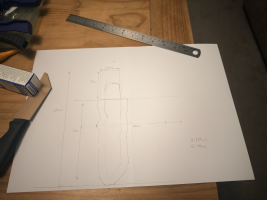
First draft was this:
1761571640344.png

Here I made the mistake of following the drawing of the welt up the spine of the blade rather than terminating it at the central fold. Still, this was accurate enough to know roughly what sized piece of leather I'd need.

I ended up redrawing this about 5 or 6 times. Each time I'd get as far as cutting it out of card and realise I needed to adjust. I surpressed the temptation to just go "Ah, sod it" and try to correct it on the leather. Measure twice, cut once. Or in this case, measure 5 or 6 times and cut once. I'm glad that Past Me made the sensible choice.

One of the additions I made to the pattern was tracing a line approx 1mm around the edge of the blade to give enough space for the blade and the welt in the sheath.
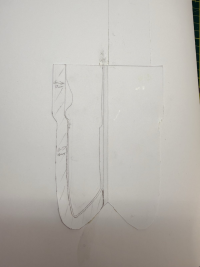
1761571972348.png

Once I was happy with the pattern, I folded the card in half and Stanley Knifed that sucker out. It's worth at this point keeping in mind which side of the sheath the belt loop needs to be on once the sheath has been folded with the rough side facing inwards.


Step 2 - Cutting the leather
My new best chum Blu Tack came back into the mix here, just a few tiny dots to hold the card steady on the leather as I drew around it. I know some people use a scratch awl, or poke little holes around with a scratch awl, but I went for a ballpoint pen. Did the trick nicely - pencil wasn't the right tool for this.

Important note: Make sure you have enough leather in your offcuts to cut out the welt! Don't chop it all into tiny pieces.
I used a rotary cutter to get the rough cut done, then a stanley knife to do the finer edges. Same gig for the welt as for the main sheath.

As of 27/10/2025 at 1337hrs, that is where I currently am.
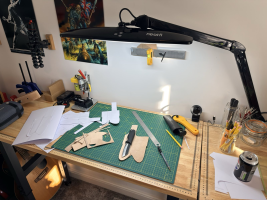
1761572302386.png

My next job is (I think) to oil the leather, leave that for a bit and then stain the leather.
 
Last edited:
I thought the plan was to wet-form the sheath. That has to be done (or ideally should be done) before oiling the leather.

Bare in mind oiling (as opposed to waxing) will make the leather soft.

If you are wet forming, here's one of many 'how to' tutorials - note the comment about fingernails - cut them short or use thin gloves. You'd be surprised how many people proudly show off their wet-formed sheath covered in fingernail indents (even on YouTube tutorial videos)!
 
  • Like
Reactions: Toddy and Chris
I thought the plan was to wet-form the sheath. That has to be done (or ideally should be done) before oiling the leather.

Bare in mind oiling (as opposed to waxing) will make the leather soft.

If you are wet forming, here's one of many 'how to' tutorials - note the comment about fingernails - cut them short or use thin gloves. You'd be surprised how many people proudly show off their wet-formed sheath covered in fingernail indents (even on YouTube tutorial videos)!

The Internet has told me that I should be oiling the leather both pre and post stain, and the wet forming should be done after the staining - is this Fake News?

Would the alternative be to skip the pre-stain oil, stain it, then wet form (once sewn together) and oil (or wax) at the end of the process?
 
OK, not a concept I have ever come across to be honest. I never oil any of my leather products. I use a mix of bee's wax and food-safe mineral oil but at a fairly 'hard' mix (think shoe polish). If I'm wet forming I do it before applying any leather treatment at all - i.e. bare veg tanned leather.

I do know that some people have successfully wet-formed sheaths supplied with knives so, presumably, it is a process that works to some extent.

Sorry, I didn't include the link!!

Here's a general wet-forming tutorial - this follows the process I use:

and here's a specific knife one (not brilliant but the process is correct):
 
  • Like
Reactions: bobnewboy and Chris
OK, not a concept I have ever come across to be honest. I never oil any of my leather products. I use a mix of bee's wax and food-safe mineral oil but at a fairly 'hard' mix (think shoe polish). If I'm wet forming I do it before applying any leather treatment at all - i.e. bare veg tanned leather.

I do know that some people have successfully wet-formed sheaths supplied with knives so, presumably, it is a process that works to some extent.

Sorry, I didn't include the link!!

Here's a general wet-forming tutorial - this follows the process I use:

and here's a specific knife one (not brilliant but the process is correct):

Thanks for the links, they're useful.

It does seem that it's OK to do this post-dye though, with a good few videos doing it this way, so I think I'll dye -> sew -> wet mould -> oil/beeswax balm.
 
I form the leather before oiling and dying. My concern being, if you were to form it after dying, the colour may leach during soaking and also become less uniform on the parts of the leather that are being stretched (formed). Saying that, people seem to do it the other way with good results. It's one of those subjects where everybody has a different answer and way of doing things.

I tend not to dye them much nowadays, as I really like the natural colour of oiled veg tan leather on a knife sheath.

Good job. Look forward to seeing the finished sheath when it's done.
 
  • Like
Reactions: Chris
Some heresy perhaps but I don't like wet forming, maybe just me but I've never got it to grip as well as a nice tight sheath... It may depend on the shape of the knife handle, looks like you have a sort of finger guard that may help grip once you get over the wet formed hump, I've never had much joy with standard bushy coke bottle handles or pukkos or boat knives, too smooth an exit?

I always thought you form before dying and oiling too.

Looking good!
 
  • Like
Reactions: Stew and Chris
It's really interesting that the forum is unanimously for forming the sheath pre-dying and YouTube's suggested me videos where they seem to do it post-dying. I wonder if there's a geographical divergence in skillsets somewhere?

I am minded to trust the opinions on here more than elsewhere, though I have unfortunately already dyed the leather as I'm referencing a video for the style of sheath I want, so will see how it goes. It will be a useful experiment regardless, I am sure. Next time I can try the BCUK recommended way.
 
Thought I'd document some of the progress/failures/challenges in one thread in case it's helpful for anyone else, plus I always get useful advice from the BCUK Megabrain.

Thank you to Broch for so kindly donating me my first piece of leather and some needles with which to (hopefully) sew it all together.

Step one - Drawing up the pattern
I drew this up on some standard crafting card. I found it helpful to Blu Tack the handle of the knife and a (thicker) blob on the end of the blade as well, stopped it sliding around as I drew the outline. The thicker bit at the blade-end is to stop the knief 'see-sawing' as I adjusted pressure on it, as this messed with the angle of the pencil as I was drawing.

I measured approx 0.5 inches from the centre of the card and then rested the spine of the handle/blade close up against that, leaving enough room at the bottom of the card for the welt and at the top of the card for the belt loop.

First draft was this:

View attachment 98626

Here I made the mistake of following the drawing of the welt up the spine of the blade rather than terminating it at the central fold. Still, this was accurate enough to know roughly what sized piece of leather I'd need.

I ended up redrawing this about 5 or 6 times. Each time I'd get as far as cutting it out of card and realise I needed to adjust. I surpressed the temptation to just go "Ah, sod it" and try to correct it on the leather. Measure twice, cut once. Or in this case, measure 5 or 6 times and cut once. I'm glad that Past Me made the sensible choice.

One of the additions I made to the pattern was tracing a line approx 1mm around the edge of the blade to give enough space for the blade and the welt in the sheath.

View attachment 98628

Once I was happy with the pattern, I folded the card in half and Stanley Knifed that sucker out. It's worth at this point keeping in mind which side of the sheath the belt loop needs to be on once the sheath has been folded with the rough side facing inwards.


Step 2 - Cutting the leather
My new best chum Blu Tack came back into the mix here, just a few tiny dots to hold the card steady on the leather as I drew around it. I know some people use a scratch awl, or poke little holes around with a scratch awl, but I went for a ballpoint pen. Did the trick nicely - pencil wasn't the right tool for this.

Important note: Make sure you have enough leather in your offcuts to cut out the welt! Don't chop it all into tiny pieces.
I used a rotary cutter to get the rough cut done, then a stanley knife to do the finer edges. Same gig for the welt as for the main sheath.

As of 27/10/2025 at 1337hrs, that is where I currently am.

View attachment 98629

My next job is (I think) to oil the leather, leave that for a bit and then stain the leather.
Don't oil before staining. Dye absorbs into the leather. Oil stops that. Oil after.
 
The Internet has told me that I should be oiling the leather both pre and post stain, and the wet forming should be done after the staining - is this Fake News?

Would the alternative be to skip the pre-stain oil, stain it, then wet form (once sewn together) and oil (or wax) at the end of the process?
Dont wet form. While it looks nice and can hold the knife in place, it wont do for long. As you'll constantly be stretching the leather a little every time you either put the knife in the sheath, or remove it from it. It'll just end up rattling about after a while. A good friction fit is a better longer term option.. (from experience)
 
Well, here’s a strong vote for wet-forming. I always do it with my sheaths - as an instructor, I often have my knife in and out of my hand, and I need to be able to relocate my knife back into its sheath quickly and without looking. If you get the wet forming right, it almost acts as a suction - a deeply satisfying plonk as it lands back in its customised space.

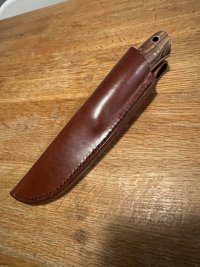
Here’s a sheath I made a little while ago. I wetformed after the dyeing and oiling, I think it’s fine either way.

1761646540767.jpeg
 
Well, here’s a strong vote for wet-forming. I always do it with my sheaths - as an instructor, I often have my knife in and out of my hand, and I need to be able to relocate my knife back into its sheath quickly and without looking. If you get the wet forming right, it almost acts as a suction - a deeply satisfying plonk as it lands back in its customised space.

Here’s a sheath I made a little while ago. I wetformed after the dyeing and oiling, I think it’s fine either way.

View attachment 98671

Looks great! I do enjoy a wet formed sheath, I’ve got several knives with them already so am sure it’s something I want to do. No issues with any of them, as you said the knife gives a nice solid ‘thunk’ as it fits back in.
 
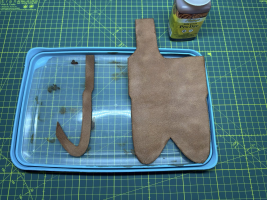
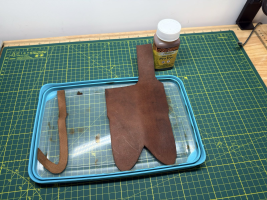
Been away for a few days, but this is how the dye has turned out. Not a hugely consistent job, I know, although I also do not mind a bit of a 'rough and ready' look to it.

Only did one pass on the rough side (and both sides of the welt), I just didn't want it to be too pale.

Outside I did 4 passes, alternating directions left and right to up and down to try and get an even overlap.

I didn't get any drips on there, so I think some of the unevenness is probably down to residue that may have been on the surface of the leather like skin oils from handling and I don't know... maybe some Blu Tack if some idiot used any on the shiny side? We can never know.

Dye used is Fiebings Pro Dye, colour Dark Brown. I still need to oil/wax/whatever I decide to do at the end, so I know that'll change things slightly.

Thought some 'before' pics might be useful to see if the wet moulding has a noticeable impact.

1761924704999.png
1761924712905.png
 

BCUK Shop

We have a a number of knives, T-Shirts and other items for sale.

SHOP HERE