Best books for .....

  • BushMoot: Come along to the amazing Summer Moot 31st July - 5th August (extended Moot : 27th July - 8th August), a festival of bushcrafting and camping in a beautiful woodland PLEASE CLICK HERE for more information.

Toddy

Mod
Mod
Jan 21, 2005
40,440
6,427
S. Lanarkshire
I know the modern affliction of being permanently attached to one's phone has become commonplace, but honestly, I prefer a book.

However, my bookshelves are groaning, and I'm thinking it's time for a clear out. Instead of ten books on birds, three on insects, dozens on plants, that I'd really like almost an encyclopedia of British/European wildlife. A decent one on insects, that's not just all butterflies and moths but shows loads of those wee insects we actually find in the garden and woodland floors, moors, etc., the different flies and bees too.
I'd like one just for food additives, vitamins, minerals, etc., not the eight I presently have.....and I don't know where to start on mushrooms (presently seven of.....or the craft books.

So, any recommendations ? any book that you really, really rate ? Some of mine are old friends, but some just don't carry enough info to be worth hanging onto if I can find one that does the work of four or five of them.

M
 
If it's wild food recipes coupled with excellent photography you're after, a book I keep getting through constantly losing my copy to folks borrowing and not returning is ' wild food ' by Roger Phillips
 
  • Like
Reactions: Toddy
I know exactly what you mean; I have multiple books on every natural history subject matter you can think of. However, I do find that even the best of them do not necessarily give me a complete picture. Take birds for example: the RSPB/DK one is fantastic, good photos, and excellent nesting, feeding, and size data, but the distribution maps are dreadfully out of date. The (relatively) new Wild Guides 'Britain's Birds' has great photos and up to date distribution maps but very little of the feeding and nesting data. It's the same with the fungi and plant books - not one book satisfies all my needs :(

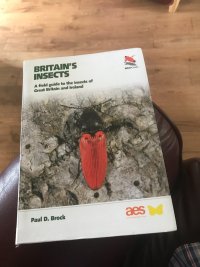
On insects however, it is very difficult. With around 20,000 species of insect in the UK, no one book is going to cover them all - the best single volume I have found is the Wild Guides Britain's Insects; they do separate books for hoverflies, moths, butterflies, and dragonflies too.
 
  • Like
Reactions: Toddy
I have an old copy of the Reader's Digest book of British Trees and shrubs....it's very good, very clear, easy to find by leaf, twig, seed, etc.,
I'm keeping that one :)

I'm also keeping the RHS encyclopedia of plants and flowers, and the one on herbs.

Heathland Harvest is a good read as well as being informative.
 
I don’t use hard copy references any more. Everything is changing (it always was.)

You mention the RHS Encyclopaedia of trees and shrubs. I have the 1970’s edition from my studying days. Many of the varieties are now obsolete.
While it mentions Dutch Elm disease it does not mention Ash decline or Horse Chestnut leaf necrosis.

My phone gives me every reference I could ever want.

Oh I have loads of reference books but they are old friends rather than useful.
 
  • Like
Reactions: Toddy
No, I don't want to use the phone. I accept they are useful, but so few ever go further than the information offered on a plate. I do follow references, I like to know where the information came from....and yes, I do pay heed to the publication dates :)

Surprising how often forgotten cultivars turn up. Where I live used to be Scotland's orchard valley. There are remnants tucked away in gardens all over the county.

Any recommendations for a decent insect book ? not one based only on butterflies and moths, but some of the more usual soil living ones. There is a beautiful bright shiny green beetle in our garden just now. It's almost gem like, and I can't find it at all, not even online. There's also a biting weevil, a wee black thing with a long snout, likes to infest the raspberries. We call it a berry bug, but what is it really ? and I'd like more on bees. We have a lot of bees :)
 
Online sources often have a limited lifespan.

How many websites will be here in 10 years? 5 Years?

Tengu the stray Archivist.
 
  • Like
Reactions: Toddy
Not sure Tengu, I'll log on to AOL, maybe Ask Jeeves will take me to a relevant Yahoo Geocities page, and I can share the results on Friends Reunited/Bebo/Myspace? ;)

As the internet gets more watered down with regurgitated computer generated content, I can easily see finding useful information becoming difficult, we may well be at the peak of the internet's usefulness. Enough of that though, it's been discussed a lot in other threads, but I'll be hanging on to-and expanding- my books.

As mentioned by Toddy, the old Reader's Digests books are a great reference, even if out of date regards distribution. I'll be keeping mine even as more modern versions with better photography come along...

Nothing beats a good invertebrate, expecially small iridescent beetles. Or a lacewing. Or an earthworm. Or a cuttlefish. Know what? I'm going to take 10 minutes off and go and look for interesting inverts.
 
  • Love
  • Like
Reactions: Pattree and Toddy
I wonder if it the same as the shiny metallic beetles that I see in clusters on the rosemary bush?

I had a quick look, and the Tansy beetle looks like a close match.

That really looks like it :) and funnily enough I have both Tansy and Gyspywort, and four Rosemarys, growing in the garden....and we're wet here, heavy clay soil with a burn running not 20m away from them :)
 
Sorry, but it's highly unlikely to be Tansy Beetle (Chrysolina graminis) where you are Toddy - it's very restricted in distribution in the UK. Well, if you have got it you should let people know.

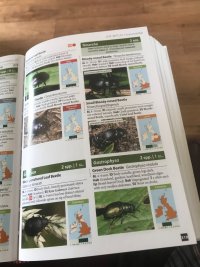
More likely is the Green Dock Beetle (Gastrophysa viridula) - though there are others similarly coloured.

This is the insect book I use (the best non-specialist insect book I have found) and the page with Green Dock Beetle on it. This book covers 1,653 species and, yes, unfortunately that includes moths and butterflies but they do not dominate the book. It has extensive coverage of bees and wasps (there are 7,760 species of Hymenoptera - ants, bees and wasps in the UK).

2025-08-08 13.11.37.jpg

2025-08-08 13.11.52.jpg
 
I noted just how restricted it could be, but where we live...the village is situated on a long teardrop shaped rise out of the valley floor, the river loops around us, and our climate is very mild, even for the warmth of the upper Clyde valley, we're mild, and damp.
The cold falls away from us down to the river, usually. If it does set in, it sets in really hard, really cold, but that's rare, especially these days.

So, if anywhere this far north was likely to harbour a population of these beetles, it wouldn't surprise anyone that it was here. The biodiversity on our doorsteps is wonderful :)

I will keep my eyes open and see if I can catch sight of one of them, and if I can get a photo too.

Thank you for the recommendation on the book; that looks interesting enough to want a copy :D
 
I can find no records at all North of Leeds area. If you do have it the Coleopterists Society of Britain and Ireland would be very excited to hear about it :) (though, I should warn you, they would want a sample to accept the record :().
 
  • Like
Reactions: Toddy
I have noticed this wee green beetle for years. If I don't get a photo this year, I'll get it next. It's like the Lily beetle, it's only obvious for a few weeks in the year.

M
 
Not sure Tengu, I'll log on to AOL, maybe Ask Jeeves will take me to a relevant Yahoo Geocities page, and I can share the results on Friends Reunited/Bebo/Myspace? ;)

As the internet gets more watered down with regurgitated computer generated content, I can easily see finding useful information becoming difficult, we may well be at the peak of the internet's usefulness. Enough of that though, it's been discussed a lot in other threads, but I'll be hanging on to-and expanding- my books.

As mentioned by Toddy, the old Reader's Digests books are a great reference, even if out of date regards distribution. I'll be keeping mine even as more modern versions with better photography come along...

Nothing beats a good invertebrate, expecially small iridescent beetles. Or a lacewing. Or an earthworm. Or a cuttlefish. Know what? I'm going to take 10 minutes off and go and look for interesting inverts.
Nah AI is revitalising it all. You do not need to go to links AI hands you the answers although to `pay lipservice to what the OP wants they do show the links with clickies to go to them directly.

Me? I use an app. In the garden it tells me if the plant is in distress too. If it isn't then more weedkiller is needed!! Grr! My weeds do better than anything I want to be there!!! Close to giving up!!!

BTW nothing on the geology of our world? You haven't asked for any good geological tomes. I would be interested in that. Certainly preferred over the bugs ones (I am a little bit phobic about things with too many legs and too few. IMHO apart from snakes every fauna should have at least two legs or 4. Those are good numbers for legs and everything else with more are showing off and wasteful of legs. Anything less is showing off that they do not need legs. Either way I do not like them. Some even head over to the phobic category. Exposure has lead to coping with moths and butterflys though. Bees and wasps and hornets I like too. Ants in adult form ok but the larvae can stay away from me!! We all have our own irrational fears afterall.
 
  • Like
Reactions: Toddy
Oh, don't start on geology books - I have bookshelves groaning under the weight of them (my missus is a geologist). However, most of them are so specific to place or geological periods, they are not easy reading unless you are well into the subject.

I do take issue with your last statement though :)
 
Last edited:
  • Like
Reactions: Toddy

BCUK Shop

We have a a number of knives, T-Shirts and other items for sale.

SHOP HERE