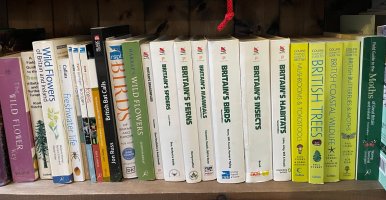
Field ID Guides

  • BushMoot: Come along to the amazing Summer Moot 31st July - 5th August (extended Moot : 27th July - 8th August), a festival of bushcrafting and camping in a beautiful woodland PLEASE CLICK HERE for more information.
Very true. There are 300 or so species of hover fly alone. You can only tell some of them apart by examining the genitalia under a microscope; it's the same with many spiders. Every subject I have picked up has exploded in complexity when I really gets into it (invertebrates, grasses, mosses, lichens, fungi ... the list goes on). Grasshoppers are OK, there are only 6 species in Powys :)

One of the county recorders I spend time with in the field specialises in wasps and bees - she points out wasps that are only a few millimetres long and identifies many species of bees that all look the same to me.

As a relatively experienced amateur, my ID skills fade into insignificance compared to the people I spend time with. Not helped by my memory losing more species each year than I'm learning :(

The insects book I recommended above only covers 1,653 species out of about 25,000 in Britain (over a million known worldwide)!
 
  • Like
Reactions: Pattree
A comprehensive guide to British snakes and legless lizards might fit into your back pocket :lmao:

Edited to ask @demented dale
Do you have a field guide to Irish snakes? :)
 
  • Haha
Reactions: Broch
As previously mentioned by Broch, these Wild Guide books are excellent. I've been looking through Britain's Insects now that a few more creatures are showing their heads and it's brilliant. Britain's Spiders is also a great book, I've had a lot of use out if it over the last year. They are both very comprehensive.

I plan on picking up a few more Wild Guides this year.

20260208_170225.jpg
 
  • Like
Reactions: johnnytheboy
Which do you consider to be some of the best field guides for our native flora, fauna and funga?

I picked these two up a year or so back, and they are excellent. We've got the larger, more comprehensive versions at the house, but these 'pocket' guides have been really useful out and about. Particularly the wild flower guide which tends to live in my bag this time of year.

View attachment 94857

View attachment 94859

View attachment 94858
These two are perfect. I always have the Collins ones. Easy to use and carry. I've got the tree one. In fact I think you sent me the link to buy it. Hope you well. DD xx
 
  • Like
Reactions: William_Montgomery
Well, I may be biased - I am a co-founder and current chair of a Habitats Management Organisation with 160+ members :)

But yes, it puts a lot of our wildlife issues into perspective. It clearly describes the recognised habitat types, where they are, and their conservation value. It doesn't cover the value of ecotones as much as I would like but it is a very good reference.
 
  • Like
Reactions: William_Montgomery
For mushrooms, I started out by reading this book:

The general sections of course, not the whole thing, as most of it is about specific species. However, it provides all methodology for getting a positive ID on most UK species of interest, along with lookalikes of interest for each species.

I don't carry it with me anymore when out foraging. Instead I use the Shroomify app, which is brilliant and answers most questions for being fairly certain. If not 100%, isolate, take it home, get a spore print and study it with the book and other reliable sources.

Goes without saying that there is no room for error with mushrooms But the flavours out of some of them are just irresistible, and the bolete species are a pretty safe bet, at least in Scotland.
 
  • Like
Reactions: William_Montgomery

BCUK Shop

We have a a number of knives, T-Shirts and other items for sale.

SHOP HERE