
billhook- reccomend please!

  • BushMoot: Come along to the amazing Summer Moot 31st July - 5th August (extended Moot : 27th July - 8th August), a festival of bushcrafting and camping in a beautiful woodland PLEASE CLICK HERE for more information.
I'd go for a morris (I have a couple), very few traditional makers left now besides morris of dunsford (sp?). Another option would be to chat to a blacksmith, but they are a pain to make apparently according to dave budd, so would be alot more expensive.

Ed
 
Thats depends what you want it for. I use the newton with the small nose (hook) as i do a bit of hurdle making where i need to split 6ft hazel wands, but if you just want a big chopper for firewood / kindeling, go for the knighton. I like the newton as its a good all rounder, but if you are not going to use the hook, then it will just get in your way.

If you do get one with a hook (nose) then it may also be worth getting a scythe stone ..... a cigar shaped sharpening stone, so you can sharpen the curved part easily.

The edges can be a little naff straight from the forge, so a little time with a file to get it up to scratch and you'll have a great tool. Also, sand off the varnish on the handle .... its only there to keep it clean while being made / stored in the smithy and can get slippy when wet.

Ed
 
Last edited:
The Morris hooks are the best of the modern manufacturers, but they aren't a patch on any of the old ones sadly. Nothing to do with the quality of the steel and everything to do with geometry and lack of proper grinding :( I was talking to another smith over the weekend who was at the Morris factory not long ago and watched them make a billhook. Apparently they laser cut a blank and then forge the distal taper in, then cut the final shape out before heat treating it. After HT its painted, the edge ground and the handle stuck on.

If buying new, then either get a Morris or have one made by a competent blacksmith who you know makes goo edged tools. Otherwise you may as well get a cheapy new one, it'll likely be the same quality. If you can buy an old one then you'll get a good hook at low price, but you may need to do a bit of work to it.

As Ed says, making a billhook properly (ie it tapers from back to edge as well as handle to tip) is a PITA and hard work without a power hammer. I don't make many because of that, but I do make them to order ;)

The pattern (and size) you go for will depend on what you intend to use it for and what you have experience of. More hooked if hedge laying or coppicing, less hooked for snedding and bushcraft. Avoid the double edged ones unless you want to lose an ear or you really know what you are doing with it!
 
cheers lads :)

think I'll have a look around for an older one then, im in no rush and would be a nice wee project if I can find one. If not then a morris will be on the cards. I'd be using it for bushy type tuff.

I would love to have a hand made job dave but unfortunately I wouldnt be able to justify the spend, thanks all the same.
 
There's always a few old hooks on ebay if you fancy a lil project of your own.

Dave Budd said:
Apparently they laser cut a blank
I never knew they were laser cut ..... you learn something new everyday :-)

Ed
 
me either. I thought they were a little more forged, but I was talking to a smith over the weekend and he was there a few months ago with a TV crew who wanted to film them making a billhook for one of the living history shows thats on telly at the moment (I forget which it is). The tv people were dissapointed when Mr Morris showed them how they make hooks and Simon (the smith) took them to Finch's and was filmed making a billhook for them properly.
 
if you can, find an old tools type stall where they may have a large selection of old ones. I got a couple over the summer, but it took me a good half hour of choosing. Not only does the blade have to be right, but so does the handle. You'll be using it for long periods (well, I will) and you want something that is comfortable and well balanced.
 
I have had a Morris Billhook that I have used for 9 years and it gets used a couple of times a week and is still going strong although my favourite I gave to my brother was Finch Spar hook lovely compact hook and at least 40 years old
 
I use Newton and Yorkshire pattern hooks mainly for my hedgelaying, both made by elwell, sadly out of production but if you can get one in good nick they are simply the best in my oppinion.
 
me either. I thought they were a little more forged, but I was talking to a smith over the weekend and he was there a few months ago with a TV crew who wanted to film them making a billhook for one of the living history shows thats on telly at the moment (I forget which it is). The tv people were dissapointed when Mr Morris showed them how they make hooks and Simon (the smith) took them to Finch's and was filmed making a billhook for them properly.

That would be Edwardian Farm and presumably Simon Summers I think it's on next weeks episode.

I am not sure that I would look down on laser cutting, many of the most respected knifemakers in the world have their blanks laser cut. If the blank is then forged or ground well it is one way of making a good tool and keeping costs reasonable. I can understand not wanting to film it for "Edwardian Farm" though.

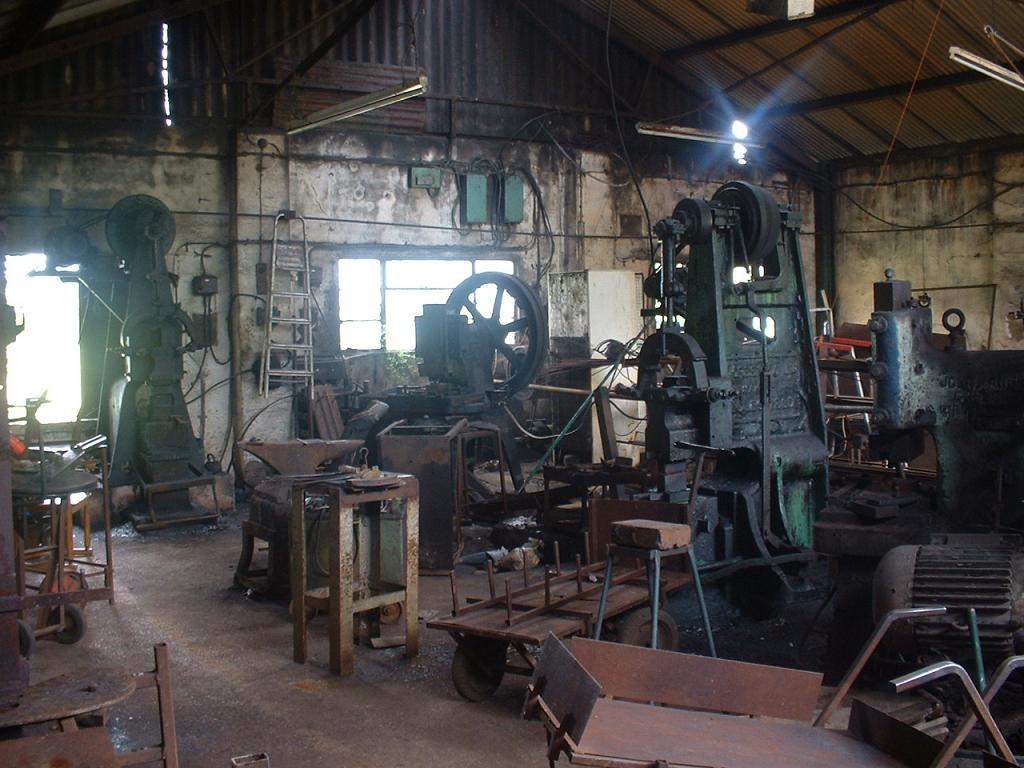
Do Morris not use these lovely power hammers?
morris%20dunsford%20foundry3.jpg


Finch's is of course perfect for showing the technology of the time since they have the last working tilt hammer in England, there is another at Patterson's spade mill in NI. I had a go on that one last year http://greenwood-carving.blogspot.com/2009/08/pattersons-spade-mill.html

Back to the original question I personally find most bill hooks on the heavy side, I have a gorgeous little Gilpin. Old ones do not command high prices. £20 would get you a lovely one.
 
well I hope I made the right choice I spent £20 on an elwell yorkshire billhook, looks a lovely old blade, hopefully will arrive soon! will put some pics up of it when its through.
 
On Edwardian Farm they sued a watermill powered Trip hammer to shape the blade. Making the steel/ iron sandwich looked tricky.
 
On Edwardian Farm they sued a watermill powered Trip hammer to shape the blade. Making the steel/ iron sandwich looked tricky.

all done for telly I'm afraid.

I was at Finch's (the forge they did the hook at) the other week demonstrating to the masses, alongside the smith who did the billhook. The laminated bar that Roger (custodian) showed was only made their early on in the works history, shortly after it was produced in a laminated stock at a mill and the bars were bought in to be reforged. Incidentally that particular piece was destined to be split in two and forged into two scythe blades. The billhook that Simon made on the day was mild steel and just done for the cameras on account of having issues with the fire not playing nicely (the machinery isn't tuned to be practical anymore, only to be shown moving to the public :( ). He then made them a proper hook from some spring steel when he got home so that it could be used in the hedging bit later ;)

When the hammers were working properly they were used to weld shovel blades together as well as forging out the big ol lumps the were turned into the shovels,ladles, hooks, scythes and everything else they used to make. Now those machines that once beat out 6" cubes are used to flatten 1/2" round mild steel for the public. Still it does show how the machinery and water wheels work :)
 
all done for telly I'm afraid.

I was at Finch's (the forge they did the hook at) the other week demonstrating to the masses, alongside the smith who did the billhook. The laminated bar that Roger (custodian) showed was only made their early on in the works history, shortly after it was produced in a laminated stock at a mill and the bars were bought in to be reforged. Incidentally that particular piece was destined to be split in two and forged into two scythe blades. The billhook that Simon made on the day was mild steel and just done for the cameras on account of having issues with the fire not playing nicely (the machinery isn't tuned to be practical anymore, only to be shown moving to the public :( ). He then made them a proper hook from some spring steel when he got home so that it could be used in the hedging bit later ;)

When the hammers were working properly they were used to weld shovel blades together as well as forging out the big ol lumps the were turned into the shovels,ladles, hooks, scythes and everything else they used to make. Now those machines that once beat out 6" cubes are used to flatten 1/2" round mild steel for the public. Still it does show how the machinery and water wheels work :)

The blower doesn't work that well either, I remember about 2 Clem's days back, there were massive problems getting more than 3 fires to any kind of heat. Even after we taped as many leaks as possible, noone could get a welding heat. This proved a slight problem as we were holding a hinge-making competition that day...
 
the problem is that the pipes leak badly ;) Roger and others plug the holes and blame clinker falling into the pipework, but by the end of St Clems this year you could see nice clean dry tracks on the floor where the air had been leaking all day! We had 3 fires going and none were very good for forging though Simon was welding up small stuff OK (1/4", nothing bigger would heat without heavy scaling)
 

BCUK Shop

We have a a number of knives, T-Shirts and other items for sale.

SHOP HERE