
A small rod..

  • BushMoot: Come along to the amazing Summer Moot 31st July - 5th August (extended Moot : 27th July - 8th August), a festival of bushcrafting and camping in a beautiful woodland PLEASE CLICK HERE for more information.

Kirsty

Full Member
Oct 2, 2017
42
60
Here and there
Please excuse my novice ignorance! I have very minimal experience but am a mackerel enthusiast and have caught some from my kayak, I hope for a few more this year and maybe some more eatable sized pollock. However, I am a bit of a klutz with hooks (lodged in the shoulder of my buoyancy aid, lodged in my spraydeck...) so I want to use only a single hook, but they all seem to come with three - but that is another question. More importantly, I will now be fishing from a skin-on-frame folding kayak which, while robust, could be pierced. As such I think it best I don't pull a line up immediately beside it so I am wondering if a small packable rod would be the answer, that way lures / fish can be dangled onto my lap with great care. Any thoughts please.tempImagelAU4hQ.jpg
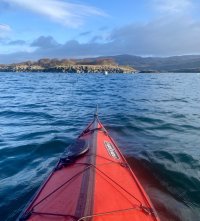
I would also appreciate advice regarding a tool to cut through the hook that will inevitably be lodged in my skin, it is likely to be my hand and it will make paddling less awkward if I can detach most of it!
 
  • Like
Reactions: Crac
Hi Kirsty

I’ve done a fair bit of fishing from my sit on top kayak over the years

I used to just by the mackerel hook sets and cut them down I to three or four hooks per set. I also didn’t use a rod I used handlines just the cheap Fladen Hand Line Plastic Winder Frames.
You can get a decent mini set of heavy wire cutters if you think you’re going to hook yourself.
One thing I’d recommend is a small dip net for landing them saves the fish flapping about and minimises hooking yourself it also helps you not to loose your fish.

Cheers Russ
 
  • Like
Reactions: Kirsty
Hi Kirsty

I’ve done a fair bit of fishing from my sit on top kayak over the years

I used to just by the mackerel hook sets and cut them down I to three or four hooks per set. I also didn’t use a rod I used handlines just the cheap Fladen Hand Line Plastic Winder Frames.
You can get a decent mini set of heavy wire cutters if you think you’re going to hook yourself.
One thing I’d recommend is a small dip net for landing them saves the fish flapping about and minimises hooking yourself it also helps you not to loose your fish.

Cheers Russ

Thanks Russ, I did wonder if a net would be good - I will Google dip net. I could secure it under the decklines. Is this the kind of wire cutter you would recommend? I'm only familiar with fencing ones which are obviously heavy heavy duty.
I got my line in a tangle with multiple fish before I even tried to unhook. One at a time is just about manageable.
 
Hi Kirsty, you may need something a little heavier than that depending on the size hooks you're using; they can be surprisingly tough to cut through.

**** squeamish warning! ****

The advised method for removing a hook in your skin is to feed it through until the barb is exposed, cut off the barb, then feed the hook back the way it went in but now without the barb ripping your skin as it comes out. If you cut the hook off at the line end you'll end up with the barb stuck in your flesh and much more difficult to extract.

I've used a small telescopic rod from my kayak but the boats have always been solid (not skinned boats).
 
  • Like
Reactions: Kirsty
Broch, I am not sure that I could do that. I think I would remove only what I had to in order to use my paddle to get home! I'm trying to think through the scenario and plan for it - particularly making sure what I need is easily accessible with either hand.
I've seen reports of people catching huge fish from their skin boats, they tend to be extremely stable so are very suitable in that respect. It is my Mr Bean fumbling that makes it problematic.
 
Yeh, I understand that, not many can. So, don't cut the hook at all, just remove the line, strap the hook up so it cannot move deeper into your skin, and get to a medic. The danger is, if you cut the hook on the shank, and you start using your hand to paddle, you end up embedding it deeper in.

The worst landing I had in a small craft was using mackerel feathers and landed 5 decent fish at the same time - it was chaos! :)
 
  • Like
Reactions: Kirsty
I swapped treble hooks for singles on some lures. On the Rapalas it did effect swim action and I got fewer hook ups, but it was a lot easier and less fraught to un-hook.


I used the VMC light inline.

I am a fan of packable rods.
 
  • Like
Reactions: Kirsty
For supplies, AliExpress or temu are your best source of inexpensive gear.

Rod wise, look for ice fishing rod or kayak rod, both are 3ft to 4ft long and are interchangable. Max power of the rod should be 12lb, with single fly you can get away with 6lb to 8lb (often called ultralight)

Reel, keep it small and saltwater proof, you are not after Great Whites.....

For the hooks, debarb them (close barb up with fishing aluminium pliers), you will lose the occasional fish but the hook is then completely able to come back out of where ever it gets stuck.

Your mainline either nylon or braid should be about 20lb.

For your casts for mackerel and small pollock buy a spool of 12lb mono and a spool of 6lb.

Have a large gated swivel attached to main 20lb line, use 4feet of 12lb line with loops in either end and surgeons knot dropper in middle with a half hitch to give leader 90 degree separation), for single hook and then standard swivel 1ft of looped 6lb line as a breakaway link attached to bottom and then weight goes on bottom of this through bottom loop.

I tie my own mackerel flies etc as I find the commercial hook sizes too large. I use a size 6 or 8 hook whilst most commercial hooks are circa size 2 which also helps with getting hooks out and minimising damage.

The pattern uses some tinsel tied to the hook as a tail (gives movement) and a small luminous shrimp or fishhead of about 12mm over the hook as main attractor.

Happy to send you a couple of casts made up with fly attached if you pm me.
 
For the hooks, debarb them (close barb up with fishing aluminium pliers), you will lose the occasional fish but the hook is then completely able to come back out of where ever it gets stuck.

I was going to suggest similar although as I've not done it I didn't know how many fish you'd lose.

If you're tying your own and prone to sticking them in you a packet of barbless hooks might be worth it.

I've used decent silver ribbon to tie my own mackerel feathers before.

I think it was one of this persons videos I followed:

 
Last edited:
  • Like
Reactions: Kirsty
@stonepark thanks very much for this really comprehensive advice and for your kind offer - I will send a PM. I would much prefer that there is less damage to any small ones I put back so this will improve things in every way.

@slowworm thank you, barbless hooks are what I need. Losing some is a small price to pay and I will feel happier about the ones that are too small to keep. I will watch that video, tying my own feathers does sound satisfying.

I don't even know what I don't know on this topic, it is a vertical learning curve. Really appreciate the advice, a fab forum to be part of.
 
  • Like
Reactions: stonepark
You don't need to search fruitlessly for barbless mackerel 'feathers'. Just take a good pair of pliers and crush the barbs down flat on your hooks. You can easily tie your own on truly barbless hooks, but I'd be amazed if you can buy 'feathers' on barbless hooks. Barbs can also be removed neatly with a 'Dremmel' type tool.
Be prepared to lose more fish when using barbless hooks. This small disadvantage will not really be much of a hinderance if mackerel fishing as once you hit a shoal of them you can literally catch hundreds in an hour or so. There may be times when you are really glad of barbless hooks though .. keep reading ;)

A mate of mine who used to do a lot of sea-kayak fishing had a wire framework table thingy. It went behind him when paddling but he had it front of him when fishing. It had a top made of very heavy duty poly-tarp type stuff that hooks didn't get caught in and served for baiting-up, unhooking fish etc. I have no idea where it came from though so cannot help with that.

Fishing hooks need to be tough by the very nature of their job, and and are usually made from heat treated steel. They are absolute sods to cut with 'normal' wire cutters ... especially the bigger hooks that you are likely to use for sea fishing. The only sure-fire tool we found ( as pike anglers dealing with large gauge treble hooks) were Knipex mini bolt cutters. I remember seeing them in use for the first time, and then wincing when I bought mine at over £35. They have, as with all things, only become even more expensive in the last 30 years :lol:
We only carried them for cutting hooks that were impossible to get out of a fish without doing more harm than needed.

Getting a good sized hook in your hand (or anywhere else) HURTS. If barbless you can pull it out yourself. If it's barbed and deep cut the line. NOT the hook. Protect it all you can and go to A+E unless you are feeling VERY brave.
A+E can give you a 'local' and then deal with it. I've been there a few times and only once where getting to hospital wasn't an option. Turning the hook to penetrate outwards so you can cut the barb off (with your trusty Knipex's) before pulling it out backwards is, to put it mildly, "Not very much fun at all." and is akin to removing your own toenails with pliers.
 
Last edited:

BCUK Shop

We have a a number of knives, T-Shirts and other items for sale.

SHOP HERE