No one knows where it came from': first wild beaver spotted in Norfolk for 400 years

  • BushMoot: Come along to the amazing Summer Moot 31st July - 5th August (extended Moot : 27th July - 8th August), a festival of bushcrafting and camping in a beautiful woodland PLEASE CLICK HERE for more information.
Who will be doing this and how will they be funded?

< Just asking :) >
Cats Protection and other cat charities already do a lot of this.

As for the rest, perhaps the polluter- big arable- should be paying for the damage it does especially to insect life.....

..... big difference between big cereal arable and family farms/veg growers. Big arable is profitable and not interested in reducing inputs. Did a project a few years back using drones to do 100% multispectral imaging at resolution of 2cm/pixel, flying 50Ha in 40 minutes. Idea being that it spots problems at early stage and enables spot treatment (using drones) not blanket use of fertiliser, pesticides and herbicides. Successful proof of concept but the farm estate who let us trial it (at our cost) wasn't interested as they harvest the crop, dry it, stick it in a temperature/humidity controlled barn and wait until the price is right to sell. So savings from input reduction didn't interest them enough to go as far as paying our expenses for the next stage of a productionisation trial.

World of a different between big arable vs smaller family farm size regenerative systems which use animals to help increase biodiversity.

GC
 
  • Like
Reactions: TeeDee
We have always trained our pussies to come in at night.

Blackie (a feral) does so...he loves to hunt...Mice and rats. He doesnt go for birds.
 
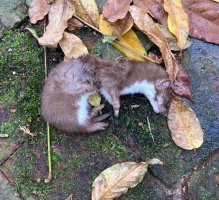
I am sorry to say one of my cats caught a weasel the other day. He’d only been out for tens minutes the sod.

IMG_8974.jpeg
 
Hes a very brave cat.

Mind you, some cats will tackle anything up to a black bear size. (There is a well attested account of a queen with kittens seeing off a black bear).

Most cats too lazy to hunt.
 
As for the rest, perhaps the polluter- big arable- should be paying for the damage it does especially to insect life.....

..... big difference between big cereal arable and family farms/veg growers. Big arable is profitable and not interested in reducing inputs.

I'm a bit wary of this sentiment- there's a lot of yelling of 'Buy British' and 'family farms' at the moment, but in reality most of it is just as damaging as the big players and imported food.

And theirin lies the problem. The population is simply too high to secure quality food for the majority. Instead it's necessary to poison invertebrates with knock on effects up the food chain, while producing food of low nutrient quality and high toxin content.
 
Sorry, I don't agree with the damaging statement - I have the pleasure of visiting many smaller farms being managed in a 'nature friendly' way and the difference in bird, insect and plant species is visible even without doing the formal surveys.

At a recent presentation a regen farmer pointed out that to get the same food value from a single carrot grown 50 years ago you would have to eat 6 modern supermarket carrots. I don't know how accurate that is, but I believe there is a lot in that statement. Take venison for example, lower fat, higher protein and nutrient value than beef. We concentrate too much on producing bulk and not on quality - mainly because a) our land is so depleted and b) try telling the public they only have to eat 1 carrot and 4oz of steak.
 
  • Like
Reactions: GreyCat
It may well depend on where you are. Many of the the smaller farms around here may well disappear in the next decade as the larger, more industrialised farms expand. One medium sized farm near us has just sold and the new owners have set about enlarging the gateways, clearing a large number of trees, removing any trace of field margins etc - all fairly normal practice down here. I'm not convinced the small patches of sympathetically farmed and used land (such as our few acres) will do much to offset the destruction.
 
  • Like
Reactions: TeeDee
Going back to the reintroduction of wild cats, living not too far away from the proposed areas, I can't help but think it's very wishful thinking. The stray/feral cat that we decided to feed to save it from eating too much of the local wildlife looks quite similar to the wildcats. I've realised it's likely to have moved on from one of the many farms as several have very similar cats about their yards, none I expect are chipped or chopped. Having watched it a fair bit over the last year it doesn't just eat voles. Anything it can catch from a pheasant to rats, mice (inc harvest mice), voles, lizards, slowworms and any number of smaller birds are on the menu and I doubt it would turn its small nose up at a nest of rare ground nesting birds if there are any left from the swarms of badgers.

So I think any wild cat release will just result in more feral cats and less wildlife. The idea that the wildlife trust 'would tackle the threat of hybridisation by working with local welfare organisations to support a neutering programme for feral and domestic cats in areas where wildcats were introduced' seems rather fanciful to me when there are so many strays, badly treated pets and no doubt after Christmas a load more abandoned pets.
 
Sorry, I don't agree with the damaging statement - I have the pleasure of visiting many smaller farms being managed in a 'nature friendly' way and the difference in bird, insect and plant species is visible even without doing the formal surveys.


Yes, but 'buying British' or 'family farm' doesn't guarantee any of that and 'regen' having no standards or real definition can be and is applied utterly inapropriately.

Nature friendly is one thing, pesticide free is another wonderful level of soil bacteria and inverts!
 

BCUK Shop

We have a a number of knives, T-Shirts and other items for sale.

SHOP HERE