

A small collecton of skulls
- Thread starter Galemys
- Start date
-
The awesome MakerMoot is coming up (13-15th Nov 2026), Visit the TORM & ARM markets,and have space back at camp to work on projects and enjoy great company. PLEASE CLICK HERE for more information.
You are using an out of date browser. It may not display this or other websites correctly.
You should upgrade or use an alternative browser.
You should upgrade or use an alternative browser.
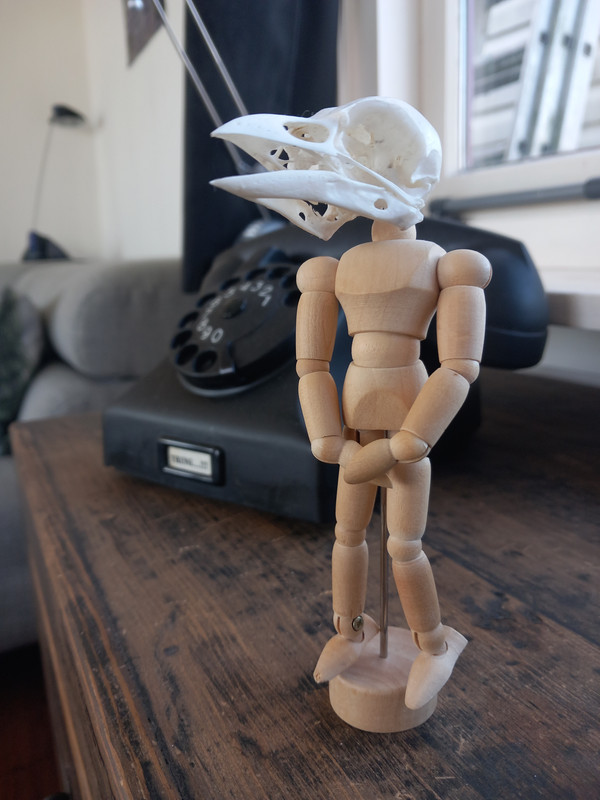

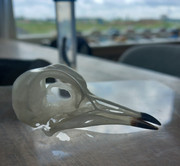
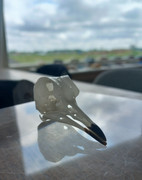
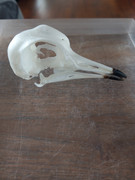
Latest addition: a northern lapwing (Vanellus vanellus), found dead in a field.
Cheers,
Tom
Cheers,
Tom

Hi Mollyshock and welcome to the forum!
All my skulls came from animals that had either naturally died or were traffic victims (I check the last category first for completeness of the skulls). My friends and family know of this hobby of mine, so they point them out to me if they come across a victim.
The lapwing was quite desiccated so I just had to soak it in water first, then got rid of the feathers, skin and fleshy parts (with knife/scalpel etc.). Fresher victims are first handled with scalpel and than either laid sheltered in a quite corner of the garden for the flies/maggots to do the dirty work or buried for a few weeks.
When most of the flesh/skin is gone I soak the skull for a few days in washing powder ('Biotex' is the brand name); this degreases the skull and it contains enzyms that breakdown proteins, making it easier to get rid of the last pieces of skin and other tissue. If all tissue has been cleaned away, I put the skull in a 6% hydroxygen peroxide solution to bleach it. After this, a quick rinse in water to get rid of the peroxide and then drying leaves a clean, white & odourless skull.
Note: use latex gloves for every step!
Cheers,
Tom
All my skulls came from animals that had either naturally died or were traffic victims (I check the last category first for completeness of the skulls). My friends and family know of this hobby of mine, so they point them out to me if they come across a victim.
The lapwing was quite desiccated so I just had to soak it in water first, then got rid of the feathers, skin and fleshy parts (with knife/scalpel etc.). Fresher victims are first handled with scalpel and than either laid sheltered in a quite corner of the garden for the flies/maggots to do the dirty work or buried for a few weeks.
When most of the flesh/skin is gone I soak the skull for a few days in washing powder ('Biotex' is the brand name); this degreases the skull and it contains enzyms that breakdown proteins, making it easier to get rid of the last pieces of skin and other tissue. If all tissue has been cleaned away, I put the skull in a 6% hydroxygen peroxide solution to bleach it. After this, a quick rinse in water to get rid of the peroxide and then drying leaves a clean, white & odourless skull.
Note: use latex gloves for every step!
Cheers,
Tom
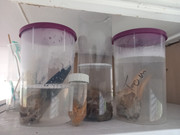
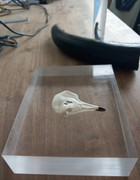
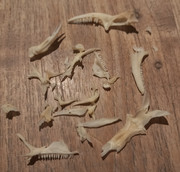
The small container contains a Curaçao whiptail lizard (Cnemidophorus murinus) skull. The skin seems to be attached to the skull directly in some places and when I tried to remove it, the skull disintegrated into a quite interesting 3d puzzle...
Some more in the making, all from the South Caribbean island of Curaçao. Will be continued!
Cheers,
Tom
The other skulls in preparation are of a badly deformed (it was a traffic victim) and fragmented crested caracara (Caracara plancus), an adult yellow-crowned night heron (Nyctanassa violacea) and an immature red-billed tropicbird (Phaethon aethereus).
More soon,
Tom
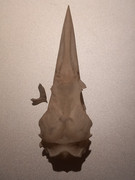
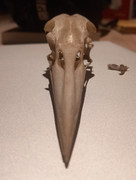
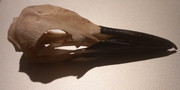
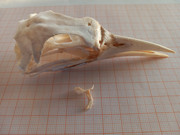
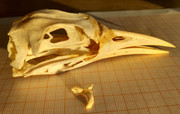
Here is the yellow-crowned night heron. The small bone beside the skull is the left 'lacrimal', a small bone that is positioned at the front of the eye socket. The right one is still attached in the right position.
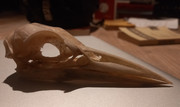
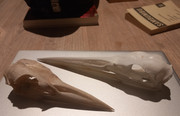
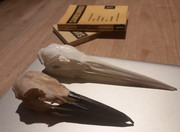
Compared to a grey heron skull:
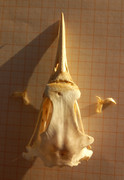
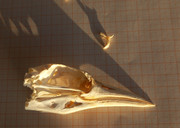
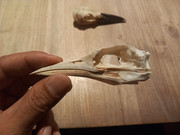
The red-billed tropicbird* (*id still has to be confirmed by Dutch natural history museum Naturalis), I still have to attach the lacrimal bones:
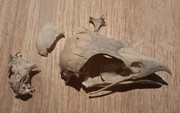
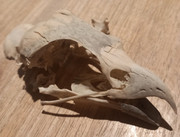
The caracara's skull had seriously been crushed, resulting in fragmentation and dislocation...
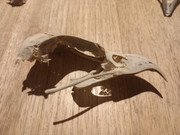
...but the caracara skull is a piece of cake compared to the whiptail lizard's:
Cheers,
Tom
Compared to a grey heron skull:
The red-billed tropicbird* (*id still has to be confirmed by Dutch natural history museum Naturalis), I still have to attach the lacrimal bones:
The caracara's skull had seriously been crushed, resulting in fragmentation and dislocation...
...but the caracara skull is a piece of cake compared to the whiptail lizard's:
Cheers,
Tom
And this is how they looked in real life,
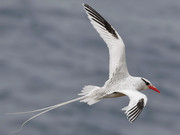
Red-billed tropicbird (Note: the id at species level of the skull is tricky, but it is now confirmed by Naturalis museum as a tropicbird species, and red-billed is far more likely to occur around Curaçao than the other candidate, the white-tailed tropicbird). Immatures have more yellowish bills (like my skull in 'as found' condition), are more barred and lack the long tail streamer feathers.
Crested caracara
Curaçao whiptail lizard
.jpg)
Yellow-crowned night heron
Cheers,
Tom
Red-billed tropicbird (Note: the id at species level of the skull is tricky, but it is now confirmed by Naturalis museum as a tropicbird species, and red-billed is far more likely to occur around Curaçao than the other candidate, the white-tailed tropicbird). Immatures have more yellowish bills (like my skull in 'as found' condition), are more barred and lack the long tail streamer feathers.
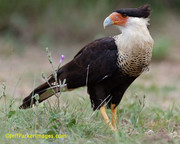
Crested caracara
Curaçao whiptail lizard
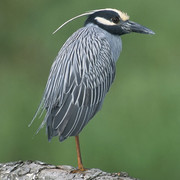
Yellow-crowned night heron
Cheers,
Tom
Last edited:

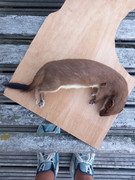
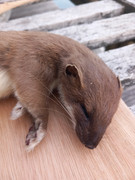
I finally found a roadkill stoat that wasn't flat or otherwise ruined, I will post the resulting skull in a few weeks.
 [/url]
Cheers,
Tom
Cheers,
Tom

I finally found a roadkill stoat that wasn't flat or otherwise ruined, I will post the resulting skull in a few weeks.
Cheers,
Tom
I can't like the stoat post as I love stoats, but I do look forward to seeing the skull.
Also, thanks for posting the method you use to clean and sanitise your skulls (I know it was a while ago but I must have missed it). I've always wondered how it was done.

What an absolutely fantastic post, animal skulls are fascinating. I'll add mine tomorrow when I've got some decent light to take photos.


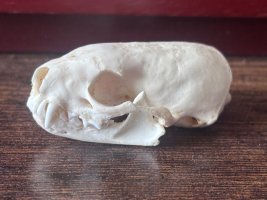
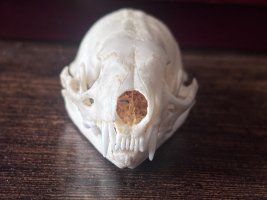
A slightly damaged Badger and an almost perfect Fox, (hopefully) showing some of the differences between the two.
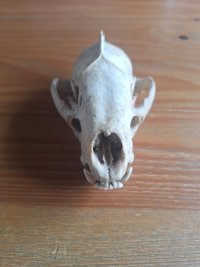
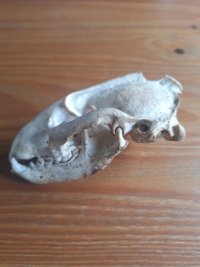
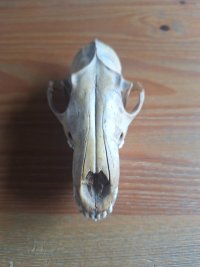
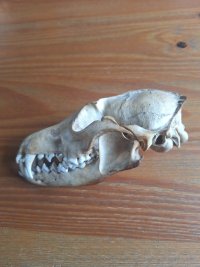
Housemartin, hopefully the box that I keep it in and the weight on the scales should give an idea of how incredibly tiny it is. I shall be taking no further questions on the scales.
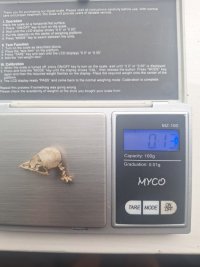
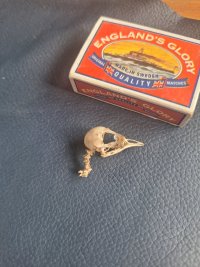
Last edited:
I have finished a really nice shnufty-pig recently.
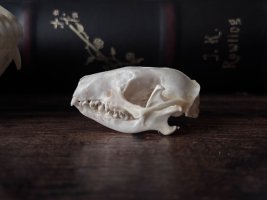
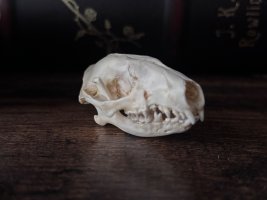
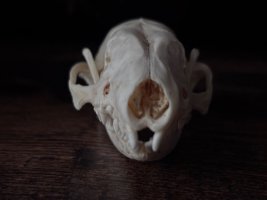

Didn't expect this to happen with my stoat skull; several teeth falling out:
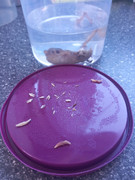
I have no clue why this happened, haven't experienced this in other mammal skullls before. Maybe the extreme high temperatures had something to do with it.
As usual, I had let the greenbottle larvae and scavenging beetles eat away most of the fleshy parts (after skinning) and had the skull for an initial soak (for a bit of degreasing) with some washing liquid for a day. When I wanted to rinse, most of the teeth just fell out.
Anyway, it will be another challenge to puzzle the teeth back to where they belong, especially the tiny ones.
Cheers,
Tom
I have no clue why this happened, haven't experienced this in other mammal skullls before. Maybe the extreme high temperatures had something to do with it.
As usual, I had let the greenbottle larvae and scavenging beetles eat away most of the fleshy parts (after skinning) and had the skull for an initial soak (for a bit of degreasing) with some washing liquid for a day. When I wanted to rinse, most of the teeth just fell out.
Anyway, it will be another challenge to puzzle the teeth back to where they belong, especially the tiny ones.
Cheers,
Tom
Last edited:

