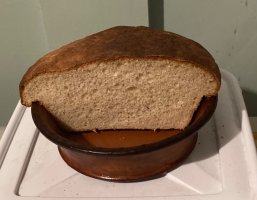
The most basic bread recipe.

  • The awesome MakerMoot is coming up (13-15th Nov 2026), Visit the TORM & ARM markets,and have space back at camp to work on projects and enjoy great company. PLEASE CLICK HERE for more information.
Real bread has four ingredients
Flour
Yeast with a tsp of sugar to make a starter, unless its instant yeast. Just bung that straight into the bowl with the flour.
Small amount of salt.
Water .
Mix, knead rest, bake.
No need for knocking back and two risings. I've made bread successfully with this simple method for years.
Tip
Bake on flat flour coated baking sheet and slash the top lightly.
Enjoy

You can see the results in the photo I recently posted in the what did you make today thread.
 
just flour and water make flatbread... easiest bread ever...advbaking soda for a bit of fluffiness :) haken it in a pan, on a stone...

If you look into making your own sourdough starter (google is your friend), with these same ingredients you can make the most delicious breads.The starter is just flour and water, and loads of patience.
Salt makes it taste better :D

Here's my starter and some breads made with it.
Either in a dutch oven with coals/briquettes, in an electric ove on a stone, or any way you like to bake.
AP1GczNpqpbNjspKWfck53X4iGJ1pEjQiKhJZdRcK_WWq9HG0ZTGdyu7vmoaKiUXLI8QMNLnG26Ufmr3PYZ4iMTs6upuM4ixCYyBzoNti9N3vyfWFa9QjUj1=w900


AP1GczMRA2p4tOClYfOb-9GQObIwoXuUiYb1_jM1lmEpAU90WXbZ87JSOee8l5qscSL9B7HyqPDuNoZwjz4Bcwf87QtUWq7rzUYYyHrmCTxAo14IIUF_fXUQ=w900


AP1GczPQXC6x_Tu4y5Ryt9tnqKoo2OLJv21oM-m0M5BMhf6dHowGtYkTDq_YWdepYtZbNqTeQYk9qe4d_mGdQCZOXZHwueebueZqCcXeE6gLOWG5mO1caE4l=w900


AP1GczNCmkyTaPUlcUfNwEb3W-EbAv_1poLZKIAjqVAuyzdCKxfP0xNo4GkUOQHgREALJrGbFZt17M_g8997q3FTkMFYZkLUFnVSTOkt0JSRyQEHiZ6VpY_p=w900
 
Last edited:
Soda bread is probably the quickest and easiest one to make. Under an hour and it's ready to eat.

Any flour, a little salt, a little oil or fat if you have some, and some baking powder.

If you use bicarbonate of soda (more stable long term than the BP mix then you need an acid of some kind to kick start it. Some folks use buttermilk (added value) but you can just use tartaric acid, which again lasts for ever )

Thing is though; there's bread and then there's 'bread'.

It worth playing around with though.

We're used to yeasted breads here, oat and rye are dense, still nutritious but heavier than most would prefer.

Personally I think it's worth the time and effort to get the yeast working, but soda bread's pretty good :)
 
  • Like
Reactions: KnOeFz and TeeDee
I've always been told, and found, bicarb of soda goes off pretty quickly?
Would a bit of yoghurt work instead of yeast?
How much of the sourdough starter kept in a jar do you use each time? I gather you keep topping it up with flour and water afterwards.
 
Yoghurt or sour cream work well with bread made with bicarb. One of the easiest Pizza doughs is made by equal quantities of live yoghurt and flour plus a little bicarb and salt (yes, I know that's flatbread, but I'm just explaining the use of yoghurt). It can also be made into bread rolls.
 
Soda bread is probably the quickest and easiest one to make. Under an hour and it's ready to eat.

Any flour, a little salt, a little oil or fat if you have some, and some baking powder.

If you use bicarbonate of soda (more stable long term than the BP mix then you need an acid of some kind to kick start it. Some folks use buttermilk (added value) but you can just use tartaric acid, which again lasts for ever )

Thing is though; there's bread and then there's 'bread'.

It worth playing around with though.

We're used to yeasted breads here, oat and rye are dense, still nutritious but heavier than most would prefer.

Personally I think it's worth the time and effort to get the yeast working, but soda bread's pretty good :)

Bread and " Bread "

100% agree.

I was more thinking upon the lines of making " things " from a restrictive pantry.

What can be done when little is available.

Taking things back to basics simplicity.
 
Well, at it's most basic, it's flour, water and yeast, as has been said. You can cultivate yeast from a wide range of foraged sources. So, for example, make up a starch 'soup' from something like reedmace tuber and add unwashed crab apple peel, and after a few days in the warm you'll have a good yeast culture.
 
  • Like
Reactions: Wandjina and TeeDee
I've always been told, and found, bicarb of soda goes off pretty quickly?
Would a bit of yoghurt work instead of yeast?
How much of the sourdough starter kept in a jar do you use each time? I gather you keep topping it up with flour and water afterwards.
I mix 50-50-50 grams of flour, water and old starter, leave it overnight to expand, the use around 100grams for a bread, put the leftover in the fridge for next time.
 
Last edited:
  • Like
Reactions: Wandjina
i made damper during my trips to the centre of the universe (commonly called "Australia" from self-raising flour and water, using a "dutch oven" on the campfire. i forgot the title, but Clay Hayes has a video on YouTube using an earth oven and collecting wild yeast from aspen bark. i also made sour dough starter using flour, a bit of salt, sugar and wood ash + vinegar, following roughly a description in "centennial" by James A. Michener...
 
  • Like
Reactions: Wandjina
Edited to add:
This isn’t just a simple recipe, it’s a simple method.

This one recipe makes the best bread around. This is the opinion of my extended family.

Times and quantities differ for full sized loaves. This recipe is based on the one shown on the Allisons strong flour packet :) It’s dead simple my way and only takes about quarter of an hour of your time - and very little tidying up.


FIVE ingredients:

Strong Flour
Water
Yeast. Dried or instant. (Sourdough takes it out of “Simple”.)
Salt
Olive oil.

Mixed and kneaded in the mixing bowl. No mess.

Five minutes mixing the ingredients.
Eight minutes settling while gluten forms and you do something else.
Maybe ten minutes kneading - probably a lot less. Just rolled and smeared into a sausage and folded over 20 times. (See article) but done in a full sized mixing bowl rather than a dog bowl!

For a full 600 gms of flour:
Prove for up to an hour - you get used to what works for you.
Baking time depends very much on the shape of your baking tin.

I use a bread crock and start baking @ 220°C before the rising dough starts to sag - if I don’t get distracted as I did this time. Bake for 35mins.
IMG_9692.jpeg
Just mess around a few times till you find your way. You can still eat the mistakes.
 
Last edited:
  • Like
Reactions: KnOeFz
Salt, bicarb, flour and water. Into a medium hot, buttered 8" cast-iron frying pan. Flip it once. Rises lovely. Five minutes to mix. Five minutes to cook. Five minutes to clean up. It is a weekly thing here, so it's down to a fine art.

I almost never stop at that, though. Maybe a handful of oats or caraways. A blob of olive oil plus some rosemary and chopped olives. That sort of thing. Even just bran. Lasts four or five days if you don't scarf the lot in one go.
 
  • Like
Reactions: Toddy
Soda bread, although it requires milk.
Flour, salt, water & yeast will make excellent but short lived leavened bread, in France you can't call a baguette a baguette if it contains anything else. If you aren't concerned about French bread law you can add some oil to make it slightly more durable.
Sourdough recipes do away with the need for yeast, but are high maintenance.

The "poor south" have a lot of unleavened breads, chapati is flour, water, salt & (a little) fat.
 
  • Like
Reactions: Toddy
I've always been told, and found, bicarb of soda goes off pretty quickly?
Would a bit of yoghurt work instead of yeast?
How much of the sourdough starter kept in a jar do you use each time? I gather you keep topping it up with flour and water afterwards.
It's considered stable and lasts for years if kept in a well sealed container.
Same with tartaric acid.
Baking powder does lose it's rise quickly though, but again a good well sealed container helps a lot.

Having said that I keep a pack of bicarb under the sink; it's useful for removing smells, cleaning, laundry, etc., and it's not in a particularly tight sealed pack and it lasts fine.

It's damp but cold here, I don't know if you're in a warmer bit and that speeds up the going off ?
 
Last edited:
Maori Rewena bread is a good one. It's like a sourdough, with the starter, called 'bug' based on a boiled potato.

You'll see recipes taking weeks to get things running, but trust me, the potato mash, flour, sugar and water will make a good enough starter to produce hard crust rolls in 24 hours or less if it's kept warm.
 
  • Like
Reactions: Toddy
Bread and " Bread "

100% agree.

I was more thinking upon the lines of making " things " from a restrictive pantry.

What can be done when little is available.

Taking things back to basics simplicity.
Flatbread is then your best bet, and it can be made very well. There is 'flatbread' and there is flatbread, more resembling the pittas you'd get with a Greek souvlaki rather than the boring 'pittas' you get in Tesco.
For greek pittas, you are looking at roughly 600gr flour, 300gr water, 15gr salt, 15gr sugar, half a teaspoon of powdered oregano and a splash of olive oil.
Mix it, let it rise somewhere warm for an hour or two, then batch it to ca. 10 balls, open them with a roll, press down the thin handle of a spatula/similar to make a criss-cross pattern on them and then oil them and fry them in a pan with heat hot enough to cook but not burn them.
The 'pattern' is not essential, nor is the oil. Actually, nor is the oregano, and in a pinch you could do without sugar or salt either, but they add a lot to it.
I am saying 'your best bet' as presumably you are talking about a situation where running an oven may not be an option, and it's a lot easier to cook on a pan or even on a hot rock.

If you can run an oven and own a dutch oven -or know how to use it with embers/coals- then the absolute best bread recipe I've ever tried (and still the one we routinely use) is:


It is subjective, but to me it is the world's best bread. No kneading either, so there's very little involvement in the preparation.
 
What would be the most basic BREAD recipe one could use if one was limited in terms of ingredients and cooking methods

Im not talking flat bread but load like breads.

But as S-I-M-P-L-E as SIMPLE could be?
Just looking at the responses to this:

Did you mean at home (kitchen and oven) or out and about using camping kit.

As per BcUK article - I’ve done it very successfully in an unmodified vertical zebra pot on my stick stove but I have also adapted several copper bottomed pans and pots for use on a fire (mainly by removing the plastic handles and fitting bales or lifting bolts.)
These are much better for bread than thin stainless steel.
If I were to make bread Dutch oven style, then I’d use one of my copper/ SS frying pans. The top of the loaf turns out pale but perfectly good (shallow) bread.

I’m still messing with “starters” and sourdoughs but they are a faf and are no better than instant yeast unless you are into 18 hour proving.

As previously:
If you are new to yeast bread, why don’t you start with the recipe on the strong flour package. That way you can work out what’s going on and vary it from there.

Whatever you intend - I’d be very interested to know how you get on.
It took me several goes to get it routinely right.

Edited to add:
By “simple“ do you mean “not complex” or did you mean “easy from the first attempt”?

Once you get used to what is right for you, any complexities smooth out and it becomes easy.
 
Last edited:
Salt, bicarb, flour and water. Into a medium hot, buttered 8" cast-iron frying pan. Flip it once. Rises lovely. Five minutes to mix. Five minutes to cook. Five minutes to clean up. It is a weekly thing here, so it's down to a fine art.

I almost never stop at that, though. Maybe a handful of oats or caraways. A blob of olive oil plus some rosemary and chopped olives. That sort of thing. Even just bran. Lasts four or five days if you don't scarf the lot in one go.
As far as the original question goes, this is it.
 
Just looking at the responses to this:

Did you mean at home (kitchen and oven) or out and about using camping kit.

As per BcUK article - I’ve done it very successfully in an unmodified vertical zebra pot on my stick stove but I have also adapted several copper bottomed pans and pots for use on a fire (mainly by removing the plastic handles and fitting bales or lifting bolts.)
These are much better for bread than thin stainless steel.
If I were to make bread Dutch oven style, then I’d use one of my copper/ SS frying pans. The top of the loaf turns out pale but perfectly good (shallow) bread.

I’m still messing with “starters” and sourdoughs but they are a faf and are no better than instant yeast unless you are into 18 hour proving.

As previously:
If you are new to yeast bread, why don’t you start with the recipe on the strong flour package. That way you can work out what’s going on and vary it from there.

Whatever you intend - I’d be very interested to know how you get on.
It took me several goes to get it routinely right.

Edited to add:
By “simple“ do you mean “not complex” or did you mean “easy from the first attempt”?

Once you get used to what is right for you, any complexities smooth out and it becomes easy.


I confess , I know how to make basic bread
Or rather I "think" I do..

It's always interesting to me to pose a question for fresh input and new opinion on how to do something basic and see how other people achieve it or interpret it.

There have been some really interesting new takes , ideas and solutions to a single problem although all interpreted in a subjective manner.
 

BCUK Shop

We have a a number of knives, T-Shirts and other items for sale.

SHOP HERE