Hooped bivvies - what's the point?

  • BushMoot: Come along to the amazing Summer Moot 31st July - 5th August (extended Moot : 27th July - 8th August), a festival of bushcrafting and camping in a beautiful woodland PLEASE CLICK HERE for more information.

Chris

Life Member
Staff member
Sep 20, 2022
3,062
4,431
Somerset, Yorkshire, Lincolnshire
To keep the other thread from being taken too far off topic...

Here are my questions after a night in my watery grave:

1. What benefit does a hooped bivvy provide over just a tarp and a normal bivvy bag?

and if the answer to this question is 'keeps the bugs out'...

2. What benefit does a hooped bivvy provide over a 1 man tent, or one of those mosquito net tent inners with tarp?

3. If a hooped bivvy isn't intended to be waterproof without a tarp, what's the point in it being made of Goretex and marketed as a waterproof sleep system?

The reason I ask this is that the hooped bivvy is quite bulky to carry, especially so if you carry a tarp with it. If you want an inflatable mat, you probably need to have that on the outside of the bivvy bag, which means it'll get wet and you'll also likely need a ground sheet to protect your sleeping mat. I suppose you can use a closed-cell foam mat to give you more space inside the bivvy bag, but then I refer you back to questions 1 and 2 above.

To Broch's point, I still think my old British Army bivvy was great and I'd still happily use one, but I do think they're substantially different in that they are not fully enclosed and they still allow the full range of movement as you'd have in a sleeping bag without the restriction on shoulder space. In fact last night I ended up with my sleeping bag in my Snugpak Special Forces bivvy bag, with my lower half inside the hooped bivvy but my upper half outside of the hooped bivvy so that I could sleep soundly and enjoy my face being in the open air. One of the joys of bivvying/tarp camping is waking up outdoors, eyes opening straight up to nature.
 
  • Like
Reactions: Ozmundo and John59
In fact last night I ended up with my sleeping bag in my Snugpak Special Forces bivvy bag, with my lower half inside the hooped bivvy but my upper half outside of the hooped bivvy so that I could sleep soundly and enjoy my face being in the open air. One of the joys of bivvying/tarp camping is waking up outdoors, eyes opening straight up to nature.
For me you've nailed it here why they're useful - they give you the freedom to do as you did when weather permits, but if things are grim then you can get sealed up inside if you don't have the facility of a covering tarp e.g. due to lack of suitable attachment points or because it's too visible. Experience hugely improved by having a tarp, but I think they have their place compared to a standard bivvy.
 
  • Like
Reactions: Chris
For me you've nailed it here why they're useful - they give you the freedom to do as you did when weather permits, but if things are grim then you can get sealed up inside if you don't have the facility of a covering tarp e.g. due to lack of suitable attachment points or because it's too visible. Experience hugely improved by having a tarp, but I think they have their place compared to a standard bivvy.

It didn't feel that useful being sealed up when it let water in, though. I may as well have had an open-top but otherwise waterproof bivvy bag like one of the British Army ones, or the Snugpak Special Forces bivvy, both of which take up a lot less space.

A tarp and two basha poles would seem to be much lighter/smaller than a hooped bivvy, I can't think of anywhere I've been where I couldn't put a tarp up whether using trees or lightweight poles.
 
I’ve asked myself the same question.
Why a hooped bivi? Why not a tent; there are plenty of small low lying ones.
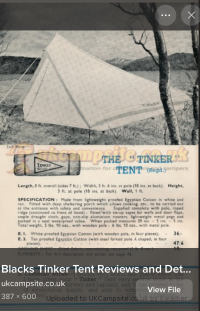
Anyone remember the Black’s Tinker?

Totally agree about the British Army bivi bag. No need for a hoop. There is plenty of room for the sleeping mat inside together with your sleeping bag. I’m 120Kg.

I use mine (90 pattern) upside down so the hood is loose over my head and held down by my boots on the inside edge. Plenty of ventilation, plenty of room to thrutch about.

Edited to add:
I did have a Snugpak sausage skin but never used it and sent it down the Gift It On route.
 
  • Like
Reactions: Ozmundo and Chris
I'm of the opinion that there isn't really a good use-case for a hooped bivi, now that one/two-man tents have reached the point where they are nearly as light and small when packed (Lanshan, etc), and personally I find them uncomfortable. I'm not remotely claustrophobic normally, but I don't like the feeling of being in a hooped bivi. I'd much rather be in a normal bivi, and have the flexibility to hunker down or leave my face to the stars and slugs.

Hooped ones just feel a little too much like a woodland coffin.
 
Fun.

That's the only thing I can come up with :lmao:

My Dutch Army Hooped Bivi is far less practical than my Hilleberg Akto, and only 200g lighter, and that's if I don't also take a tarp, which I would want if it was raining. I do still use it occasionally, though, just for fun.

Actually, I do have one good use case for the hooped bivi, and that is when dogsbodying. It's great for keeping both rain or sun off your face, although that is presuming you have a flat area to pitch the bivi properly and taught. I've learnt that if you're told to go lay behind that gorse bush a 100 yards up a hill that you struggle to walk up with zero flat areas, and only a gorse bush to stop you from rolling down the hill, that I would prefer a normal bivi!


My guess is that the primary purpose of the Dutch Army Hooped Bivi is camouflage for army personnel who need to sleep somewhere dangerous without being noticed. Things like comfort and a high degree of water proofing are probably secondary.

As for the advantage of a hooped bivi over an non-hooped bivi I have no idea or experience.

maxresdefault.jpg


maxresdefault.jpg
 
I've had my Dutch Army out a couple of times in light rain with zero issues, and once in moderately heavy persistent rain which was dogsbodying last weekend as in my post above.

When I was setup, very poorly, behind the gorse bush, on a steep incline, I had some pooling of water at the head end. The bivi was setup the best I could get it which was not very good at all, it was impossible to get it taught. The hooped bivi also has a lot more seams and attachment points sewn in which could allow water to get in. I was also soaking wet getting into the bivi which made it worse.

Later on the same day, I was moved to a different location in a valley where I could find flat ground and I didn't have anywhere near the amount of water getting in with a proper, taught setup, although there was some, but hard to tell what was getting in, what was already in, and what was running off of me.

 
  • Like
Reactions: John59 and Chris
My guess is that the primary purpose of the Dutch Army Hooped Bivi is camouflage for army personnel who need to sleep somewhere dangerous without being noticed. Things like comfort and a high degree of water proofing are probably secondary.

As for the advantage of a hooped bivi over an non-hooped bivi I have no idea or experience.

maxresdefault.jpg


maxresdefault.jpg
That's certainly the intention from a military procurement point of view. I've slept under open skies in a non-hooped bivvy in the rain plenty of times, and the British Army ones at least are completely waterproof which makes them fit for purpose. I would have my boots, rifle and a few other bits in there with me even sometimes, still with room for my shoulders and the gigantic issue sleeping bag.

The hooped bivvy (just one hoop especially so) seems to provide even less benefit if it isn't even waterproof, and I would argue that it being made of Goretex shows that it is supposed to be waterproof, yet it isn't. And whilst a basha (tarp) absolutely compliments a bivvy bag (in particular the bit where you have to get in and out of the bivvy bag), it should also be viable independently.

That double hooped bivvy in the second picture looks more practical, though at that point you may as well have a 1 man tent.
 
I've had my Dutch Army out a couple of times in light rain with zero issues, and once in moderately heavy persistent rain which was dogsbodying last weekend as in my post above.

When I was setup, very poorly, behind the gorse bush, on a steep incline, I had some pooling of water at the head end. The bivi was setup the best I could get it which was not very good at all, it was impossible to get it taught. The hooped bivi also has a lot more seams and attachment points sewn in which could allow water to get in. I was also soaking wet getting into the bivi which made it worse.

Later on the same day, I was moved to a different location in a valley where I could find flat ground and I didn't have anywhere near the amount of water getting in with a proper, taught setup, although there was some, but hard to tell what was getting in, what was already in, and what was running off of me.

I reckon having a second hoop down the feet end of the bivvy would help reduce pooling fairly significantly.
 
The Nortent bivi looks good but is as heavy as some tents.

w1200h899.jpg

Weight is really a good point here. 1.9KG for the XL hooped bivvy. Then add an issue basha onto that of 1KG and a ground sheet (if you have your mat on the outside as recommended) is another say 500g and some more for the pegs. 3.5kg or so for a bivvy is insane - the Hilleberg Allak 2 tent (two man) weighs nearly half a kilo less than that!
 
I like my Carinthia Observer - I think the benefits are that the Hooped ( double hooped , so a bit more head space once inside ) creates a warm area or bubble. Maybe as the Hooped bags originated in colder climate countries this is a potential reason?

I like a tarp up for admin reasons if I'm staying but if push comes to shove I'm quite happy to seal it down and close the world off into my little gortex crawl space.
 
It didn't feel that useful being sealed up when it let water in, though. I may as well have had an open-top but otherwise waterproof bivvy bag like one of the British Army ones, or the Snugpak Special Forces bivvy..

Still a bit grumpy after a lousy night eh ;):D

I remember my first night out on my new Multimat. I mounted it strapped across the top of my rucksack as I was very proud of it, then battled through fairly thick brush and bushes to find my spot, unknowingly puncturing it with brambles many times. That was a rough night lying on hard chalkland.

Tried a bivvybag once, and that was enough.
 
  • Haha
Reactions: Ozmundo and Chris
I think the arrival of reasonably cheap ultra light weight solo tents has removed it's only advantage which was slightly better habitability than a bivi.

Whereas the bivi still carries on as a big waterproof bag with compactness and simplicity.

The fact you can't sit up in a hooped bivi makes it a tight place to live. In a bivi and a solo tent you can sit up, cook and sort your gear.
 
I thought the Dutch bivi was meant to be top dog apart from the carinthia. I recently got one and spent one night in it so far. No issues and loved it. I have been used to the alpkit though.
I do have the British army which I love. Stuff mat and bag in it and roll up good to go under a basha. I have a cheap bug net off temu if needed. But I am pleased with the Dutch and like being tucked up in it. I just don’t like tents
 
  • Like
Reactions: CLEM
1. What benefit does a hooped bivvy provide over just a tarp and a normal bivvy bag?
2. What benefit does a hooped bivvy provide over a 1 man tent, or one of those mosquito net tent inners with tarp?
3. If a hooped bivvy isn't intended to be waterproof without a tarp, what's the point in it being made of Goretex and marketed as a waterproof sleep system?

Hi Chris, great question. I enjoyed your video and good on you for putting the dutchy to the test. It was a shame that things didn't work out for you. To be honest, I feared your experience would not be a good one when I watched you putting the large inflatable pad inside it. I don't imagine the design of the Dutchy is particularly compliant with modern inflatable sleeping pads. I only use mine with a closed cell mat or sometimes treat myself to a self-inflating mat and they are always put through the straps underneath the bivy.

I was surprised that you had water ingress though, whereabouts was the water coming in and what sort of condition was your bivy in when you bought it?

In terms of your questions, I'm a little biased here because I adore bivy camping regardless of it being in my British army goretex or Dutch army hooped bivi. I've also just forked out for a posh Carinthia Survival Bivi which is very similar to the Dutch army hooped bivi (standby for an upcoming video in which I compare and contrast the two products!).

I often (but not always) pair it up with a tarp and love the versatility of this system over a tent. I've put my bivy bag down in spots that simply would not accommodate the footprint of a tent and, am usually able to pitch a tarp in a variety of different ways to suit my need and/or the weather conditions. I concur that the tent can weigh less, but I think you get more bang for your buck with a tarp/bivy combo. You can buy a very good quality tarp/bivy combo for similar sort of money that you might otherwise spend on a budget backpacking tent (or perhaps even less).

But why a hooped bivy? Simple answer, I liken mine to a fortress because I have complete faith in it. My dutch hooped bivy has established itself as one of my go-to options for those camps that I know are likely to be in terrible weather. I've had it for years, used it multiple times with and without a tarp, it has always proven to be waterproof and it has never let me down.

In terms of the dutchy, I bought mine in new/unissued condition from surplus and outdoors just before Covid and have used it quite a lot since then (mine is the version made in Spain by FECSA). My most memorable camp was a couple of years ago, I camped on top of a very exposed hill in Cornwall on the SW Coastal Path. The wind was blowing a gale and I opted to take down the tarp before I went to bed as it was flapping so much. It was two days before the winter solstice and I spent a long night in that bivvy getting battered by 40+mph wind and rain. I was snug as a bug in a rug in my warm sleeping bag on top of my foam mat and all my kit was stashed in the head end creating a very comfotable pillow. I questioned my sanity at the time, but the hooped bivy felt like a sanctuary on top of a hill in which I'm certain many a tent would have otherwise been destroyed.

I pitched the bivvy so that the head end was pointed into the wind, meaning that no rain would get under the storm flaps and could get away without having to seal myself in (I used the poppers across the head end to close the bivy and zipped it about half way). For what it's worth, I think that pitching the hooped bivi with the wind conditions in mind is important to ensure a comfortable night (not dissimilar to a tent). Shameles plug - there's a video of this camp on my channel!!

There's been a few more camps like that in which the dutchy has kept me safe and established itself as my little fortress. Those camps have usually been in very exposed locations on Dartmoor/Bodmin Moor and the North Kent Marshes. And while the dutchy has become a go-to option for those camps, I'm planning some more camps in the coming months in which I subject the new Carinthia bivy to similar conditions (it's coming to Dartmoor with me in December!!)

Apologies for the waffle, suffice to say that I love bivy camping!!
 
Last edited:
Weight is really a good point here. 1.9KG for the XL hooped bivvy. Then add an issue basha onto that of 1KG and a ground sheet (if you have your mat on the outside as recommended) is another say 500g and some more for the pegs. 3.5kg or so for a bivvy is insane - the Hilleberg Allak 2 tent (two man) weighs nearly half a kilo less than that!

In some ways this is like comparing two swimmers when one is swimming freestyle while the other is doing backstroke. They're both doing the same thing, but in different ways. Different courses for different horses and all that.

You're right though this is a bulky brute and is perhaps representative of the more extreme end of the hooped bivi market. My new Carinthia hooped bivy weighs in at just over 900g. The design of this Nortent looks good though and will definitely offer more comfort. But, in my humble opinion, I wouldn't even contemplate getting this hooped bivi because I don't think the fabric will breath sufficiently for a bivi bag and that single vent at the head end will probably not be up to the task. Fabric is by far the most important factor when choosing a bivi bag. Goretex (or similar) always wins for me because it seems to breath better than most waterproof fabrics.
 
Hi Chris, great question. I enjoyed your video and good on you for putting the dutchy to the test. It was a shame that things didn't work out for you. To be honest, I feared your experience would not be a good one when I watched you putting the large inflatable pad inside it. I don't imagine the design of the Dutchy is particularly compliant with modern inflatable sleeping pads. I only use mine with a closed cell mat or sometimes treat myself to a self-inflating mat and they are always put through the straps underneath the bivy.

I was surprised that you had water ingress though, whereabouts was the water coming in and what sort of condition was your bivy in when you bought it?

In terms of your questions, I'm a little biased here because I adore bivy camping regardless of it being in my British army goretex or Dutch army hooped bivi. I've also just forked out for a posh Carinthia Survival Bivi which is very similar to the Dutch army hooped bivi (standby for an upcoming video in which I compare and contrast the two products!).

I often (but not always) pair it up with a tarp and love the versatility of this system over a tent. I've put my bivy bag down in spots that simply would not accommodate the footprint of a tent and, am usually able to pitch a tarp in a variety of different ways to suit my need and/or the weather conditions. I concur that the tent can weigh less, but I think you get more bang for your buck with a tarp/bivy combo. You can buy a very good quality tarp/bivy combo for similar sort of money that you might otherwise spend on a budget backpacking tent (or perhaps even less).

But why a hooped bivy? Simple answer, I liken mine to a fortress because I have complete faith in it. My dutch hooped bivy has established itself as one of my go-to options for those camps that I know are likely to be in terrible weather. I've had it for years, used it multiple times with and without a tarp, it has always proven to be waterproof and it has never let me down.

In terms of the dutchy, I bought mine in new/unissued condition from surplus and outdoors just before Covid and have used it quite a lot since then (mine is the version made in Spain by FECSA). My most memorable camp was a couple of years ago, I camped on top of a very exposed hill in Cornwall on the SW Coastal Path. The wind was blowing a gale and I opted to take down the tarp before I went to bed as it was flapping so much. It was two days before the winter solstice and I spent a long night in that bivvy getting battered by 40+mph wind and rain. I was snug as a bug in a rug in my warm sleeping bag on top of my foam mat and all my kit was stashed in the head end creating a very comfotable pillow. I questioned my sanity at the time, but the hooped bivy felt like a sanctuary on top of a hill in which I'm certain many a tent would have otherwise been destroyed.

I pitched the bivvy so that the head end was pointed into the wind, meaning that no rain would get under the storm flaps and could get away without having to seal myself in (I used the poppers across the head end to close the bivy and zipped it about half way). For what it's worth, I think that pitching the hooped bivi with the wind conditions in mind is important to ensure a comfortable night (not dissimilar to a tent). Shameles plug - there's a video of this camp on my channel!!

There's been a few more camps like that in which the dutchy has kept me safe and established itself as my little fortress. Those camps have usually been in very exposed locations on Dartmoor/Bodmin Moor and the North Kent Marshes. And while the dutchy has become a go-to option for those camps, I'm planning some more camps in the coming months in which I subject the new Carinthia bivy to similar conditions (it's coming to Dartmoor with me in December!!)

Apologies for the waffle, suffice to say that I love bivy camping!!

Firstly, I appreciate you watching the video and I am glad you enjoyed. I may have even seen your bivvy video! Was it the one with a French RCIR ration pack as well? I am sure I also saw you bivvying in a video on Bourne Outside perhaps? With your bike.

I think you're almost certainly right about the bivvy not being suitable for an inflatable mat inside and if I try again, I'll probably take a footprint and put the mat on the outside, or I'll get myself a self inflating mat and use that instead. That said, that does then start to increase the weight/volume of kit which is where I think one of the weak points lies with the hooped bivvy, and where I question the effort/space/reward balance of a hooped bivvy over the other options. Of course, there will be an element of personal preference here as well.

For the sake of clarity, I really do love bivvy camping with a British Goretex bivvy bag and a tarp (particularly the DD Superlight due to it being so tiny when packed down). I just am not sure that the enclosed end of a hooped bivvy is for me, though it may be fair for me to try again with the sleeping mat situation sorted out as my biggest issue by far was the lack of shoulder space.

Those Carinthia ones look very cool and I'll be excited to see you use that, especially as it means I won't have had to pay for it to see it! I almost fell off my chair when I saw the price. :D Though you will no doubt love it as you already know you like hooped bivvies, and that one looks like the Mutt's Nuts.

Mine was bought in 'Super' condition allegedly. It seemed to let water in basically everywhere that water could rest, which was from the chest downwards. This is where I think a second hoop at the foot end would really help, for not much additional weight at all.
 

BCUK Shop

We have a a number of knives, T-Shirts and other items for sale.

SHOP HERE