
Walking with the Ju/‘hoansi San: Lessons in Living with the Land

The Kalahari morning sun was still low when we followed our Ju/‘hoansi guides across the sand. Their movements were light, almost effortless, as if they belonged to the land in a way we never could. For us, every step felt clumsy, the landscape hostile and alien. For them, every mark in the dust was a story: a springbok had passed at dawn, a porcupine had shuffled through in the night, a jackal had lingered too long by the bushes.
Origins
The San are often described as the world’s oldest continuous culture, their genetic branch diverging from the original Homo sapiens around 150,000 years ago.
The word Ju/‘hoansi, which is the name for the people who live in the Nyae Nyae area of Namibia, translates loosely to ‘the real people.’
After a year of building a friendship with a master tracker in a remote village in the Nyae Nyae Conservancy, we were incredibly honoured to be invited to spend time with his community.
Their ancestors have lived in Southern Africa for tens of thousands of years, surviving in one of the harshest environments on earth by learning to live with nature rather than trying to conquer it. To spend time with them is not to watch a show for tourists, but to be welcomed into an authentic way of life that still carries echoes of humanity’s origins.
The Craft of the Hunt

One of the most profound lessons came when we sat down with the men to learn how they made bows and arrows. Each element came from the land around us. The bow was carved from the strong local gwashi raisin bush (Grewia flava) wood, its curve shaped by hand over the fire and strung with twisted sinew or cordage made from the Sansevieria hyacinthoides plant. The arrows were slender straight shafts of grass.
A bone spacer is carved and placed between the shaft and the arrowhead. The purpose of this is to ensure that the shaft breaks away from the tip when it makes contact with the animal. The benefits of this are twofold, the hunter does not lose his arrow, and he is able to see from the placement of the fallen shaft which animal’s tracks he should now pursue.
Arrow tips were once carved from bone, though many now use steel salvaged from wire or scrap. The tiny pieces of metal are shaped, sharpened, and fitted with quiet precision.
Yet what makes a San arrow most remarkable is not its tip, but its poison. The men showed us the larva of a small beetle, crushed, mixed with plants and applied to the arrowhead with immense care. The smallest amount in a tiny cut on a person’s skin would be fatal if the limb is not amputated straight away!
Once an animal is struck by an arrow, the poison begins its slow work. The creature may run for hours, even days, before it collapses. This is where the San’s legendary tracking and persistence hunting skills, plus their unique physiology become vital. The Ju/‘hoansi do not eat or drink before a hunt, the lack of food and water sharpening their minds and their focus on the task at hand. The ability to chase an animal for days and survive with very little hydration is incredible.
The Hunt
We joined the men on a traditional hunt. For us, it was an exercise in wonder, and in trying to minimise our heavy footfalls! For them, it was survival. Every broken twig, every tuft of hair caught on a thorn, every shift in the sand was read and understood. To track a wounded antelope for miles on dry, baked ground under the desert sun requires not just stamina but also patience, memory, and extraordinary attention to detail.
Watching them work was humbling. Where we saw emptiness, they saw abundance. Where we felt completely lost in seconds, they followed almost invisible trails written clearly in the sand. Their knowledge was not read in books, but passed down through generations of practice, story, and shared experience.
The Rhythm of Daily Life

Life with the San was not all about hunting. We walked with the women as they foraged for roots and tubers, food hidden in plain sight, if only you know how to look. Up to 75% of food is provided by the women through foraging and trapping small game.
We also learned which plants to use for many illnesses. The bark of the silver terminalia tree was stripped and chewed as a cough remedy. The same bark tied around the head to treat headaches.
The women found a tiny twisted vine winding its way up a thorny shrub. With much excitement they dug with a digging stick, deeper and deeper, with some of our group helping, until a huge gxòà (Fockea angustifolia) root was revealed. This root is a primary source of water for the Ju/‘hoansi during the dry season and also a great survival food. We took it back to the village and gratefully ate the chunks of it that were passed to us to try.
The older women then showed us how ostrich eggshells are broken, chipped, and polished into beads, strung together into beautiful jewellery.

Around the fire in the evening, laughter filled the air as children played, elders told stories and sang songs, and we began to feel less like outsiders and more like part of the circle.
Perhaps the greatest lesson was the importance of community. In San life, no one stands alone. Food is shared, skills are taught, and decisions are made together. Survival in such a harsh environment depends not on individual strength but on collective care. It was a reminder that in our own world, where independence is prized above all, we may have forgotten the value of interdependence.
What We Carried Home
We came to Namibia expecting to witness another way of life. What we didn’t expect was how much it would change the way we saw our own. The San reminded us that humans are not separate from nature, but part of it, and that wisdom, patience, and generosity are as essential to survival as food and water.
As we left the village, one of the elders told us: “The land is always teaching. You only have to listen.”
Next year, we will return to Namibia to spend more time with the Ju/‘hoansi, to walk with them again, and to continue learning from their extraordinary connection to the land. It is not just travel. It is a chance to step into humanity’s oldest story, and to carry its lessons forward.
Visit TrackCraft for details on joining their next trip: https://www.trackcraft.uk/copy-of-courses-2
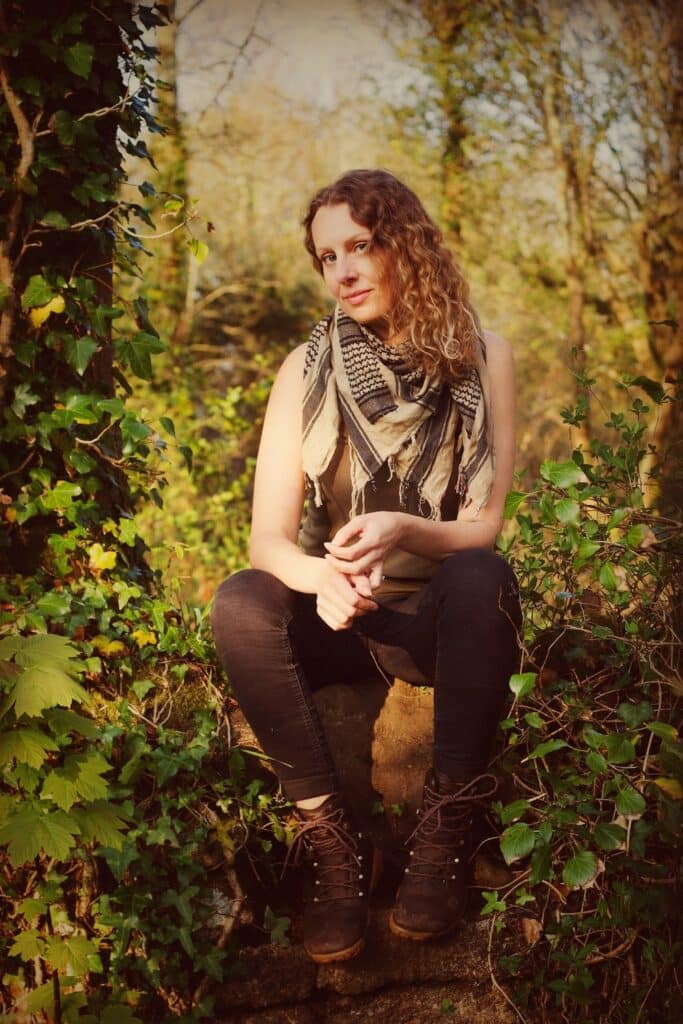
Rhoda Watkins is a seasoned tracker and devoted naturalist bridging the gap between people and the natural world. She’s been an instructor for mantracking and wildlife tracking courses and workshops for over two decades, and has led daring expeditions in remote locations worldwide.
Rhoda’s deep affinity for nature was nurtured in her formative years, leading to a lifelong immersive tracking education. After honing her skills in mantracking and tactical tracking, she studied under the esteemed San people of Namibia, amongst others, becoming one of the few women dedicated to mastering tracking at such a high level.
With qualifications in Zoological Conservation and Environmental Protection, Rhoda now imparts her expertise in tracking, foraging, survival skills, and rewilding principles to others.
She leads a search and rescue tracking team, reducing the time to locate missing individuals, as well as training both Mountain Rescue and Lowland Rescue teams in mantracking for SAR through her tracking school ‘TrackCraft.’
Her dynamic presence on screen includes documentaries like “Panthera Britannia” and “Big Cat Britain Declassified.” She is crafting her inaugural wildlife tracking book, cementing her legacy as a trailblazer connecting humanity to the world of tracking.


