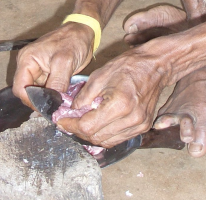
Having just posted (well, yesterday) another khukuri back to it's owner with a new edge on it I'm left wondering about them. I'm not talking about western copies of the design a-la Cold Steel and the like, but the 'real thing'.
I'm aware of the history of the Kuk and it's endemic usage on it's home turf where the hills grow big. I well know about the way the blade-shape can increase cutting efficiency in some applications and the advantages that some users see in it, but hells bells they're horrible things ! Now, I know I have hands like hams with sausages attached for fingers, but the tradition handle shape is awful ! I've met a few Nepalese and I know they tend to be somewhat smaller than me (to put it mildly
  ) but I still cannot understand how anyone can use one of those things for hours of work without shredding their hands.
I'd say that 99% of the kuks I've come across have been soft. Really soft. I know this makes them easier to fettle back to a semblance of an edge with the accompanying chakmak, but it also makes the things go dull at a silly rate. Now .. the Nepalese aren't daft. Many of them have to make what they need from what they have, I know, but why not use better steel for their blades (or heat treat it better) and put more comfortable handles on them ? Perhaps it's that most of the khukuris I see are 'Tourist Trade Tat', but I'm not so sure. I know a good few of them cost a pretty penny .. and they were no better.
I own a couple, given to me as gifts over the years. One is definitely TTT (see above), but the other was bought by a family member who was, at the time living in Kathmandu, working 'in the field' with locals so I hoped it might be better. They're as horrible as each other
I own an Enep from Northern Thailand, a blade of a very similar design made for a pretty-much identical sort of job. I traded for it with a man who was out with his elephant cutting fodder for his animals, well, well off the beaten tourist-y routes. (He made me wait until he had enough greenery cut before doing the trade.) It has an integral hollow steel handle and was very obviously made from some other agricultural tool by either him or a local village blacksmith. Whilst it's no example of high-end powder metallurgy it's better steel than any khukuri I'm yet to come across, and it's more comfortable in the hand.
If a poor villager from Northern Thailand knows a good tool when he sees it, how come they're still making and using the same old khukuris in Nepal ?
I know there are one or two fans of the khukuri dwelling here in BCUK-land, and I'm looking straight at one in particular, but please ... what do you see in them that I don't ? I'm happy to be educated if I'm way off the mark. Honest I am
I'm aware of the history of the Kuk and it's endemic usage on it's home turf where the hills grow big. I well know about the way the blade-shape can increase cutting efficiency in some applications and the advantages that some users see in it, but hells bells they're horrible things !
Now, I know I have hands like hams with sausages attached for fingers, but the tradition handle shape is awful ! I've met a few Nepalese and I know they tend to be somewhat smaller than me (to put it mildly ) but I still cannot understand how anyone can use one of those things for hours of work without shredding their hands.I'd say that 99% of the kuks I've come across have been soft. Really soft. I know this makes them easier to fettle back to a semblance of an edge with the accompanying chakmak, but it also makes the things go dull at a silly rate. Now .. the Nepalese aren't daft. Many of them have to make what they need from what they have, I know, but why not use better steel for their blades (or heat treat it better) and put more comfortable handles on them ? Perhaps it's that most of the khukuris I see are 'Tourist Trade Tat', but I'm not so sure. I know a good few of them cost a pretty penny .. and they were no better.
I own a couple, given to me as gifts over the years. One is definitely TTT (see above), but the other was bought by a family member who was, at the time living in Kathmandu, working 'in the field' with locals so I hoped it might be better. They're as horrible as each other
I own an Enep from Northern Thailand, a blade of a very similar design made for a pretty-much identical sort of job. I traded for it with a man who was out with his elephant cutting fodder for his animals, well, well off the beaten tourist-y routes. (He made me wait until he had enough greenery cut before doing the trade.) It has an integral hollow steel handle and was very obviously made from some other agricultural tool by either him or a local village blacksmith. Whilst it's no example of high-end powder metallurgy it's better steel than any khukuri I'm yet to come across, and it's more comfortable in the hand.
If a poor villager from Northern Thailand knows a good tool when he sees it, how come they're still making and using the same old khukuris in Nepal ?
I know there are one or two fans of the khukuri dwelling here in BCUK-land, and I'm looking straight at one in particular, but please ... what do you see in them that I don't ? I'm happy to be educated if I'm way off the mark. Honest I am